Costs
Barbershop Music License US: Rules and Risks
A barbershop music license US covers public-performance rules, illustrative annual costs, and statutory risks for shops that play music for customers.
What to take away
- A US barbershop that plays music for customers needs a public performance license. There is no small business exemption in the Copyright Act.
- Blanket licenses from ASCAP and BMI commonly run from about $300 to $2,000 a year for a single shop, depending on size and how the fee is calculated. Treat that as an illustrative range, not a quote.
- Playing without a license exposes the shop to statutory damages, which the statute sets per infringed work rather than per song played.
- The cheapest legal route for many shops is a licensed streaming service built for commercial use, not a consumer subscription.
Why the radio in the corner is a licensing question
An owner who plays a Spotify or Apple Music account through shop speakers publicly performs copyrighted music. US copyright law gives the owner of a musical work the exclusive right to perform it publicly under 17 U.S.C. §106(4). A barbershop with customers is a public place.
That right sits in Chapter 1 of the Copyright Act, and it does not shrink because the shop is small.
Four organizations license public-performance rights for many of the musical compositions a barbershop might play. ASCAP and BMI are the two largest performing rights organizations, SESAC is a smaller third, and Global Music Rights (GMR) licenses a boutique catalog of prominent songwriters. Each holds rights to a different catalog, so a license from one does not cover the others.
A recorded track contains a musical composition and a sound recording, which are separate copyrighted works. ASCAP, BMI, SESAC and GMR license composition rights in their own catalogs. Performance rights in sound recordings are narrower in the US — they cover digital audio transmissions rather than ordinary speaker playback — and SoundExchange administers those digital royalties. Ask any commercial music service which rights it covers, for compositions, sound recordings, or both, before you commit to a playback method.
The annual cost, line by line
Quotes vary by square footage, seating count, whether music is live or recorded, number of locations, and whether the shop is part of a chain. The figures here are illustrative, not an official fee schedule. To request current pricing, apply through each organization's licensing request form and give the shop's size, seating, locations and whether it plays live or recorded music. ASCAP and BMI quote from the details you submit; SESAC and GMR price by request, so no figure from either appears below.
| Cost item | Illustrative figure stated here |
|---|---|
| ASCAP | Roughly $300–$900 per year for a single shop, depending on the fee schedule and shop size. |
| BMI | Roughly $300–$900 per year for a single shop, depending on the fee schedule and shop size. |
| SESAC | Described here as lower, but no specific figure is stated; request its current pricing. |
| Commercial streaming service | A few hundred dollars more, according to the estimate discussed here. |
| Overall range | About $300–$2,000 per year; an illustrative range, not a quote. These figures describe different licensing arrangements and should not be added mechanically. |
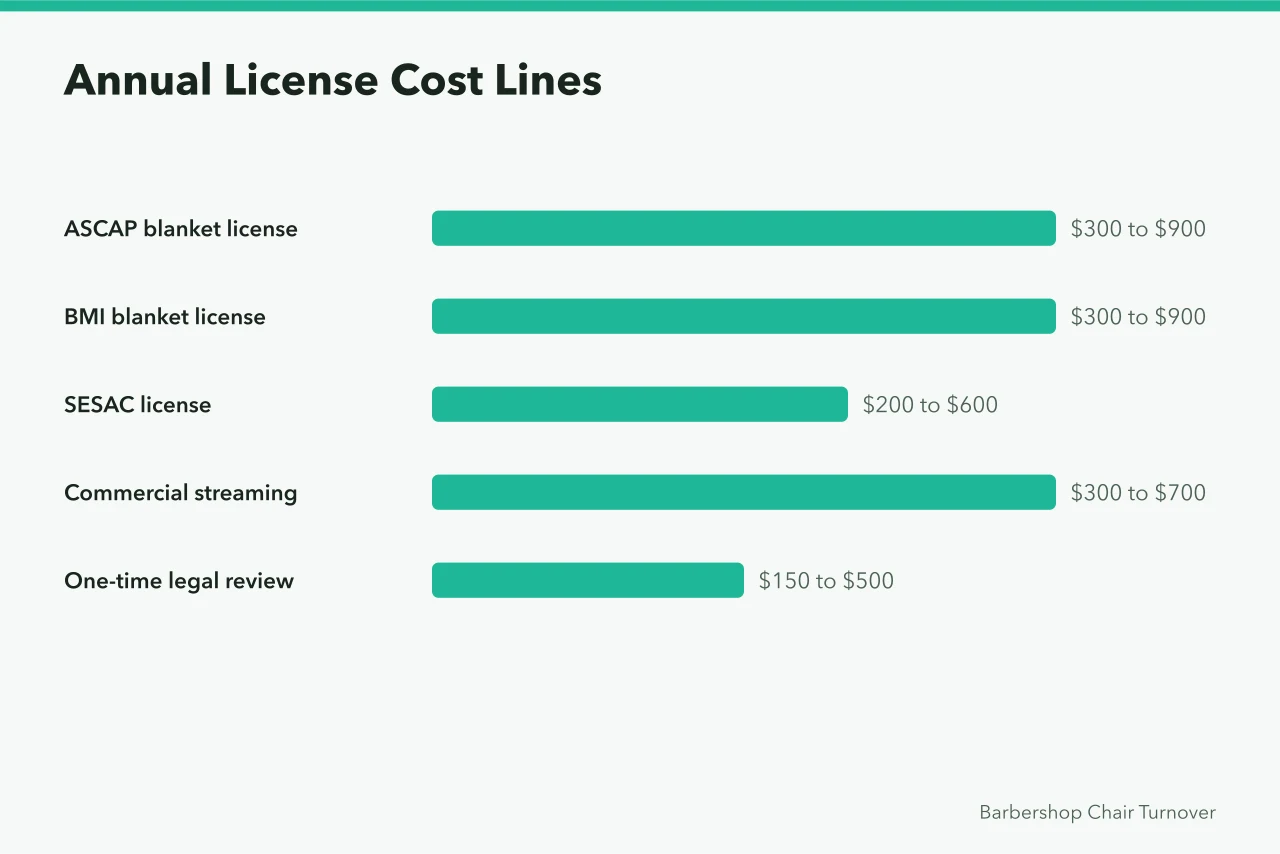
A shop that licenses ASCAP and BMI and also pays for a commercial streaming service can land near $1,500 a year. A one-chair shop playing a single licensed streaming feed may stay under $400.
What moves the number
Three drivers explain most of the spread between quotes.
- Seating capacity and square footage. Both ASCAP and BMI use size measures in their fee schedules, so a ten-chair shop pays more than a two-chair shop.
- Recorded versus live. Live performances by a hired musician raise a different set of questions than a speaker system, and some venues need both licenses.
- Number of organizations licensed. Skipping SESAC saves money until a song from that catalog plays, which is the risk the fee is meant to remove.
Consumer plans from Spotify and Apple Music are priced for personal use, and their terms do not cover commercial playback. Services built for commercial use — among them Soundtrack Your Brand, Mood Media, Pandora for Business and SiriusXM Music for Business — sell business tiers intended for in-store playback. Compare what each licenses, confirm the scope of coverage in writing before signing, and keep the receipt.
What quotes leave out
Most quotes cover one calendar year and one address. A second location needs its own license, even if the owner is the same person. If the shop moves mid-year, the license does not travel automatically.
The other omission is enforcement. Performing rights organizations employ field representatives who visit businesses and log what they hear. A shop that has never been contacted is not a shop that is exempt. It is a shop that has not been visited yet.
Statutory damages under the Copyright Act can reach thousands of dollars per work infringed, and a single afternoon of unlicensed playback can involve many works. That exposure is why the license is usually cheaper than the argument.
Where people overspend
Before buying licenses separately, ask the commercial streaming provider in writing which composition catalogs and other rights its service covers. Do not assume that one service covers the ASCAP, BMI, SESAC and GMR catalogs alike, or every right needed for the shop's intended playback.
A second overspend is buying a license for a shop that has stopped playing music. If the speakers came out, cancel the license and keep the cancellation email. A third is paying a consultant to negotiate a fee schedule that the organization publishes. The published schedule is the starting point for the conversation.
Owners with more than one location should also keep the music cost separate from the labor side of the books. A license attaches to one address, so the music line grows with the shop count even when payroll does not.
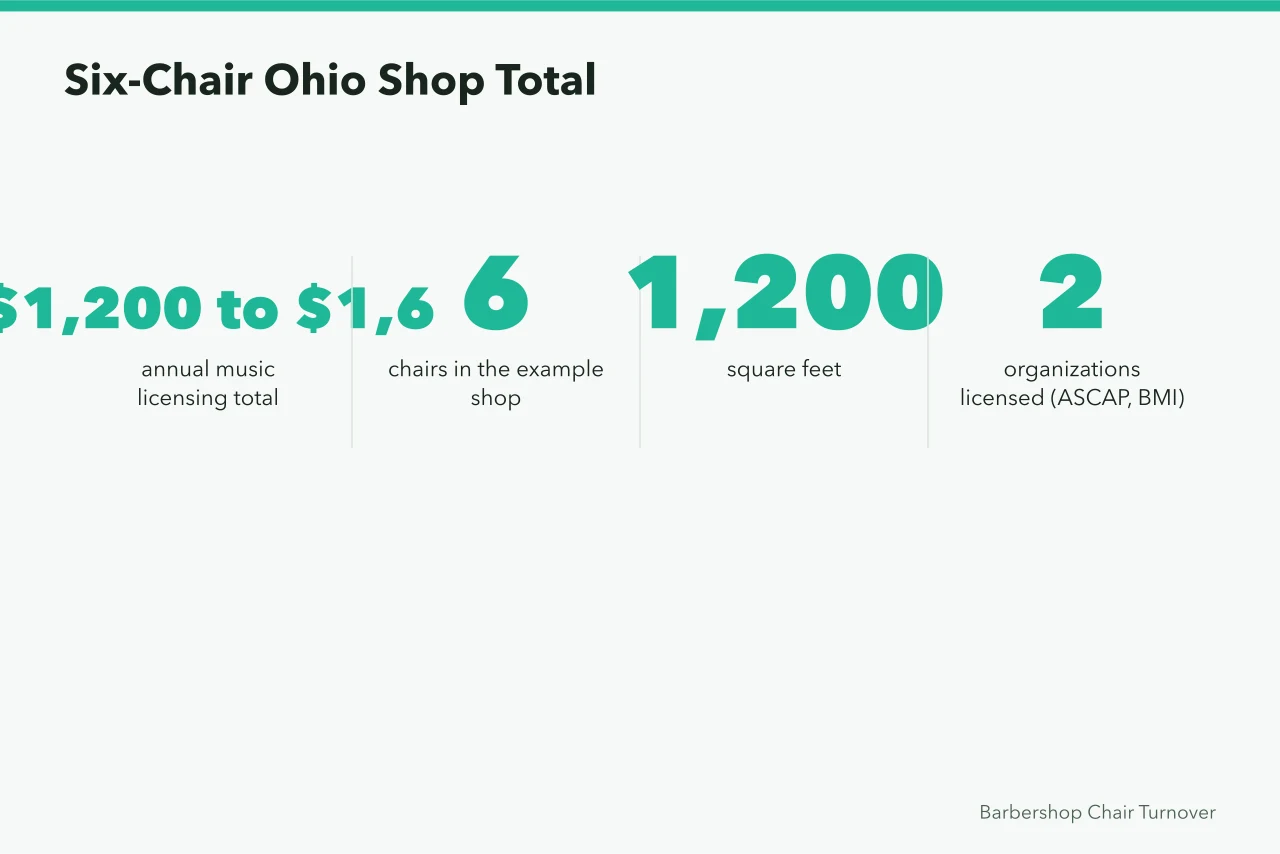
Example: a six-chair shop in Ohio
Assume 1,200 square feet, six chairs, recorded music only, and no live performers. The owner licenses ASCAP and BMI, skips SESAC, and pays for a commercial streaming tier, with an illustrative annual total near $1,200 to $1,600. This is an example, not a quote.
If a field representative visits and the shop shows both licenses and the streaming receipt, the conversation ends. If not, the same visit becomes a legal matter.
The paperwork is small. Keep the license certificates and the streaming invoice in one folder, and note the renewal date. Owners who already track vendor renewals for insurance, waste pickup and the like can add the music line to the same sheet.
Where to check the rules
The controlling statute is Title 17 of the US Code. Section 106(4) gives the copyright owner the exclusive right to perform a copyrighted musical work publicly, and §504(c) sets the statutory-damages range for infringement. Section 110(5) contains narrow exemptions for certain radio and TV performances in qualifying establishments; it is not a general exemption for small businesses or consumer streaming.
If the shop is run through a separate entity, the license should be in that entity's name, and the certificates should match the name on the shop's registration and bank account. If the entity changes, update each license rather than waiting for the renewal date.
For shops that host live music or events, ask each organization in writing whether its blanket license covers live performances as well as recorded playback, or whether the event needs a separate license.