
Guides
Trademark a Brand Name in Canada: Rules and Records
Trademark a brand name in Canada involves federal rights, searches, filing stages, recordkeeping, renewal duties, and Quebec language rules.
What to take away
- The Registrar of Trademarks at CIPO grants every registered trademark in Canada, under the federal Trademarks Act.
- An application must name the owner, show the mark, and describe the goods and services in ordinary commercial terms.
- A search record should show the CIPO register check, the common-law check and the provincial name check, each dated.
- Missing an examiner deadline abandons the application; ignoring a section 45 notice can expunge the registration.
- Quebec applies language rules to signage and commercial documents that a federal registration does not override.
When you trademark a brand name in Canada, you gain one federal right, granted by a single office and good in every province and territory.
Who has jurisdiction over a Canadian trademark
The Canadian Trademarks Act sets the rules, and the Registrar of Trademarks at CIPO applies them. One filing covers all ten provinces and three territories. A provincial corporate name registration, a municipal business licence or a domain name grants no trademark rights.
Provincial courts hear passing off claims between businesses trading in the same region, which is where most disputes begin. The Act settles ownership, not demand, so whether a name can carry a business is a marketing strategy question before it becomes a legal one.
Where a trademark fits in a licensing and compliance file
A trademark is not a business licence. It does not replace a municipal licence, a provincial registration, or a sector permit. It is a separate federal right that a compliance team should still track with those items.
Add the CIPO application number, the registration date, the renewal date, and the address for service to the same calendar that holds your licences and permits. Keep the dated use records with your licence file.
When a licence application, a franchise disclosure document, or a signage review asks for proof of name rights, that file answers it. Miss a CIPO deadline, and the mark can be abandoned or expunged, which can affect how you use the brand on licensed premises. Treat it as a compliance record, not just a marketing asset.
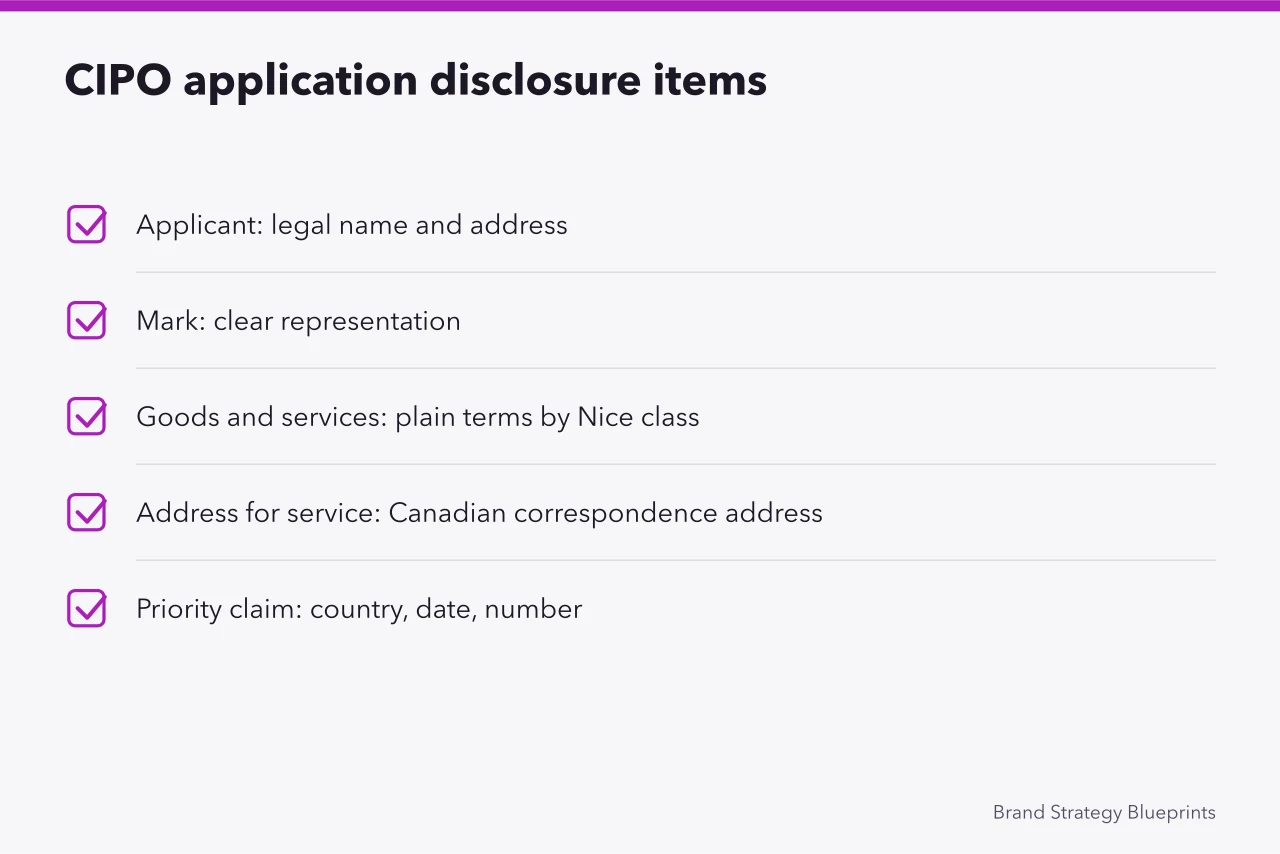
What a CIPO application must disclose
| Item | What you provide | Why it matters |
|---|---|---|
| Applicant | Legal name and address of the owner | Sets who holds the right |
| Mark | A clear representation, in words, design or sound | Defines what is protected |
| Goods and services | Plain statements grouped by Nice class | Fixes the limits of the registration |
| Address for service | A Canadian address for correspondence | Every CIPO notice goes there |
| Priority claim | Country, date and number, if claimed | Secures an earlier filing date |
The goods and services statement draws the most objections. "Clothing and accessories" invites an examiner's report, because the Act requires ordinary commercial terms.
Write the list as a customer would read it, then sort it into classes. Choose classes that match the goods and services you intend to protect.
A registration protects the mark for the listed goods and services, and for nothing else.
Searching before you file
A Canadian trademark search starts with the Canadian Trademarks Database, CIPO's own register. It is free and searchable online. It returns live and dead applications, showing whether an earlier owner abandoned a similar mark. The register does not reveal unregistered use.
A shop that has traded under a name for years without filing can still stop a national launch. So a common-law search belongs in the same file. Check search engines and trade directories, then the NUANS name search and the corporate name registries of the provinces where you trade, and date each check.
The filing sequence
- Finish the searches and save the results with dates.
- Draft the goods and services list, then place each item in its Nice class.
- File the application through CIPO's online services, using its trademark application form.
- Answer the examiner's report within six months of its date, or request an extension in writing.
- Wait through publication in the Trademarks Journal and the two month opposition period; CIPO then issues the registration certificate, and the registration runs for ten years from that date.
Records to keep
- Dated samples showing first use of the mark for each good or service
- Advertising, packaging and invoices that display the mark
- Search reports with the date each search ran
- The registration certificate, the renewal date and the address for service on file
- Licence agreements and any public notice given for them
The owner carries the burden of proving use, not CIPO. A dated file answers a section 45 notice in days rather than months. Keep the material for each ten year cycle, and for any stretch in which you expect to enforce the mark. Watching the register is ongoing work that belongs in the compliance calendar.
What happens if you do not comply
A section 45 notice is the sharp edge of the Act. Any party can ask the Registrar to require evidence of use in Canada, and the owner must answer for each registered good or service. File nothing, or file evidence that does not show use, and the registration is expunged in whole or in part.
Missed deadlines carry their own penalty. An application that ignores an examiner's report is deemed abandoned. Reinstatement takes a written request to CIPO and is not automatic.
Where the rules differ by place
Quebec layers its own language law on top of federal registration. The Charter of the French Language requires French on commercial signage and in commercial publications, and the 2022 amendments tightened those duties. A registered trademark can qualify for a narrow exception where no French version is registered. Public signage carries separate requirements that registration alone does not satisfy.
The United States process is different: a US application states a filing basis. A use in commerce basis needs a specimen showing the mark in trade, as the USPTO trademark overview explains.
Canada has not required a filing basis since 2019, so an applicant in Canada can file on proposed use. A US registration does not cover Canada, and a Canadian one does not cover the United States.
A registered name is also a compliance asset, and licensing records lean on it more than most owners admit.