Rules
How Quebec's language rules change appointment booking in Montreal salons
A manicure appointment in Montreal runs on Quebec's language law, OQLF rules, CNESST duties and bilingual booking that keeps every confirmation compliant.
What to take away
- French is the default language of commerce in Quebec, so a manicure appointment is booked, confirmed and receipted in French first, with English only after the client asks.
- The Office québécois de la langue française (OQLF) applies the language law, and the Regulation respecting the language of commerce and business sets how French must appear in signs, advertising and publications.
- CNESST covers every salon with staff, whatever its size, and sets the prevention notices you post where employees can see them.
- You need a Quebec Enterprise Number before you hire, and it must appear on receipts and contracts.
- Bilingual technicians are the hardest role to fill in Montreal, so open the vacancy before the busy season, not during it.
What Quebec's language law asks of a Montreal salon
French is the normal language of commerce in Quebec. In a salon that reaches past the window sign into how you answer the phone, write a confirmation and print a receipt.
The governing text is the Charter of the French Language, chapter C-11 of Quebec's statutes, as amended by Bill 96. Bill 96, passed in 2022, widened the Charter's reach into everyday business, and its provisions took effect in stages from June 1, 2022.
The authority that applies the law is the Office québécois de la langue française, the OQLF. It publishes the rules and the guidance, answers questions from businesses, receives complaints from clients and employees, and can open an inquiry into a business; offences under the Charter carry fines.
The detail the OQLF enforces sits in the Regulation respecting the language of commerce and business, made under the Charter. It sets how French must appear in commercial signs, advertising and commercial publications, which for a salon means the window, the price list, the website and the booking page.
The rule owners miss is the order. Where French and English both appear, French has to be markedly predominant, the standard the Charter applies to public signs and advertising. A bilingual service menu is fine. A menu where the English is larger, bolder or placed above the French is not.
Montreal is not a French-only market. Clients in Côte-des-Neiges, Verdun and the Plateau book in English, Mandarin, Farsi and Spanish. Serving them is allowed. The law sets the default language of the business, and the client can choose another once they ask.
For booking, the safe pattern is French as the default interface, a visible language switch, and a language flag on the client record. The confirmation, the reminder and the receipt then follow that flag.
Online booking pages and phone scripts follow the same rule. A booking page is commercial communication, so the French version has to be complete and reachable before a client picks a language, and where both languages appear, French has to be markedly predominant. A recorded greeting on the salon line works the same way: French first, then the choice to switch.
One threshold decides how much extra paperwork the law adds. Bill 96 cut the size at which the francization program applies from 50 employees to 25. A salon with 25 or more employees has to register with the OQLF and put a francization plan in place, analyzing how French is used at work, adopting measures and reporting on progress. Below that size, the French-first rules on client communication still apply; the francization program is what changes.
Get this right early. It touches your nail salon licences and compliance file, your website copy and your front desk script.
How a bilingual booking system confirms a manicure appointment
A bilingual booking system is any setup that runs French first and still serves each client in the language they booked in. One booking sets the language for every message that follows.
Montreal salons run three setups. A Quebec-built booking tool with French-first templates. A mainstream tool where you maintain French and English templates yourself. Or a paper book with phone and text confirmations, still common in smaller Plateau and Saint-Henri shops.
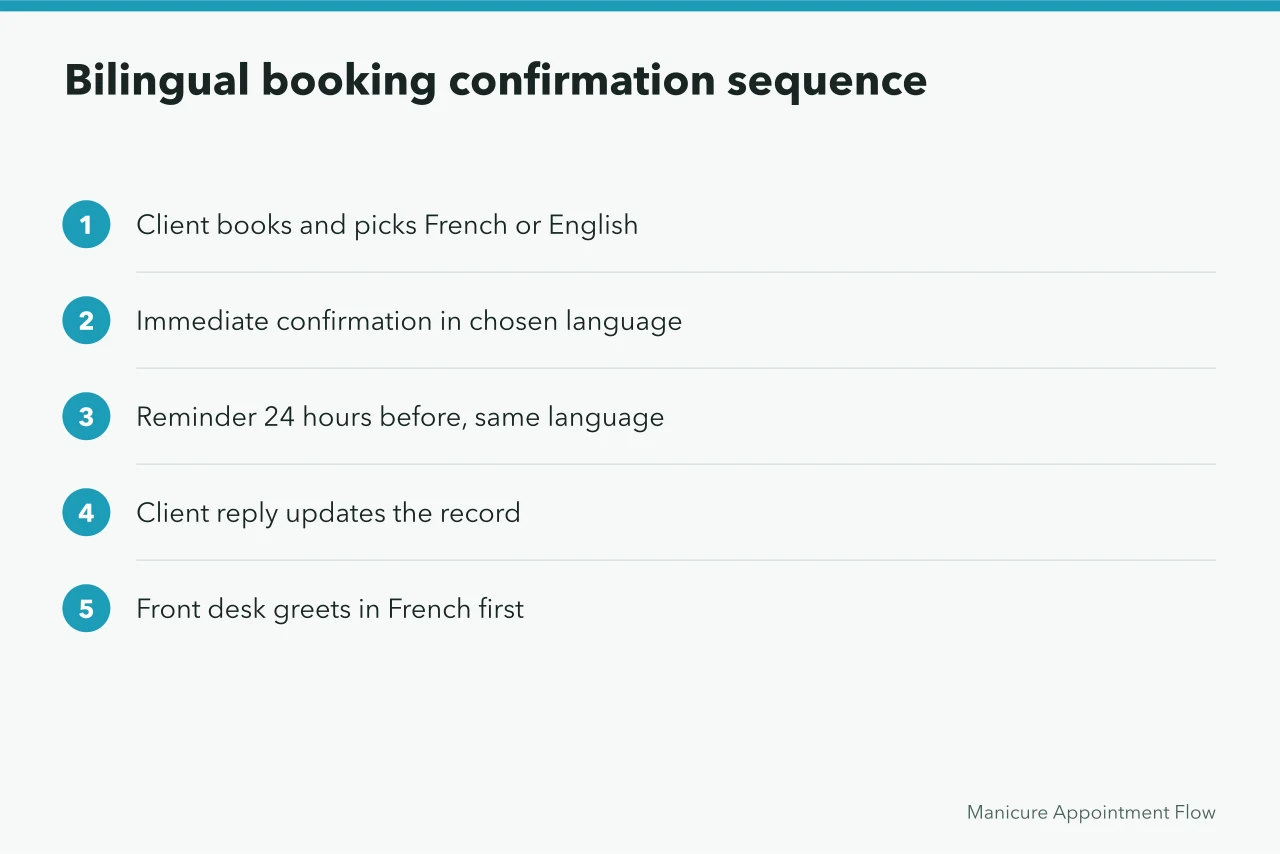
The sequence matters more than the tool:
- Booking. The page opens in French, with a visible switch to English.
- Confirmation. It goes out in the language the client booked in, French first with English underneath when both are used.
- Reminder. It repeats that language the day before the appointment.
- Receipt. French leads, and the registered business details appear exactly as filed.
That sequence is the backbone of scheduling nail salon appointments without double bookings or no-shows.
Worked example: a Verdun salon on a Saturday
A Verdun salon takes 40 bookings on a Saturday. Twenty-eight clients booked in French, twelve in English. Each confirmation and reminder goes out in the language that client booked in.
Two English-speaking clients reply to reschedule. The system reissues both messages in English.
At 8 a.m. the owner opens the day sheet and sees which clients booked in English, so the front desk knows how to open the conversation. Fewer miscommunications, fewer no-shows, and a record that matches what the client asked for.
Signage, menus and receipts: what the front desk checks
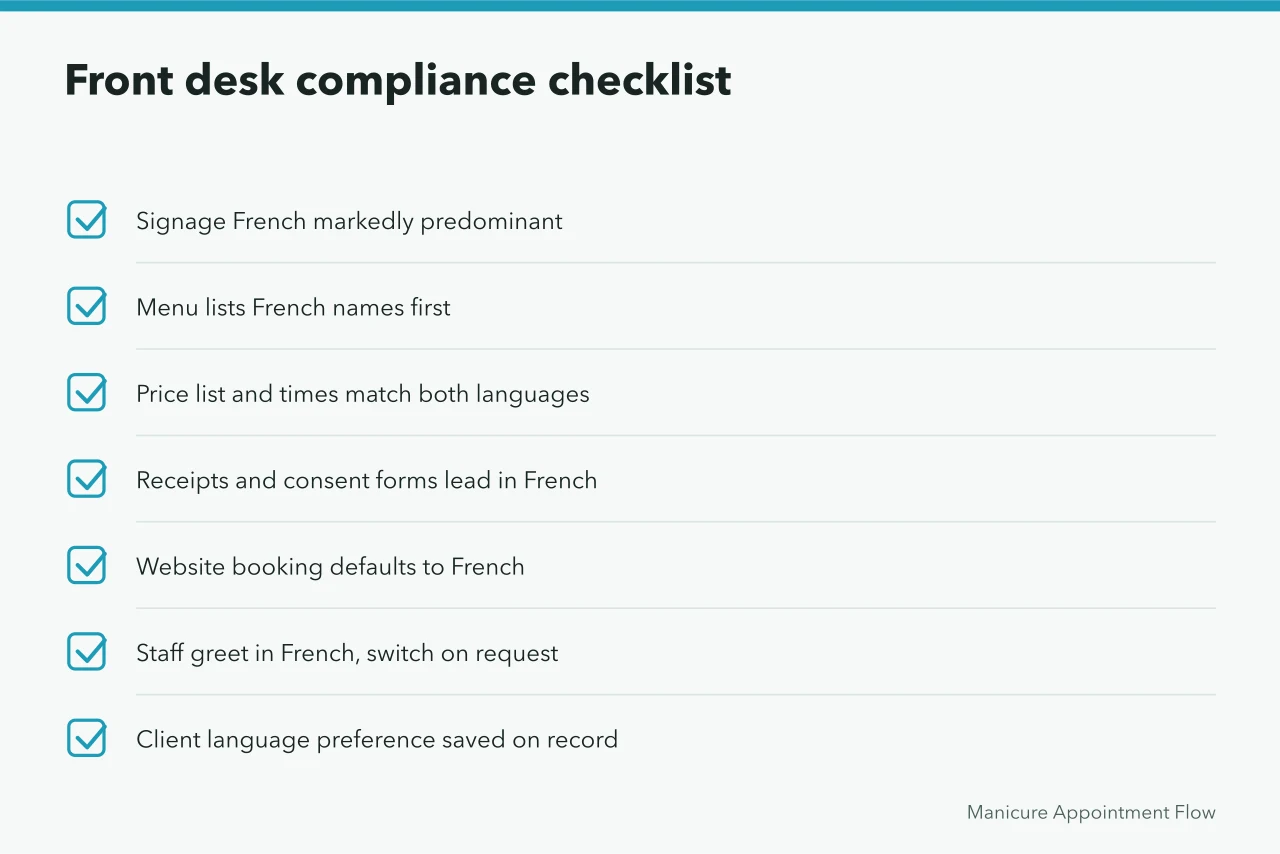
Client communication is where the law is most visible and where complaints start. Signage, service menus, price lists, receipts and consent forms all count.
On signage, French must be markedly predominant. A window reading "Manucure" and "Manicure" at the same size is a risk. French larger and English smaller is safer ground. A registered trademark keeps its original form; a descriptive tagline usually cannot.
On the menu, list services in French first:
Signage, menus and receipts
- manucure
- pédicure
- pose d'ongles
- remplissage
- vernis semi-permanent Put the English beside or below, never above. Show the price and the expected time, because clients compare both.
On receipts, the French version leads, and the business name, address and Quebec Enterprise Number appear as registered.
A confirmation, French first:
Signage, menus and receipts
- Bonjour, votre rendez-vous de samedi à 10 h est confirmé. Répondez à ce message pour le modifier.
- Hello, your appointment on Saturday at 10 a.m. is confirmed. Reply to this message to change it.
A receipt, French first:
Signage, menus and receipts
- Reçumanucure et vernis semi-permanent. Merci de votre visite.
- Receiptmanicure and gel polish. Thank you for your visit.
If your website carries this work, it also feeds local SEO for a nail salon, because French and English searches behave differently in Montreal.
CNESST: coverage, postings and prevention duties
CNESST is Quebec's workplace health and safety and labour standards body, the provincial counterpart to WorkSafeBC or Ontario's WSIB. It applies to every Montreal salon with employees, whatever the headcount.
Coverage means you register with the commission, report payroll and pay contributions. It also means you post certain information where staff can see it: prevention notices, CNESST contact details, and the steps to report an injury or a hazard.
Nail work carries its own hazards. Acrylic and gel products, acetone, filing dust and repetitive strain all fall under prevention duties. You assess the risks, provide ventilation, supply gloves and masks, and train staff on safe handling. The Canadian Centre for Occupational Health and Safety publishes chemical safety guidance many Quebec salons use alongside CNESST material.
If an employee is injured, the process is defined: report to CNESST, complete the required forms, follow the return-to-work steps. Smaller salons miss the posting requirements because nobody tells them. A short annual review keeps it current.
These duties sit alongside the pay, hours and leave standards in Quebec's employment information. The language side runs in parallel: the Charter gives employees the right to carry on their work in French, and that right belongs in the same compliance file as the postings.
Postings to keep visible
Two statutes set what goes on the wall: the Act respecting occupational health and safety (chapter S-2.1), with its Regulation respecting occupational health and safety (the ROHS), and the Act respecting labour standards (chapter N-1.1). Four postings are checked most often in a salon:
- The CNESST notice with the address and phone number of the nearest service centre, so a worker can file a claim or report a hazard.
- The labour standards poster, which covers minimum wage, hours, breaks and leave.
- The notice on the right to refuse dangerous work, a right the Act respecting occupational health and safety grants every worker.
- The hazard information for the products in use, which staff must be able to consult, covering ventilation, gloves, masks and the safe handling of acrylics, gel and acetone.
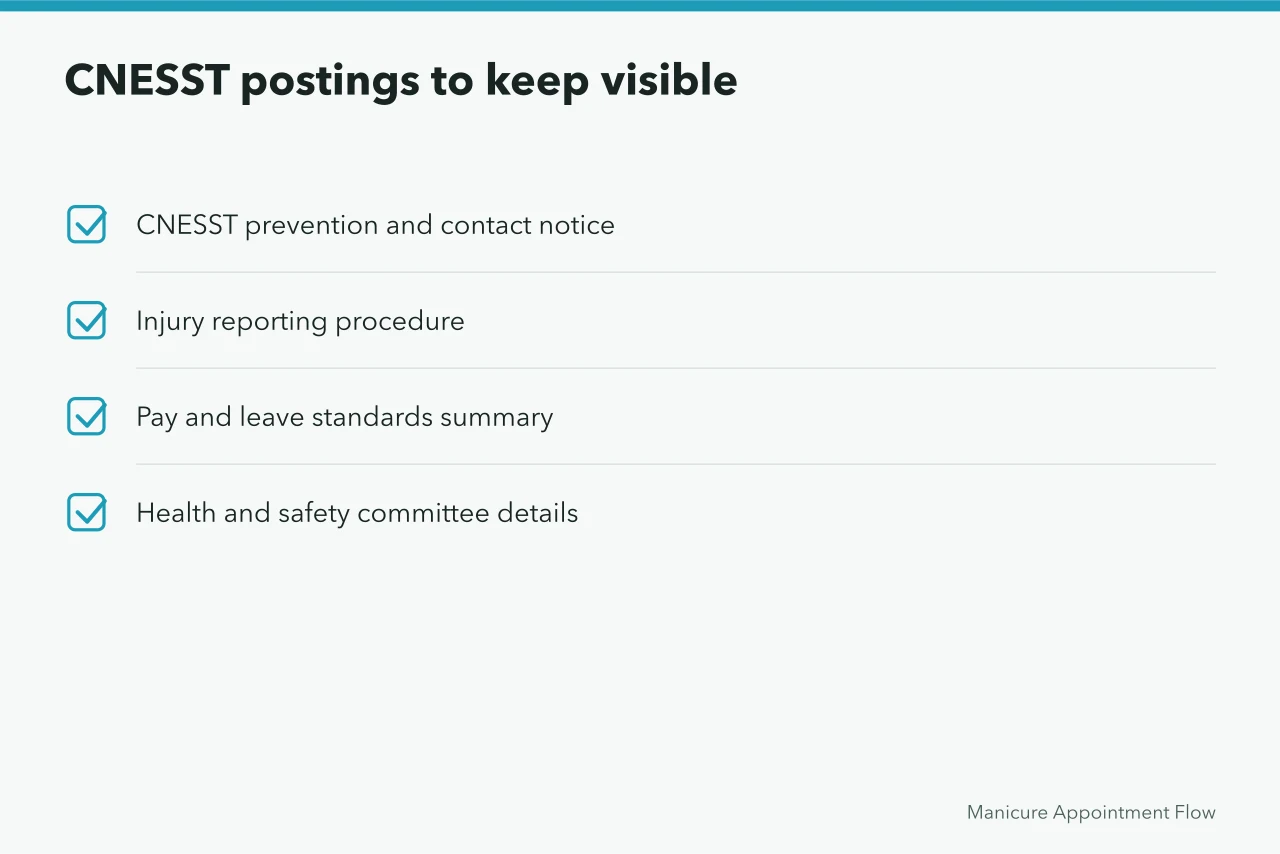
CNESST supplies the current versions free of charge, and the wording changes from time to time, so reprint a notice when the commission updates it.
Hiring bilingual technicians and the immigration route
Montreal's bilingual market rewards salons that serve clients in French and English without friction. That makes the bilingual technician your most valuable hire, and it makes recruitment a language question as much as a skills question.
Bilingual staff are what make a French-first booking flow work at the desk, so this is a language decision before it is a staffing one.
Start locally. Quebec's hiring and managing staff guidance covers the basics: define the role, write the ad in French, check qualifications, issue a written contract. For a technician, test both languages in the interview, not just French reading.
When local hiring falls short, the province's Quebec immigration pathways are the next step. Quebec runs its own selection process, separate from federal programs, and it favours candidates with French. A bilingual technician is often easier to bring in than a French-only or English-only candidate.
Plan the timeline honestly. Paperwork, credential checks and arrival can take months, so open the vacancy before the busy season. The staffing a nail salon process starts with a written role description and a stated language requirement, so the ad and the interview match the job.
Once hired, the first weeks decide whether the hire holds. A structured nail salon hiring plan covers products, sanitation, booking software and the French-first greeting.
The Quebec Enterprise Number and your hiring obligations
The Quebec Enterprise Number, or NEQ, is the ten-digit identifier Quebec gives a registered business. You need it to operate formally, to appear on receipts and contracts, and to deal with Revenu Québec and CNESST.
Registration starts with the province's start an enterprise guide, which walks through choosing a structure, registering the name and filing with the enterprise register. The Quebec Enterprise Number page explains what the number is and where it must appear.
For a salon, the NEQ shows up on receipts, invoices, contracts, the website footer and any official filing. If you change address or ownership, update the register. The number follows the business, not the owner.
Hiring obligations follow registration: an employer account for payroll, CNESST coverage, and the standard deductions. Salaried technicians, chair renters and contractors are treated differently, so confirm each worker's status before the first pay run. Misclassifying a technician as a contractor is a common and expensive mistake.
Keep one compliance file: registration documents, the NEQ, CNESST account details, payroll records and staff contracts. Review it once a year, and before any new location.
Common questions
Does my Montreal salon have to be fully French?
No. French must be the normal language of commerce and markedly predominant wherever both languages appear. A client can be served in English or another language once they ask for it.
Can I take bookings in English?
Yes, if the client chooses English. The system should default to French, offer a switch, and store the preference so later reminders and receipts match.
What is the NEQ and do I need one?
The Quebec Enterprise Number is the province's business identifier. If you are registered and operating in Quebec you need one, and it must appear on your receipts and official documents.
Do CNESST rules apply to a salon with one employee?
Yes. Coverage, payroll reporting and posting duties apply once you have staff, regardless of size. Confirm the current requirements with CNESST before you rely on any summary.
Who enforces Quebec's language rules?
The Office québécois de la langue française (OQLF). It publishes the current rules and guidance for businesses, answers questions from owners and employees, and receives complaints about signs, advertising and the language of service.