Rules
Montreal apartment renovation permit RBQ: Quebec rules
Montreal apartment renovation permit RBQ rules cover borough applications, French-language obligations, contractor licenses, and Quebec building codes.
What to take away
- A Montreal apartment renovation permit RBQ license check comes first: any contractor charging for the work must hold a valid Régie du bâtiment du Québec license.
- Borough permit applications are expected in French, with French-language documentation, so confirm with your borough before submitting anything in English.
- Walk-up triplexes limit what you can doexterior staircases, shared walls and party walls constrain layout changes.
- Fire separation and egress in an older triplex are the two items that most often force a redesign.
- Plumbing work in a basement bathroom or compact secondary suite must follow the plumbing chapter of the Code de construction du Québec, which builds on the National Plumbing Code with Quebec amendments.
- Budget time for both the license check and the borough file, because neither moves quickly.
How Régie du bâtiment du Québec licensing applies to a small apartment renovation
The Régie du bâtiment du Québec (RBQ) licenses contractors who do construction work for others under Quebec’s Building Act (Loi sur le bâtiment). If you hire someone to renovate your Montreal apartment, that person or company needs a current RBQ license covering the category of work. A handyman charging by the hour for a bathroom rebuild is not exempt just because the job is small.
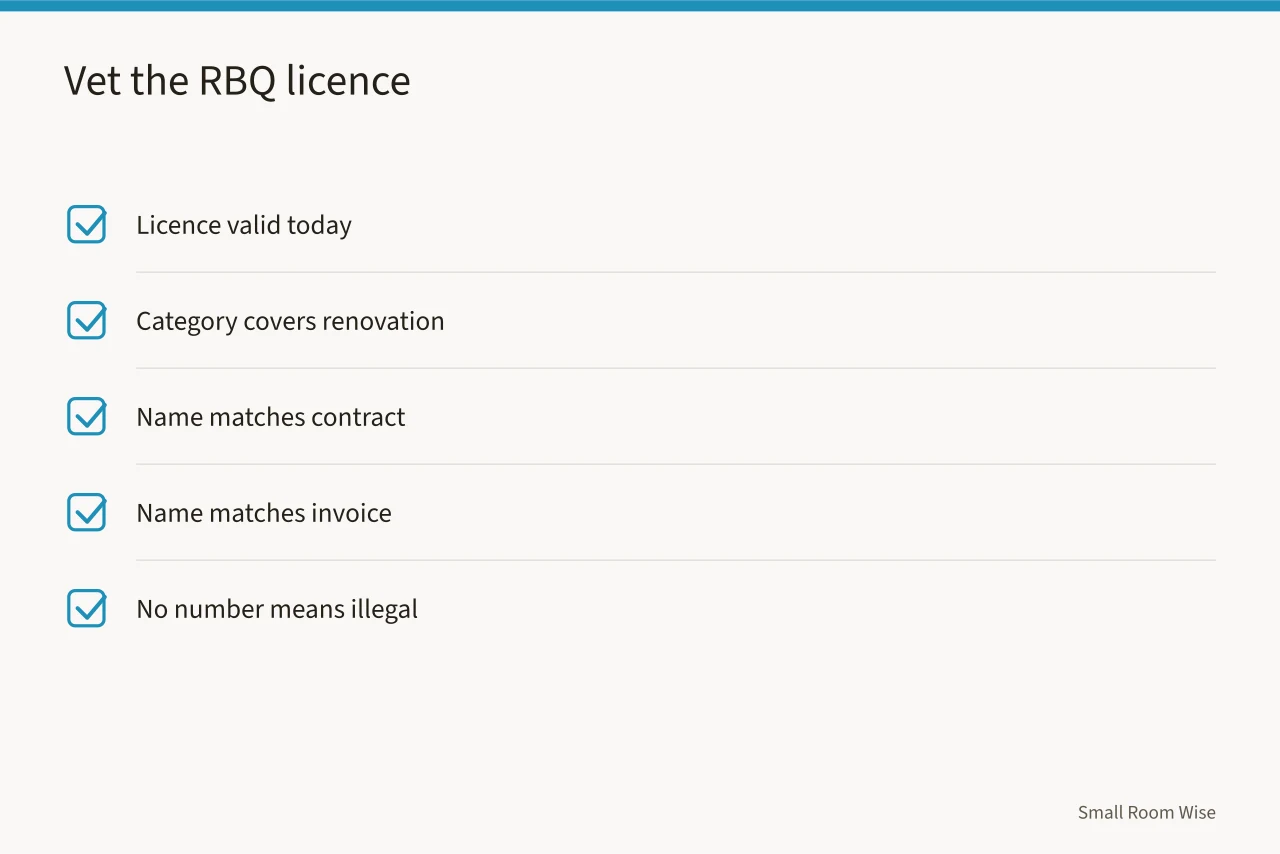
The license number is public. Look it up using the RBQ’s Registre des détenteurs de licence, its public license-holder register, before signing anything. Check that the license is valid today, that the category covers the work, and that the name on the license matches the name on the contract and invoice.
Quebec also requires licenses for many specialist trades. The RBQ register lets you verify license holders, including subcontractors. Confirm that the contractor gives you the license numbers for the people responsible for each part of the job.
For work covered by Quebec’s construction-industry rules, workers may also need a Commission de la construction du Québec (CCQ) certificate of competence. Ask the contractor to confirm whether the tradespeople on your project need one; requirements and exemptions depend on the work and site.
For a small job, the temptation is to skip the paperwork. Resist it. A licensed contractor carries the liability for defects, and the RBQ has a complaint process if the work goes wrong. An unlicensed one leaves you holding the problem.
License categories matter for scope. The RBQ issues a general contractor license (entrepreneur général) and specialty contractor licenses (entrepreneur spécialisé) divided into numbered subclasses; look up the exact subclass on the RBQ register for the work you are buying. A contractor licensed for general residential renovation can usually handle a kitchen or bathroom. Plumbing and heating contractors are tied to the Corporation des maîtres mécaniciens en tuyauterie du Québec (CMMTQ), and electrical contractors to the Corporation des maîtres électriciens du Québec (CMEQ). Structural work, electrical connections and gas are separate categories, and each needs its own license holder. Ask which parts of your job fall outside the main contractor's license. The license fundamentals overview explains how to find which requirements apply.
Borough permit applications and the French-language requirement
Montreal is divided into boroughs, and the borough where the building stands handles its renovation permit application. A triplex in Le Plateau does not use the same borough office as a building in Verdun. Depending on the work, the borough may require a building permit (permis de construction) or a certificate of authorization (certificat d’autorisation); the application form and checklist are borough-specific.
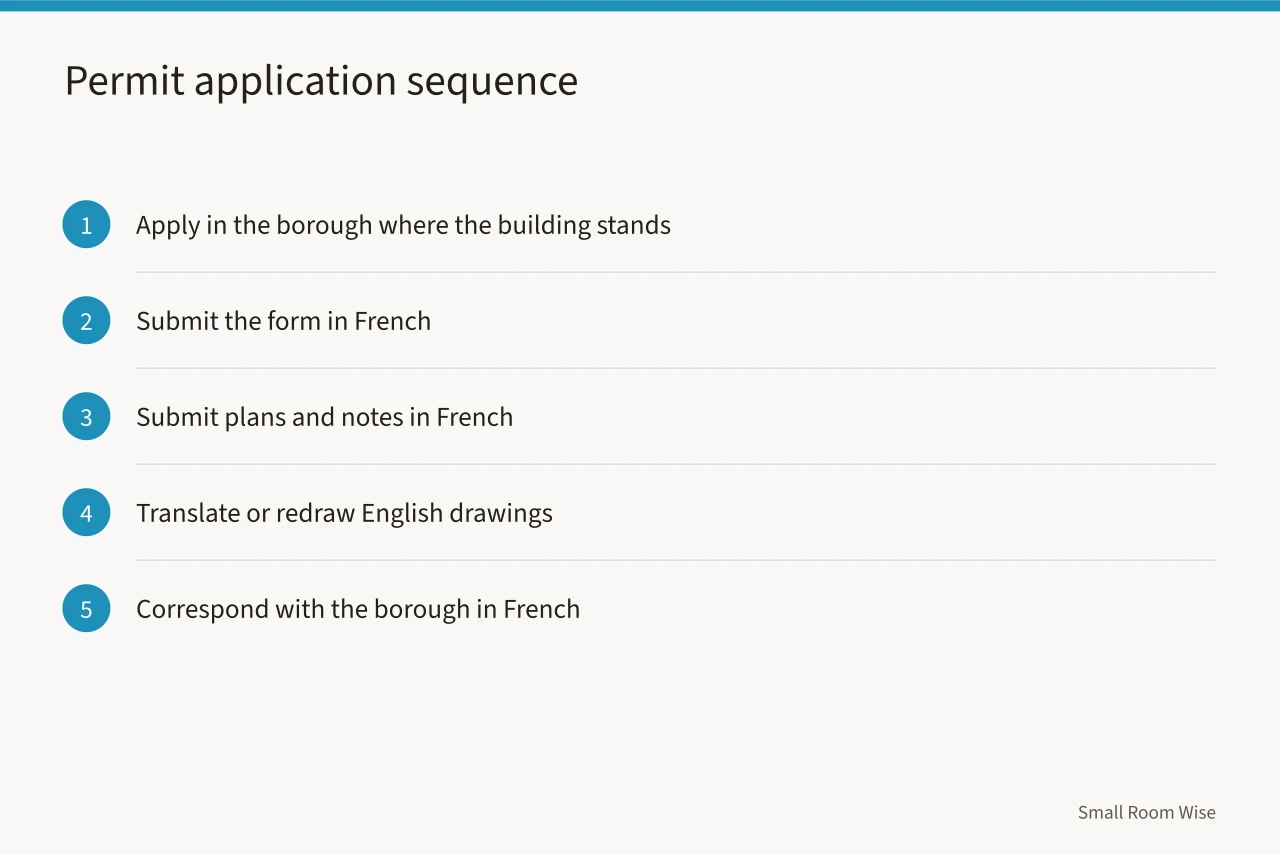
Expect to apply in French. That includes the form, the plans, the descriptions and the correspondence. Boroughs work in French and the Charter of the French Language governs public administration, so plan on French drawings and French notes. An English-only plan set may be returned, so ask the borough whether it accepts anything else before you submit.
This catches out owners who bought from anglophone sellers and inherited English drawings. If your existing plans are in English, they need translation or redrawing before submission. A designer who works in Montreal will know what the borough wants.
The RBQ publishes the construction laws, regulations, and codes that apply in Quebec. Its Lois, règlements et codes page is a reference for construction requirements; for French-language obligations, consult the Charter of the French Language and the OQLF.
Entreprises Québec is a provincial business information portal for registration and business obligations. It is not the borough’s renovation-permit application or the RBQ’s license register, so use the relevant authority for each check.
Here is the sequence most owners follow:
- Confirm the borough office that covers your address. Ask which permit applies, which borough-specific form to use, and what plans and supporting documents it requires.
- Assemble French-language plans, sections, and a scope description.
- Submit the application and check the borough’s current fee schedule for the amount due. Ask the borough for its current processing estimate; there is no single Montreal-wide permit fee or timeline.
- Respond to any deficiency notice in French, in writing, and ask the borough whether the revised file changes its review estimate.
- Post the permit on site before work starts.
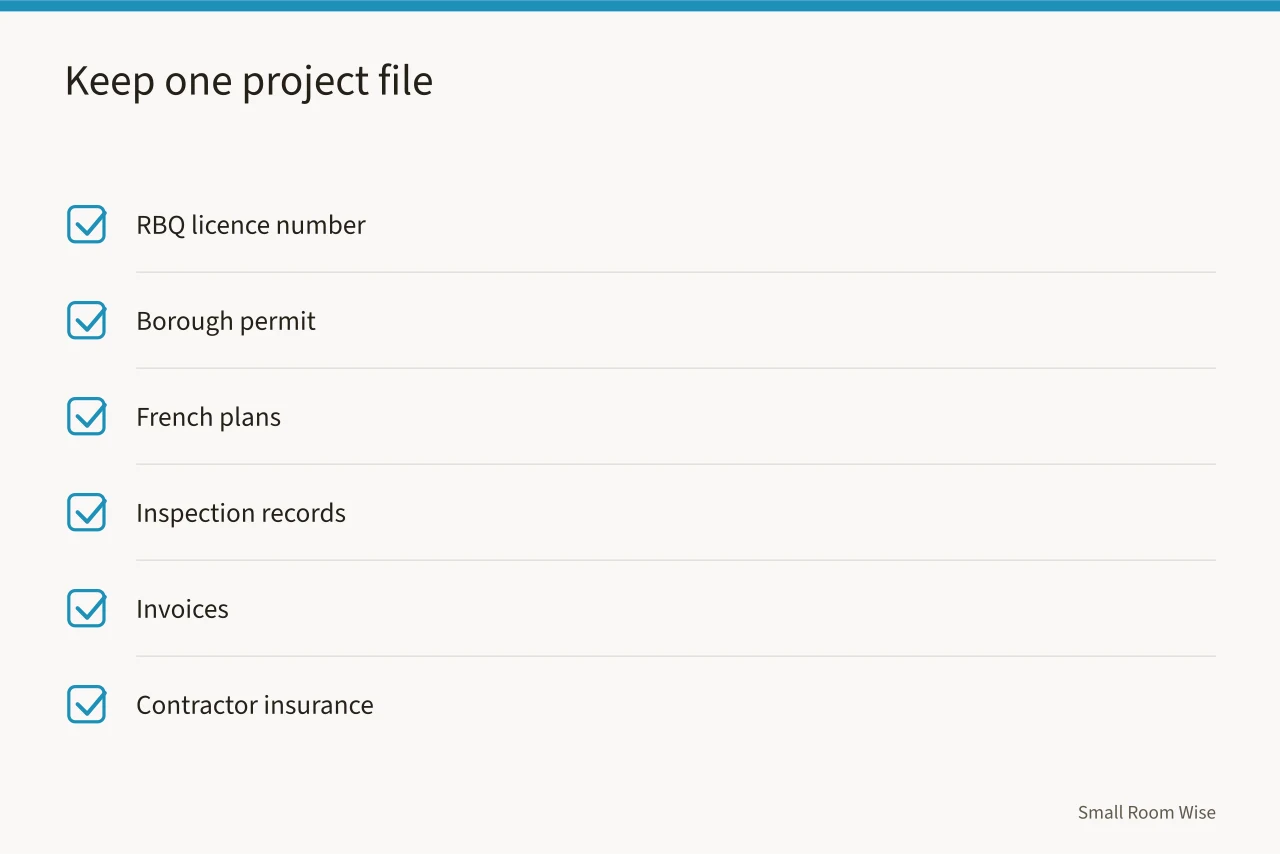
- RBQ license number checked and current
- Borough permit application filed in French
- Plans and notes translated into French
- Scope description matches the drawings
- Permit posted at the building before demolition
- Inspection stages confirmed with the borough
- Contractor's insurance certificate on file
Naming the offices and forms
For a Montreal address, the permit office is the borough's Bureau Accès Montréal, and the City of Montréal also accepts permit requests online through its permit service on montreal.ca. Montreal boroughs commonly call the permit for altering an existing building a permis de transformation. Confirm the exact name and form with your borough, since each borough publishes its own checklist. The guide to which permits a business needs, renewals and inspections shows how those permit layers fit together.
Permit fees are set by the borough and are usually tied to the estimated value of the work, so ask for the current fee schedule instead of relying on a figure in an article. Processing times depend on the borough and on how complete the file is. Whether a borough or the RBQ is the right authority depends on the question: the borough decides whether the work may be done at that address, and the RBQ decides who may legally do it.
A worked example: an owner in Rosemont (the borough of Rosemont–La Petite-Patrie) wants to move a kitchen wall and add a bathroom in the basement of a triplex. The owner should ask the borough whether the work requires a building permit or a certificate of authorization and use its application form. The file needs French plans showing the new wall, the plumbing rough-in, and the fire separation.
The contractor needs an RBQ license for renovation. The basement bathroom triggers plumbing review. None of these steps is optional, and each one adds weeks.
Walk-up triplex constraints that shape small Montreal apartment work
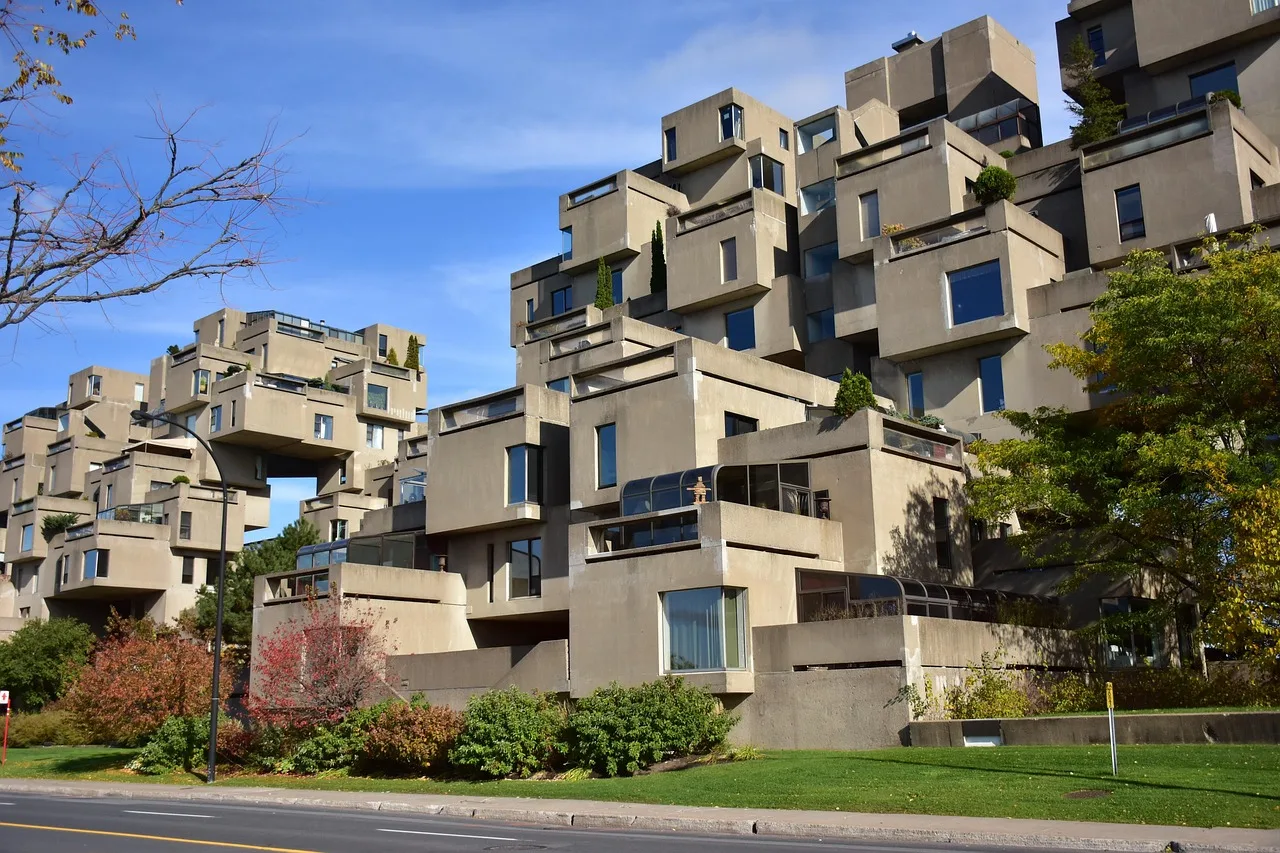
The walk-up triplex is the defining Montreal building type. Three stacked units, an exterior staircase, a shared entrance, and party walls on both sides. That shape limits renovation in ways a detached house does not.
The exterior staircase is often the only exit from the upper units. If your renovation blocks it, or if stored materials block it during construction, you have created a safety problem the borough inspector will flag.
Party walls and shared structure mean you cannot cut freely. Removing a wall that carries the floor above affects the neighbors, and any structural change needs an engineer's stamp. In an older triplex the walls may not be where the original plans say they are.
Acoustic separation between units is thin in older stock. Adding a bathroom above a neighbor's bedroom is legal but unpopular, and sound transmission rules in the Quebec construction code set minimum expectations for separating assemblies.
Ceiling height and window size constrain small apartments more than floor area does. A basement unit with a low ceiling and one small window has hard limits on what a bathroom or bedroom can look like, and those limits come from the code, not from taste.
If your apartment is in a condominium, approval from the syndicate of co-owners is separate from the borough permit. Confirm both requirements before starting work.
Fire separation, plumbing, and egress in an older triplex
Fire separation in an older triplex is the single most common reason a small renovation grows. Units in a triplex must be separated by a fire-rated assembly, and any work that opens a wall or ceiling exposes what is there.
If the existing separation is missing or degraded, the borough can require you to restore it as part of the permit. That means closing the wall again with the right materials, inspected before it disappears behind drywall.
Quebec's Code de sécurité and municipal fire-prevention rules govern fire safety, and they draw on Canada's national model codes. Ask the borough which fire-safety provisions apply to a secondary suite.
Egress matters as much as separation. Every sleeping room needs a compliant exit path, and in a walk-up that usually means a window of adequate size or a door to a shared corridor. A basement bedroom with one small window may not qualify.
Plumbing is the other hidden cost. Adding a bathroom in a basement or converting a space into a compact secondary suite means new drains, vents, and supply lines. The Code de construction du Québec (Quebec Construction Code), including Quebec’s adopted plumbing requirements, governs how they are sized and vented.
The National Plumbing Code is a model code; Quebec’s adopted requirements, as set out in the Code de construction du Québec, are the rules to verify for the project.
Older Montreal buildings often have cast iron drains and undersized vents. A new bathroom tied into them can back up or fail inspection. Budget for replacing the run you are connecting to, not just the fixtures.
A change in how a unit is used can raise separate housing and land-use questions, including occupancy and short-term rental rules. Provincial housing pages provide context, but the borough determines the permit requirements for the renovation.
Working with Quebec construction laws and codes end to end
The Quebec construction code is the reference for how buildings must be built and altered, and it draws on the National Building Code of Canada with Quebec amendments. Your designer and contractor work to that code, and the borough inspects against it.
Start with the license, then the permit, then the code. Owners who reverse that order end up with plans that cannot be permitted or a contractor who cannot legally do the work.
If your renovation is in a condo rather than a triplex, the approval layer shifts to the syndicate of co-owners. The permit logic is similar.
Small apartments in Montreal reward planning more than square footage does. A tight bathroom or kitchen can be excellent if the plumbing, fire separation and egress are right. They cannot be fixed later with finishes.