
Rules
Business license compliance: which permits you need, renewals and inspections
Business license compliance rules decide which permits you need, when renewals fall due, who inspects first and how long to keep records. Fees and penalties included
What to take away
- A general business license comes from the city or county where you operate, and states license only regulated work.
- Renewal dates and continuing education hours are where compliance usually breaks, and which agency inspects depends on the permit, not the address.
- Penalties run from late fees to a lapsed license to a stop-work order in regulated trades.
- Importers carry a second stacka customs bond, the importer of record role, five years of records.
- Canadian operators need a municipal license on top of provincial registration.
Which licenses a US business actually needs
Licensing starts at the city where the doors open, not in Washington. State boards take over for regulated trades: Texas contractor licensing rules and fees come from TDLR, which publishes its own fees and renewal windows.
A city general business license is the base document. A clerk, a finance office or a consumer affairs department issues it, and zoning sign-off usually comes first.
NYC Department of Consumer Affairs business licenses show how one city stacks approvals: a general license, plus separate permits for sidewalk use, signs and alcohol.
A seller's permit comes from the state tax agency — the Texas Comptroller, the California Department of Tax and Fee Administration — while a contractor license comes from a licensing board such as the Texas Department of Licensing and Regulation or the California Contractors State License Board. Each one sets its own fees and its own renewal date.
| Level | Typical license | Issuing office |
|---|---|---|
| City | General business license | City clerk or consumer affairs |
| County | Food permit, weights and measures | County health department |
| State | Contractor license, seller's permit | Licensing board or tax agency |
| Federal | Importer of record, regulated goods | Customs, FDA, CPSC |
Inspections: who arrives first, city or state
Inspection authority follows the permit, not the address. A city inspector and a state investigator can both appear in the same month with different checklists.
The Austin Public Health department permits and inspects food establishments inside the city, and its findings stand apart from any state license the same kitchen holds.
New York City shows the order: the Department of Buildings signs off on the space first, the Department of Health and Mental Hygiene inspects food operations after that, and the state filing runs in parallel.
Renewals, continuing education and the dates that break you
A license is a subscription: the date printed on the certificate decides whether you keep trading.
Boards mail a notice weeks ahead, and owners still file late because it reaches someone who left.
Continuing education is the second trap: hours earned after the deadline rarely count.
Contractor licenses, liquor licenses and health permits each carry their own renewal clock, and those clocks do not line up. A business holding three permits can be mid-cycle on one and overdue on another. A missing hour of training can hold up a renewal that is otherwise paid and filed.
Two jurisdictions show how far apart those clocks sit. In Washington, most city and state endorsements must be renewed annually. In Charleston, South Carolina, business licenses expire on April 30 each year, with the license fee due on May 1 and payable by May 31.
The renewal fee is the smallest part of the bill. The real cost is the week of trade lost while a license sits suspended. A quiet lapse can stop paid work.
Denver contractor renewals under DORA run on a fixed cycle, and continuing education has to be posted before the renewal clears.
Texas barber and cosmetology licenses show the arithmetic. Licensees must complete continuing education to renew — 4 hours every two years — including one hour in sanitation, one hour in human trafficking awareness and two hours of their choice. Someone who has held a Texas license for at least 15 years needs only two of those hours.
Example: the compliance stack behind one import order
A screen-printing shop that buys blank shirts overseas and decorates them at home carries more paperwork than the owner expects.
- A city or county general business license for the shop address.
- A state seller's permit to collect sales tax on decorated goods.
- A customs bond, with the shop named as importer of record.
- CPSC testing and a certificate of conformity for children's blanks.
- Country of origin marking that survives laundering, on the label or the packaging.
Customs entry begins before the goods arrive, and errors surface after release, so each filing step carries weight.
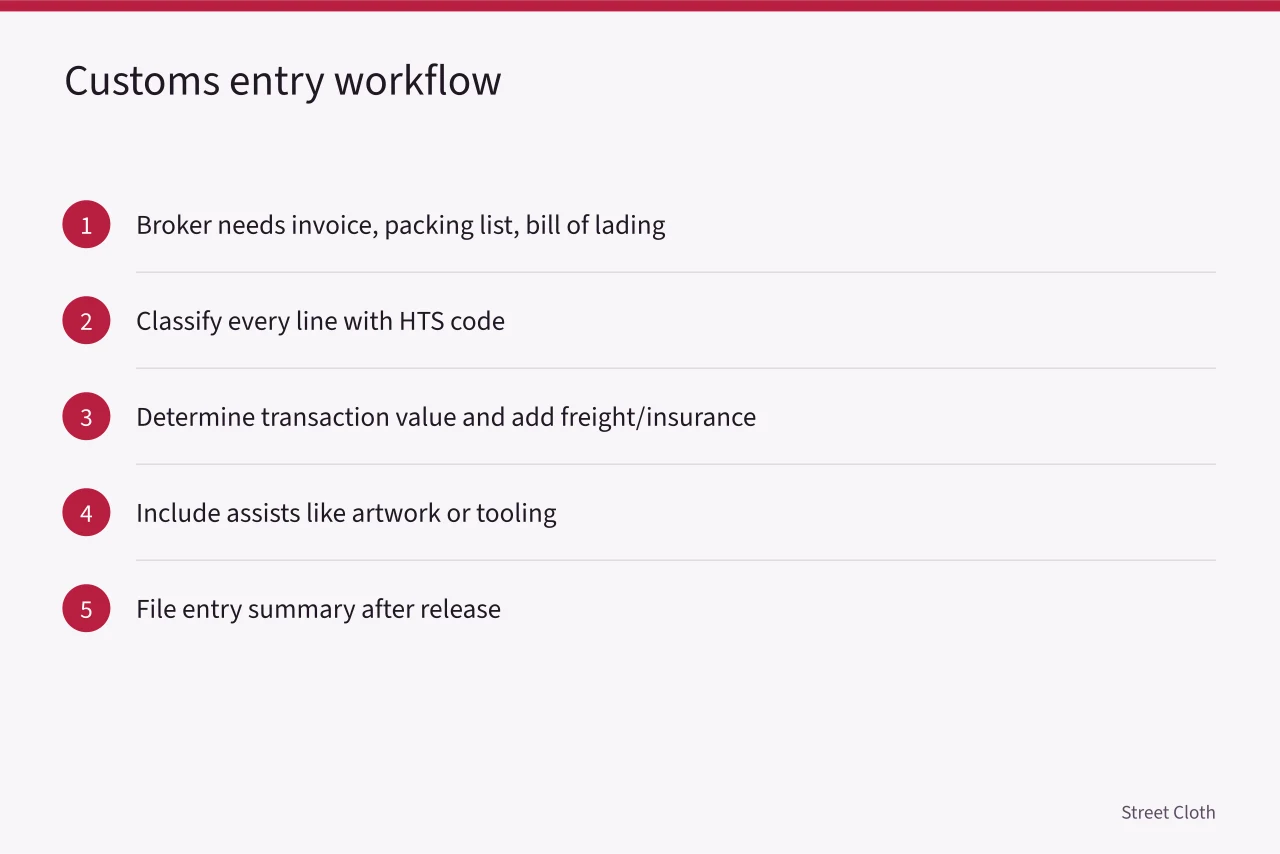
The importer of record stays legally responsible for the entry even when a broker files it. If the shop's name is on the entry, the shop owes the duty and any penalty later.
Recordkeeping: what an auditor asks for
An auditor works from the documents you kept. One folder per license, rebuilt each cycle, answers most questions first.
- The current certificate and the renewal receipt.
- Inspection reports and correction notices, with dates.
- A named person for each license and its deadline.
IRS, SBA and OSHA filings sit on a separate calendar from licensing, and missing one does not excuse the other.
What the license fees actually cover
Fees are small next to the cost of a lapse. City licenses commonly run from about fifty dollars to a few hundred a year, and state trade licenses sit higher. Treat that range as illustrative.
Importers add broker fees, customs bonds and duty to the same budget line, and those numbers move with every shipment.
Canada: municipal permits sit on top of federal rules
A Canadian address needs a municipal business license in addition to provincial registration.
Provincial registration runs through the province's own registry — Ontario's Business Registry, BC Registries and Online Services, or Quebec's Registraire des entreprises — and the city or municipality issues its business license on top of that.
The Canada Business permits and licenses page gathers the federal starting points and links to municipal requirements, including Vancouver.