Rules
Does BC's PIPA change what a Victoria tourism business must report?
BC PIPA breach reporting applies to Victoria tourism businesses and public-sector suppliers, with duties that differ from PIPEDA reporting to the OPC.
What to take away
- BC PIPA breach reporting is narrower than PIPEDAyou notify the OIPC BC when there is a real risk of significant harm, not on every incident.
- Victoria tourism operators hold passport numbers, booking records and payment data, so most serious breaches cross that threshold.
- Public-sector suppliers in Victoria can face PIPA duties through their contracts and through the provincial rules their clients follow.
- PIPEDA reporting to the OPC still applies to some federally regulated activity, so a single incident can touch two regulators.
- A written checklist, kept current, is what makes the decision defensible when an incident happens at 2 a.m.
Yes. For most Victoria tourism businesses, BC PIPA breach reporting is the rule that applies, not PIPEDA. If your organization is provincially regulated, you notify the OIPC BC under PIPA section 22.1, and you keep breach records under section 22.2. PIPEDA reporting to the OPC still applies only to federally regulated activity.
This site covers business licensing, law and compliance. The same habits that keep a license current, named responsibility and written records, apply to privacy breach reporting.
A tourism business in Victoria may hold a business license issued by the City of Victoria and provincial obligations, and privacy duties sit in that same compliance stack.
For a US reader, the lesson is to map every jurisdiction where you operate and keep the paperwork ready. Confirm the current rule with the regulator before you rely on any summary.
What BC's Personal Information Protection Act requires a Victoria business to report
The BC Personal Information Protection Act, usually called PIPA, governs how private organizations in the province collect, use and disclose personal information. It is provincial law, not federal.
That matters because the obligations attach to your organization as soon as you handle personal information in the course of commercial activity in British Columbia, which nearly every Victoria tourism business does.
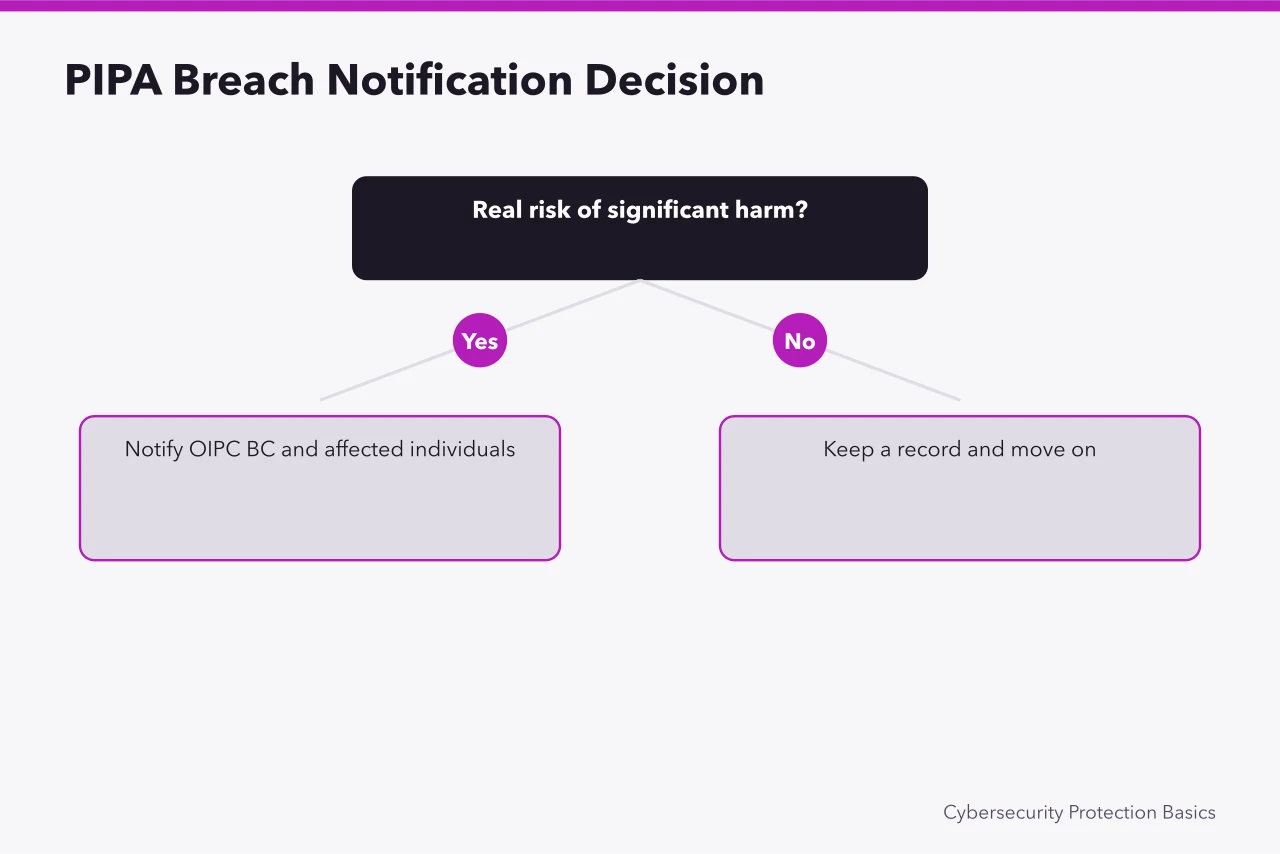
PIPA's breach notification duty under section 22.1 is built on one test: is there a real risk of significant harm to an individual as a result of the breach? If yes, you must notify the OIPC BC without unreasonable delay by using the OIPC BC privacy breach report form on its online reporting portal. If no, you keep a record and move on. The threshold is not the size of the breach. It is the harm.
Significant harm under PIPA includes humiliation, damage to reputation or relationships, financial loss, identity theft, negative effects on credit records, and harm to health or safety. A leaked guest list is embarrassing. A leaked guest list with passport scans and credit card numbers is a different problem entirely.
You must also inform the people impacted when there is a real risk of significant harm. In practice, that means telling guests what happened, what data was involved, and what they can do about it. The notification has to be clear enough that a reasonable person understands the risk.
The OIPC BC also expects organizations to keep records of every breach, including those below the notification threshold. Those records are not optional paperwork. They show the regulator that you have a functioning process. A Victoria hotel that cannot produce a breach log looks like a hotel that never noticed.
One more piece: PIPA allows the OIPC BC to require notification even where the organization has not reported. If the commissioner becomes aware of a breach, the office can order you to notify affected individuals. Waiting is not a strategy. Reporting early gives you room to manage the message.
The BC government's Law, Crime and Justice section on gov.bc.ca links to PIPA and related reporting rules, which is a reasonable place to confirm the statute before you rely on a summary.
For a small operator, the practical question is who makes the call. Assign one person, name a backup, and write down the criteria they will use. Good record-keeping habits transfer across both statutes, even though the two are not identical.
How PIPA reporting differs from PIPEDA reporting to the OPC
PIPEDA is the federal private-sector privacy law. It applies to organizations engaged in commercial activity in provinces without substantially similar legislation, and to federally regulated businesses such as banks, airlines, telecoms and interprovincial trucking. British Columbia has its own substantially similar law, recognized by the federal order designating BC's PIPA as substantially similar to PIPEDA, so most purely provincial businesses fall under PIPA instead.
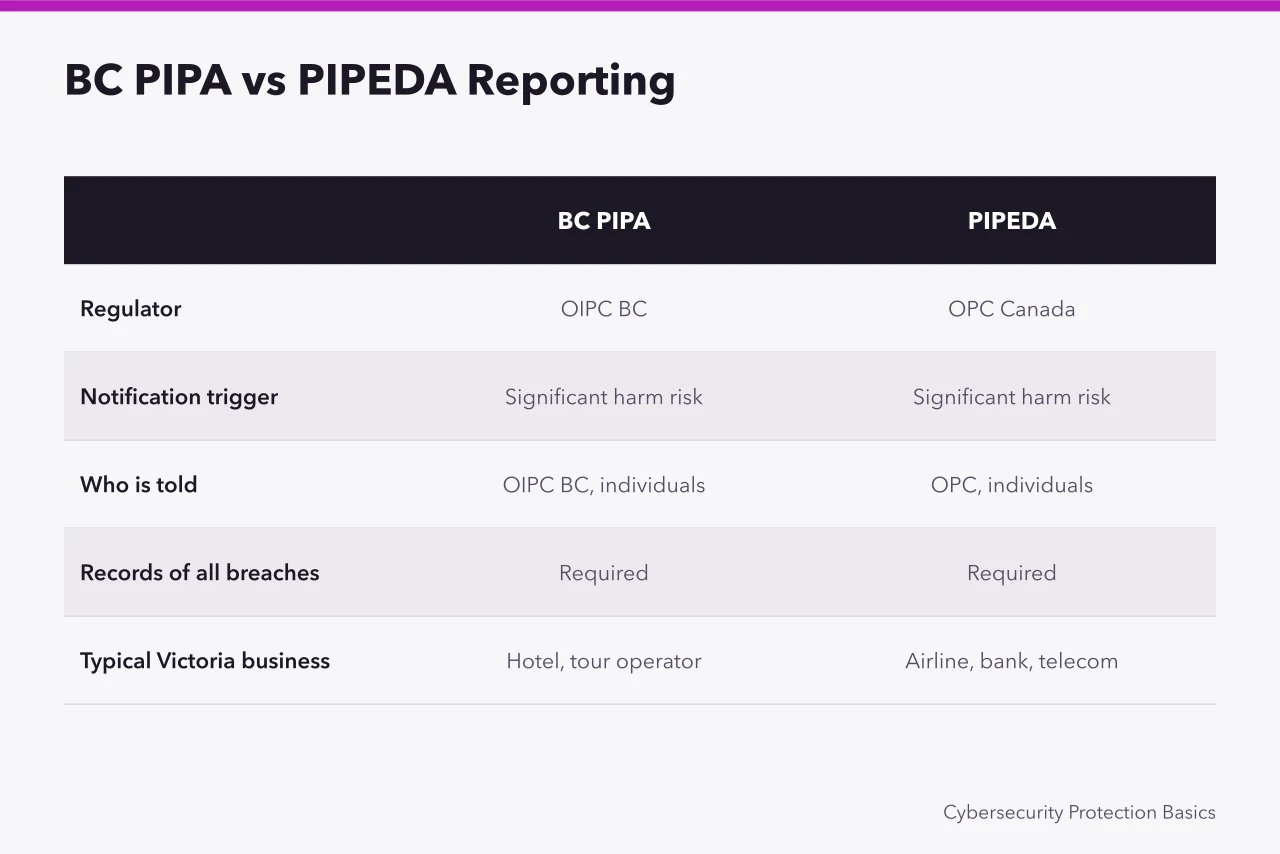
The federal privacy picture, including how provincial statutes sit alongside PIPEDA, is set out by the Office of the Privacy Commissioner of Canada in its overview of privacy laws in Canada. The short version: PIPA covers most Victoria businesses, PIPEDA covers the federally regulated ones, and some organizations answer to both.
BC PIPA
- Regulator
- OIPC BC
- Notification trigger
- Real risk of significant harm
- Who is told
- OIPC BC and affected individuals
- Records of all breaches
- Required
- Typical Victoria business
- Hotel, tour operator, retail, restaurant
PIPEDA
- Regulator
- Office of the Privacy Commissioner of Canada
- Notification trigger
- Real risk of significant harm
- Who is told
- OPC and affected individuals
- Records of all breaches
- Required
- Typical Victoria business
- Airline, bank, telecom, interprovincial carrier
The triggers sound identical, and in substance they are close. The difference that catches people is jurisdiction. A Victoria tour company that also runs a booking call centre in Alberta, or stores data with a supplier in Ontario, may find that more than one regulator has an interest.
Provincial regulators across the country, including the OIPC BC, the OIPC Alberta and the CAI in Quebec, each run their own notification regimes.
PIPEDA also has a mandatory reporting duty for breaches of security safeguards involving personal information under the organization's control. Where a Victoria business is federally regulated, that duty runs to the OPC.
If you are unsure which regime applies, the safest course is to document your reasoning and report to the regulator you believe has authority. Regulators would rather receive an early report than discover a concealed one.
If your business is federally regulated, or you are not sure, work through the Office of the Privacy Commissioner of Canada's PIPEDA compliance checklist before you need it. And remember that a breach report is not the only way a regulator hears about a problem. Individuals can bring complaints directly, and the OPC explains how a concern reaches a privacy regulator.
Tourism and public-sector supplier duties in Victoria
Victoria's economy leans on visitors. Hotels, whale watching operators, bike rental shops, tour companies, restaurants and short-term rental hosts all collect personal information as a condition of doing business. The province treats tourism as a core sector, and the visitor economy brings a specific data profile: names, addresses, passport numbers, payment cards, travel dates and sometimes health details.
That data profile raises the stakes. A breach at a Victoria hotel in July affects people who are already back home in another province or country. Notifying them is harder, and the reputational damage travels faster. A small operator with a seasonal staff roster is also more likely to have access controls that drift when the season ends.
British Columbia publishes its tourism and immigration guidance for the sector, and the province also sets out how its own data and information management practices work. Suppliers to provincial bodies are expected to align with those practices, which shapes what a contract will demand of you.
Public-sector suppliers face a second layer. If you provide services to a provincial ministry, a Crown corporation, a school district or a health authority, your contract will almost certainly include privacy and security terms. Those terms can require you to report incidents to your government client on a tighter timeline than PIPA itself imposes, sometimes within hours.
The practical effect is that a Victoria IT contractor serving a ministry may have to notify the ministry first, then the OIPC BC, then affected individuals. Miss the contract clock and you can be in breach of your agreement even if you met the statute.
Supplier risk does not stop at the contract. If your own vendors hold visitor data, their breach becomes your breach. A payment processor, a booking platform, a cloud email provider or a cleaning contractor with after-hours access all sit inside your privacy perimeter.
Run a vendor risk assessment at least annually, and again whenever a vendor changes how it handles data.
Physical exposure matters too in a tourism setting. Front desks, back offices and storage rooms hold devices and paper records, and seasonal turnover means keys and codes circulate. A physical security checklist for locks, cameras and access is not paranoia in a downtown Victoria property with a transient guest population.
When an incident also triggers notification to the OIPC BC
Not every incident is a reportable breach. A phishing email that nobody clicks is an incident. A stolen laptop with an encrypted guest database may not meet the harm threshold. A stolen laptop with an unencrypted guest database almost certainly does.
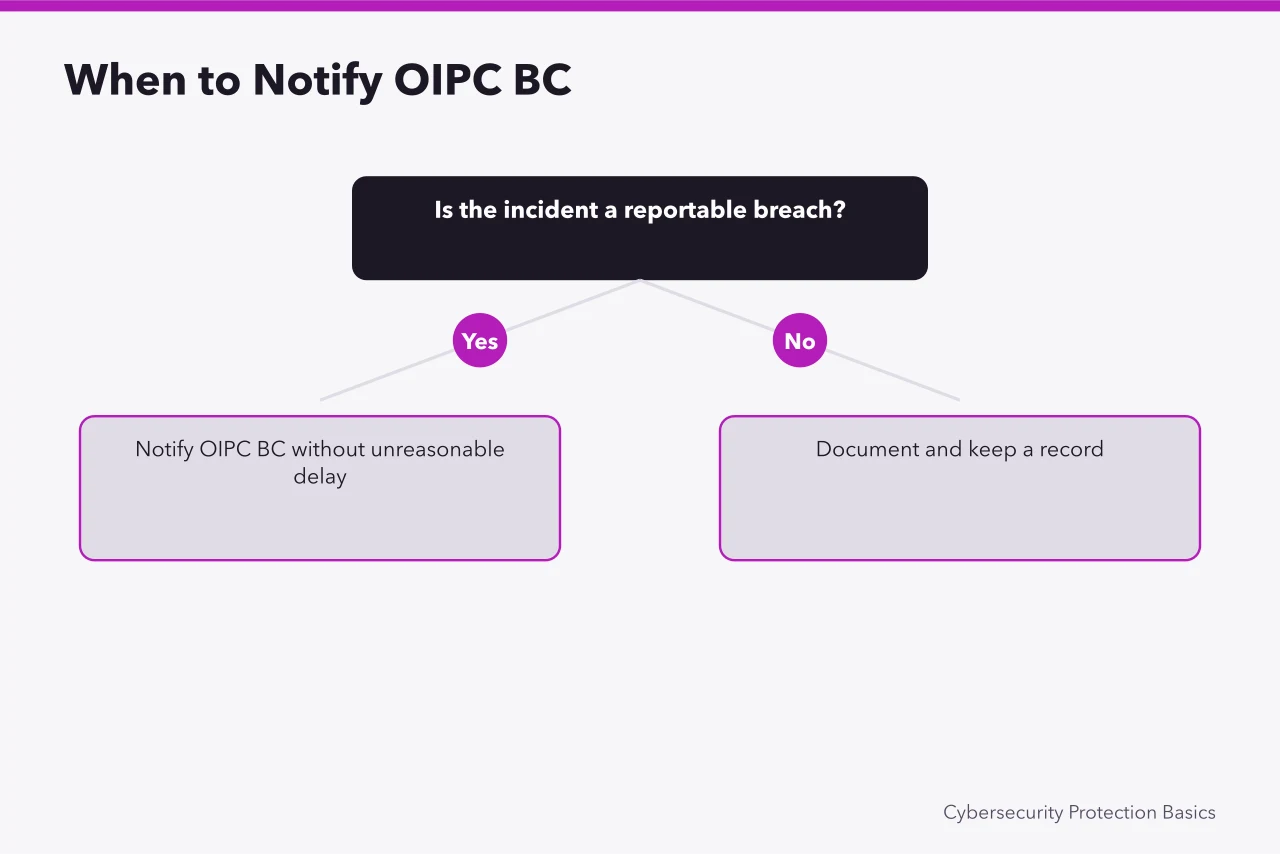
The OIPC BC expects notification without unreasonable delay once you determine a breach has occurred and that the threshold is met. That determination is yours to make, and the clock starts when you know enough to make it, not when you finish the investigation. Delay for a tidy report is a common and avoidable mistake.
Several factors push an incident over the line: sensitive data such as passport or health information, a large number of affected people, data that could support identity theft or fraud, and any indication that the information is being misused. Encryption and other safeguards can reduce the risk, which is why they are worth having before anything happens.
Your incident response plan should name the person who decides, the evidence they need, and the timeline for each notification. A plan that exists only in someone's head fails on the day the decision maker is on holiday. Write it, test it once a year, and keep the contact details current.
One related duty is easy to overlook. If the breach involves spam, malware distribution or unauthorized commercial messages, the Canadian Radio-television and Telecommunications Commission has its own reporting expectations. Fraud losses should also go to the Canadian Anti-Fraud Centre. Neither replaces the OIPC BC notification, but both may run alongside it.
Cyber insurance is worth checking against your actual exposure. The Insurance Bureau of Canada publishes guidance that helps small businesses understand what a policy covers, including breach response costs. Do not assume your general liability policy handles a privacy breach. Most do not.
A reporting checklist for a Victoria tourism operator
Use this checklist as a working document. Print it, keep it with your incident response plan, and review it each spring before the visitor season starts.
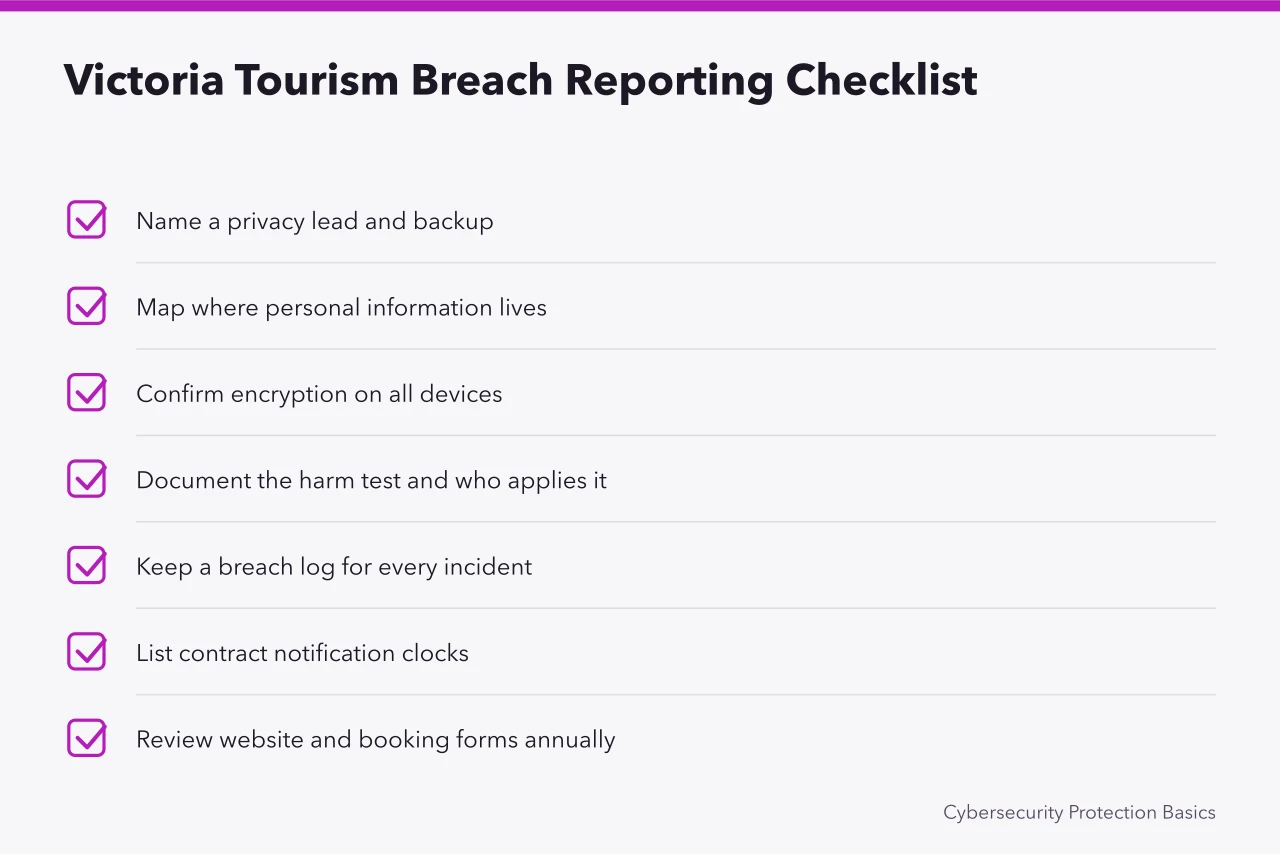
- Name the person who decides whether a breach is reportable and a backup.
- Save the OIPC BC privacy breach report form and online reporting portal link in your incident response plan.
- Keep a breach log template that captures date, facts, harm assessment, notifications and fixes.
- List each public-sector contract's shorter notice period.
- Confirm cyber insurance coverage for breach response costs.
- Review vendor contracts for breach notification duties.
For the website security review, use the Canadian Centre for Cyber Security's website security guidance.
When an incident happens, work through these steps in order.
- Contain the incident. Stop the loss, revoke access, isolate the device, and preserve evidence before you clean anything up.
- Assess the data and the people affected. What was involved, how sensitive is it, and how many individuals are at risk?
- Apply the harm test. Decide whether there is a real risk of significant harm, and write down the reasoning.
- Notify on the right clocks. File the OIPC BC privacy breach report form without unreasonable delay, notify affected individuals as soon as practicable, and notify any public-sector client within the contract timeline.
- Record everything. What happened, when you knew, what you decided, who you told, and what you changed afterwards.
A worked example makes the timing concrete. A Victoria whale watching operator discovers on a Tuesday morning that a booking system account was accessed from outside Canada over the weekend. Guest names, emails, phone numbers and partial card data were visible.
The operator contains the access, confirms the data set, and concludes there is a real risk of significant harm because of the payment data.
The OIPC BC is notified that afternoon, once the facts are clear enough to describe. Guests are notified the same day, with a plain description of what happened and what to watch for.
The public-sector client whose staff bookings ran through the same system is notified within the contract's 24-hour window. The breach log entry is written before anyone goes home.
That sequence is not heroic. It is a process that was written down in advance. The businesses that handle these events well are rarely the ones with the biggest budgets. They are the ones that decided who calls whom before the phone rang.
BC's tourism sector runs on repeat visitors and referrals, and a calm, honest response to a breach protects both.