
Guides
Document management software for law firms: retention, redaction, and audit logs
Document management software for law firms must satisfy bar retention rules, redaction duties, and audit log standards that vary by state and by court.
What to take away
Document management software for law firms must satisfy bar retention, redaction, and audit log rules that vary by state and court.
- Retention periods for client files come from state bar rules and court orders, not from the software vendor, and they differ by state.
- A compliant disclosure of an audit log names the user, the timestamp, the action, and the affected document.
- Redaction must remove the underlying text, not cover it; a black box over readable text is a disclosure failure.
- The consequence is disciplinarystate bars sanction lawyers for lost files, improper disclosure, and destroyed records.
- NetDocuments, iManage, Worldox, Clio Manage, and MyCase provide retention settings and audit trails, but redaction usually requires Adobe Acrobat Pro or a similar PDF tool.
- Software is evidence of compliance, not compliance itself. The duty stays with the firm.
For a licensed law firm, document management software belongs in business licensing compliance because the state bar license carries recordkeeping duties. The same pattern applies to other licensed businesses: the license or permit authority sets retention, disclosure, and audit rules.
The software is only the control layer. A firm that cannot show a compliant retention schedule, a true redaction process, and an unaltered audit log is exposed to licensing discipline.
Readers evaluating compliance rules for any licensed business can treat this article as a specific case of a general duty to keep records, protect confidential data, and prove compliance when a regulator asks.
Who has jurisdiction over law firm records
Each state supreme court adopts its own rules of professional conduct. Most track the ABA Model Rules with local amendments. Rule 1.15 covers safekeeping of client property. Rule 1.6 covers confidentiality. State bar associations publish retention schedules that tell firms how long to keep closed files. Those schedules are advisory in some states and binding in others.
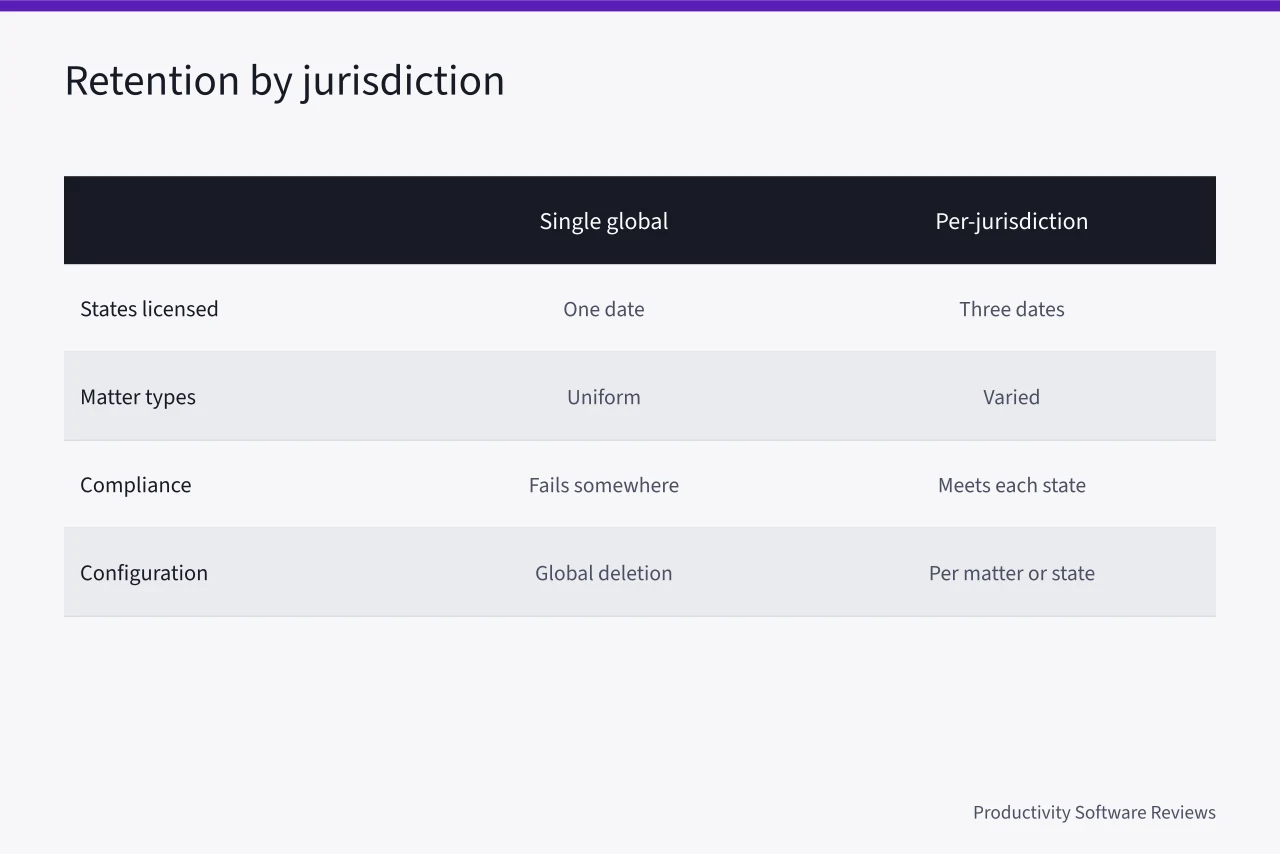
A firm licensed in three states can face three retention periods for one matter. NetDocuments applies retention policies per workspace. Worldox uses a profile date field per client or matter and sells per seat licenses with annual maintenance.
A single global deletion date will not satisfy all three. Configuration must be per jurisdiction, per matter type, or both.
What a compliant disclosure contains
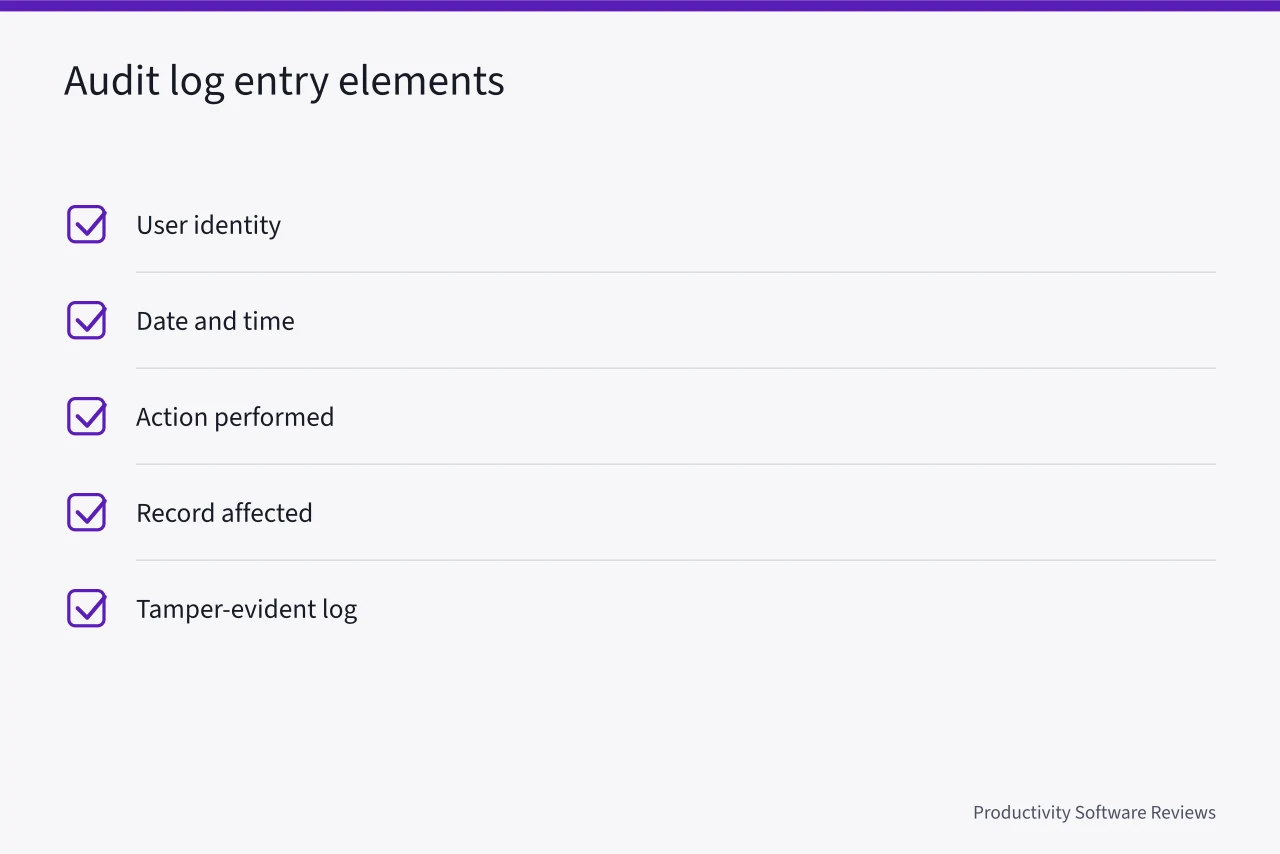
When a client, a court, or a bar counsel asks who touched a file, the audit trail answers. A usable entry carries four elements together: the user, the date and time, the action, and the record affected. View, edit, download, share, and redact are separate actions. Delete is separate too, and each should be logged on its own.
iManage Work captures all four elements in its audit history. Clio Manage logs user actions with timestamp and document version. Clio Manage charges a monthly per user subscription and suits solo and small firms.
An audit log without user identity and timestamp is a list of events, not a record of accountability.
Audit trails in document management are defined this way in the general literature, and legal practice adds one more requirement: the log itself must be tamper evident, because a log that any administrator can edit proves little. NetDocuments exports an audit trail with user, timestamp, action, and document ID.
Records to keep and for how long
Retention schedules vary widely; state bars publish illustrative ranges from five years after a matter closes to permanent retention for estate and trust files. Some states require notice to the client before destruction, and some require a written destruction log.
Adobe Acrobat Pro removes underlying text on redaction; Worldox assigns deletion dates by matter type; M-Files enforces retention via metadata and logs destruction.
| Record type | Typical retention trigger | Common range |
|---|---|---|
| Closed litigation file | Matter closure | 5 to 10 years |
| Estate and trust documents | Matter closure | Permanent in many states |
| Trust account records | Transaction date | 5 to 7 years |
| Conflict check data | Client relationship end | Indefinite in practice |
| Audit logs | Event date | Often shorter than the file itself |
Firms miss the last row: a ten-year file with a ninety-day audit log cannot answer a question asked in year three.
MyCase charges a flat monthly per user fee and includes document storage and an activity log, but audit log retention may be shorter than file retention on some MyCase plans. Confirm the limit.
What happens if you do not comply
The concrete consequence is discipline. State bars impose sanctions for failing to safeguard client property, from private reprimand to suspension. Courts add penalties when a party cannot produce records during discovery, including adverse inference instructions and monetary sanctions under federal and state civil procedure rules.
Redaction failures carry a second path. Redaction done by drawing a shape over text leaves the text recoverable in the file. Courts have sanctioned firms for filing documents that still contained hidden content. The FTC's data security guidance frames the same duty in consumer protection terms: sensitive information must actually be protected, not merely obscured.
Where the rules differ by place
Retention periods, notice requirements, and destruction methods are set at the state level. A single national policy will fail somewhere. USA.gov maintains state consumer protection links that help firms locate the applicable state authority. Bar rules themselves come from the state bar.
- Confirm the retention schedule for every state where the firm is licensed.
- Set deletion dates per jurisdiction rather than globally.
- Verify that redaction removes text at the file level.
- Confirm the audit log cannot be edited or deleted by a system administrator.
- Match audit log retention to the longest file retention period in force.
Firms that need a broader view of how collaboration and document systems interact should read team collaboration security before writing the policy. Firms weighing suites against standalone tools can start with office suites security.
For the account layer controlling file access, see account administration decisions. When non-lawyers on staff need the retention policy explained, publish it on internal wiki software that stays useful.