
Guides
SFCR licence requirements Canada: who needs a CFIA licence
SFCR licence requirements Canada: when specialty food makers need a CFIA licence, how to apply, provincial approvals, label rules, records and enforcement.
What to take away
- A federal Safe Food for Canadians (SFC) licence under the Safe Food for Canadians Regulations (SFCR) is required when you import, export, or send food across a provincial or territorial border — including food you manufacture for interprovincial sale, even if a distributor handles the shipment.
- The Canadian Food Inspection Agency (CFIA) is the federal regulator; Ontario, BC, and Quebec each add their own public health or food processing approvals.
- Getting the licence means a My CFIA account, an application for the activity and establishment you use, and a written preventive control plan where the regulations require one.
- A compliant label carries a common name, net quantity, ingredient list, and allergen declarations. It also carries the responsible party's name, lot code, and bilingual text where required.
- Selling without a required licence can lead to product seizure, licence cancellation, mandatory recall, or prosecution.
A specialty food maker in Toronto selling jam at a farmers market does not automatically need a federal SFC licence. The same maker shipping jam to a Montreal retailer does. The line is drawn by what you do with the food, where it travels, and whether you sell directly to the final consumer.
When federal jurisdiction kicks in
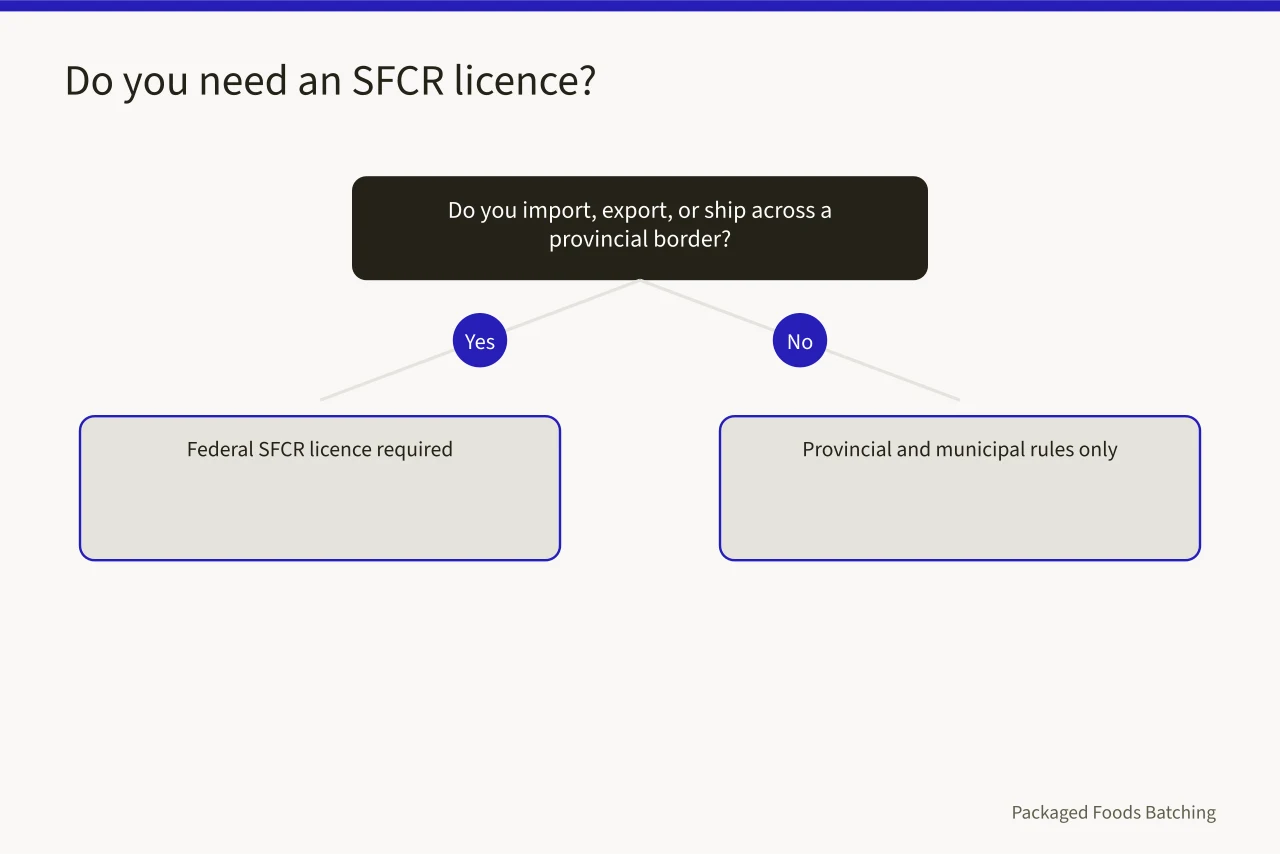
Under the Safe Food for Canadians Regulations, the CFIA regulates food that is imported, exported, or sent from one province or territory to another. If you manufacture and sell only within your home province directly to consumers, you may be outside federal licensing, but you still face provincial and municipal rules. A manufacturer that sells to a distributor or retailer in another province needs a licence.
Federal licensing under the Safe Food for Canadians Act is triggered when you:
- import food into Canada;
- export food from Canada;
- send food from one province or territory to another for sale;
If you also ship into the US, the triggers differ. See Cross-border packaged food sales between the US and Canada for what changes at the border.
How the CFIA issues an SFC licence
The CFIA issues SFC licences by activity and establishment, not by product category or licence class. A specialty food manufacturer usually holds a licence for manufacturing or processing food that is sent across a provincial or territorial border. The activities that require a licence under the SFCR include importing, exporting, and manufacturing, processing, treating, preserving, grading, packaging, labelling, storing, handling or distributing food for interprovincial sale or export. There is no separate 'specialty food permit'; the same SFC licence covers low-risk and high-risk foods. Most licensed manufacturers must also keep a written preventive control plan.
How to apply for an SFC licence
The licence is issued by activity, not by product, and it names the establishment where the activity happens. The practical sequence is:
- Confirm that the activity you carry out is one the SFCR requires you to be licensed for, and that your establishment and processes meet the regulations.
- Open a My CFIA account, the CFIA's online portal for licences, and add your business and establishment details.
- Assemble the supporting documentsyour written preventive control plan where one is required, your recall procedure, and the information the application asks for about your establishment and the foods you handle.
- Submit the licence application in My CFIA for each activity and establishment, and keep the confirmation the system gives you.
- Answer any follow-up questions from CFIA. When the application is complete, CFIA issues the licence, which lists the activities and the establishment covered.
- Keep the licence current and your preventive control plan up to date, and produce the licence when a CFIA inspector or a buyer asks for it.
A provincial public health approval does not replace an SFCR licence when food crosses a provincial border.
The preventive control plan borrows from HACCP. For the seven principles, the FDA's HACCP principles and application guidelines are a useful reference, even in a Canadian context.
The preventive control plan requirement
A preventive control plan under the SFCR covers hazard analysis, control measures, critical control points, monitoring, and corrective actions. It also covers recall procedures and record keeping. The plan must be written and available to CFIA inspectors. The regulator does not pre-approve every plan, but it reviews plans during inspections and when food safety incidents occur.
If you also sell into the US, you will hear similar language in FSMA preventive controls for small specialty food manufacturers.
What a compliant label carries
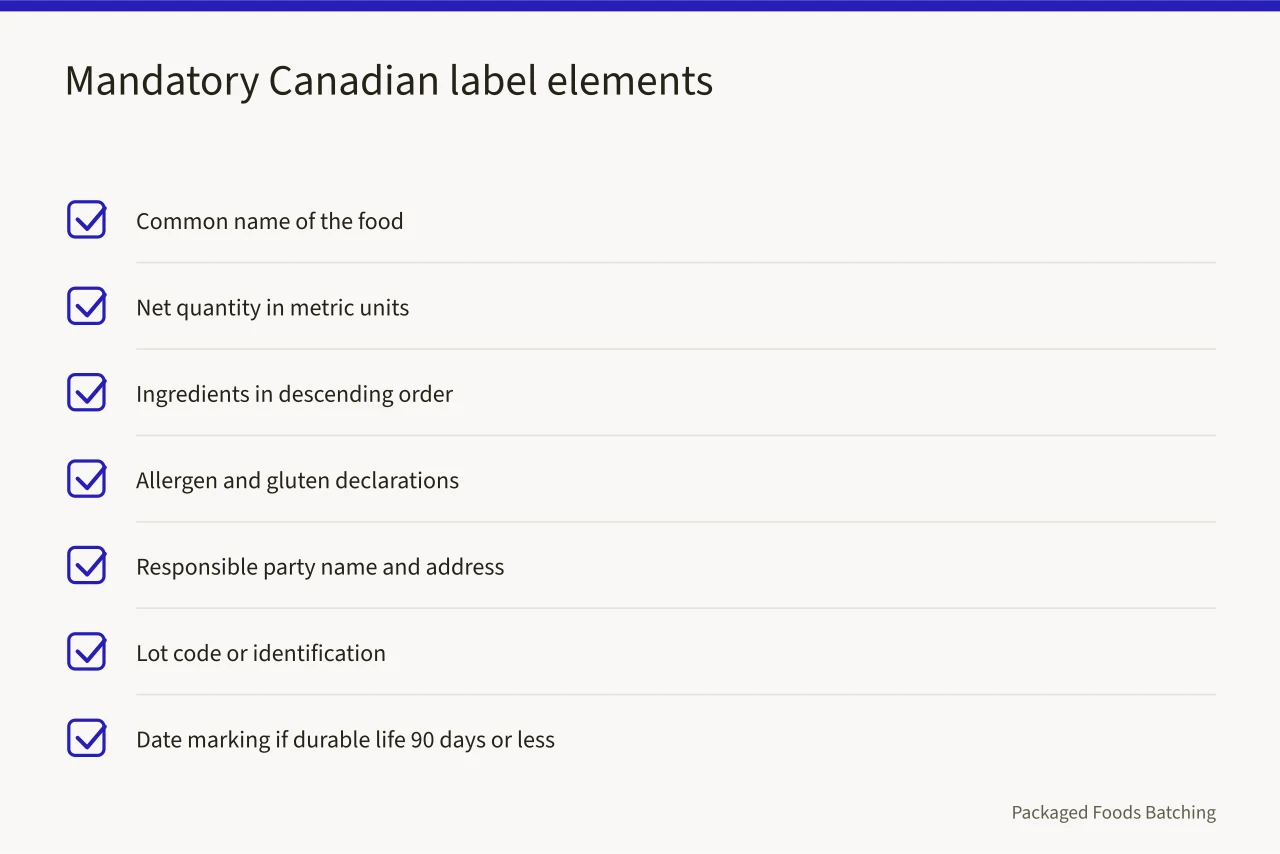
A compliant Canadian label carries mandatory information in both English and French unless a specific exemption applies. The core elements are:
- the common name of the food;
- the net quantity;
- the ingredient list, including allergen, gluten source, and added sulphite declarations;
- the name and principal place of business of the responsible party, the business whose name appears on the label;
- the lot code or other traceability information, plus a durable life date where one is required;
- a Nutrition Facts table, unless the food qualifies for an exemption;
- bilingual presentation of the mandatory information, unless an exemption applies.
The exemptions from bilingual labelling and from the Nutrition Facts table are set out in the Food and Drug Regulations. Check which one fits your product before you print, and note why it applies in case a CFIA inspector asks.
Canada's labelling rules come from the Food and Drugs Act and the Food and Drug Regulations, together with the Consumer Packaging and Labelling Act and its regulations. Provincial rules may add requirements such as a public health sticker or permit number. For contrast, the US system operates under different labelling rules, as described on the FDA's food labelling and nutrition page.
Provincial layers: Ontario, BC, Quebec
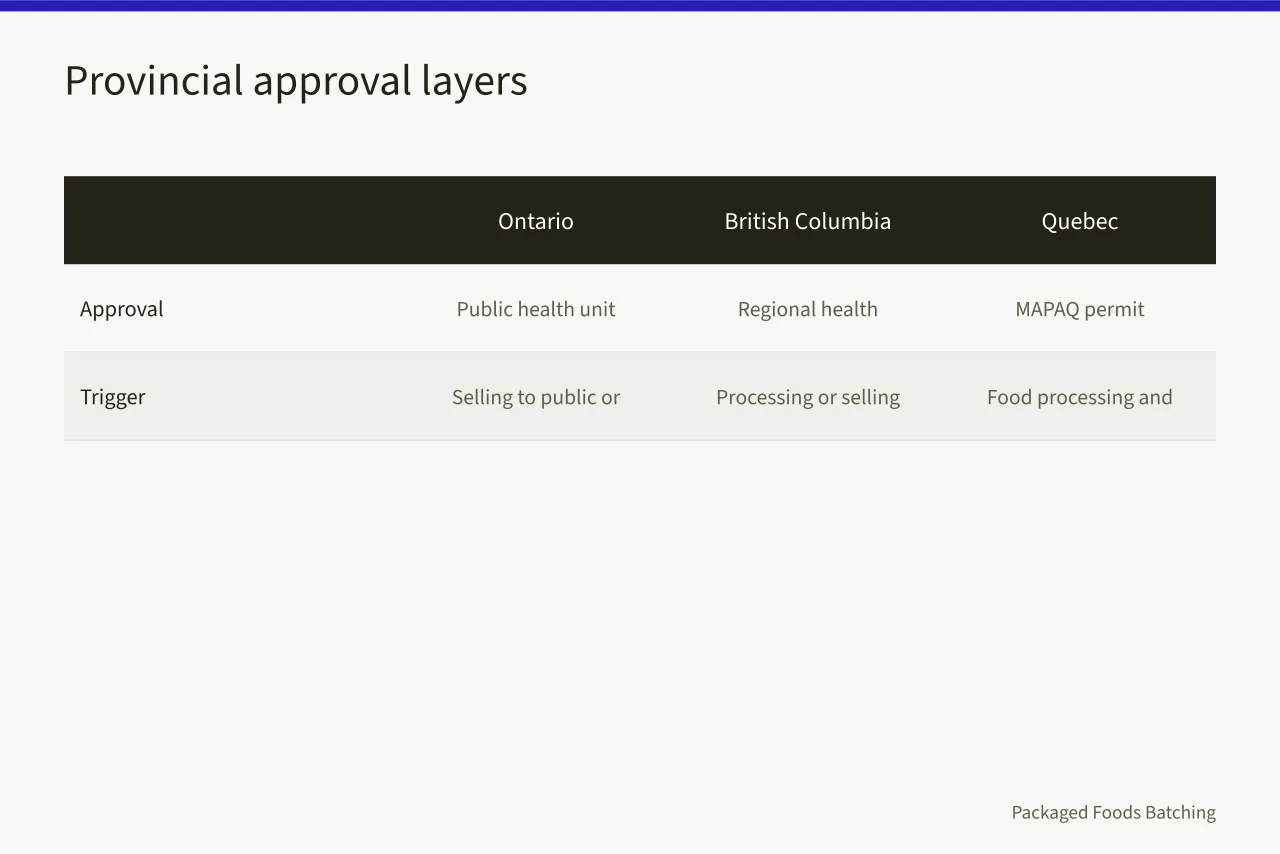
Provincial approvals stack on top of the federal licence, not instead of it. Each province has its own legal instrument and its own food protection authority. Ontario's Food Premises Regulation (O. Reg. 493/17) under the Health Protection and Promotion Act sets the requirements that local public health units enforce. British Columbia's Food Premises Regulation under the Public Health Act does the same through regional health authorities. In Quebec, the Food Products Act governs food processing and MAPAQ issues the permits.
Provincial layers
| Province | Additional approval layer | What triggers it |
|---|---|---|
| Ontario | Public health unit approval | Selling food to the public at a farmers market or retail location, or operating a food premise |
| British Columbia | Regional health authority approval | Processing or selling food in BC, including cottage and small-scale operations |
| Quebec | MAPAQ permit | Food processing and sales, issued by the Ministère de l'Agriculture, des Pêcheries et de l'Alimentation du Québec |
A maker in Vancouver may need a Fraser Health or Vancouver Coastal Health approval in addition to a federal licence if the product crosses a border. A maker in Montreal needs a MAPAQ permit even for local sales.
Records to keep
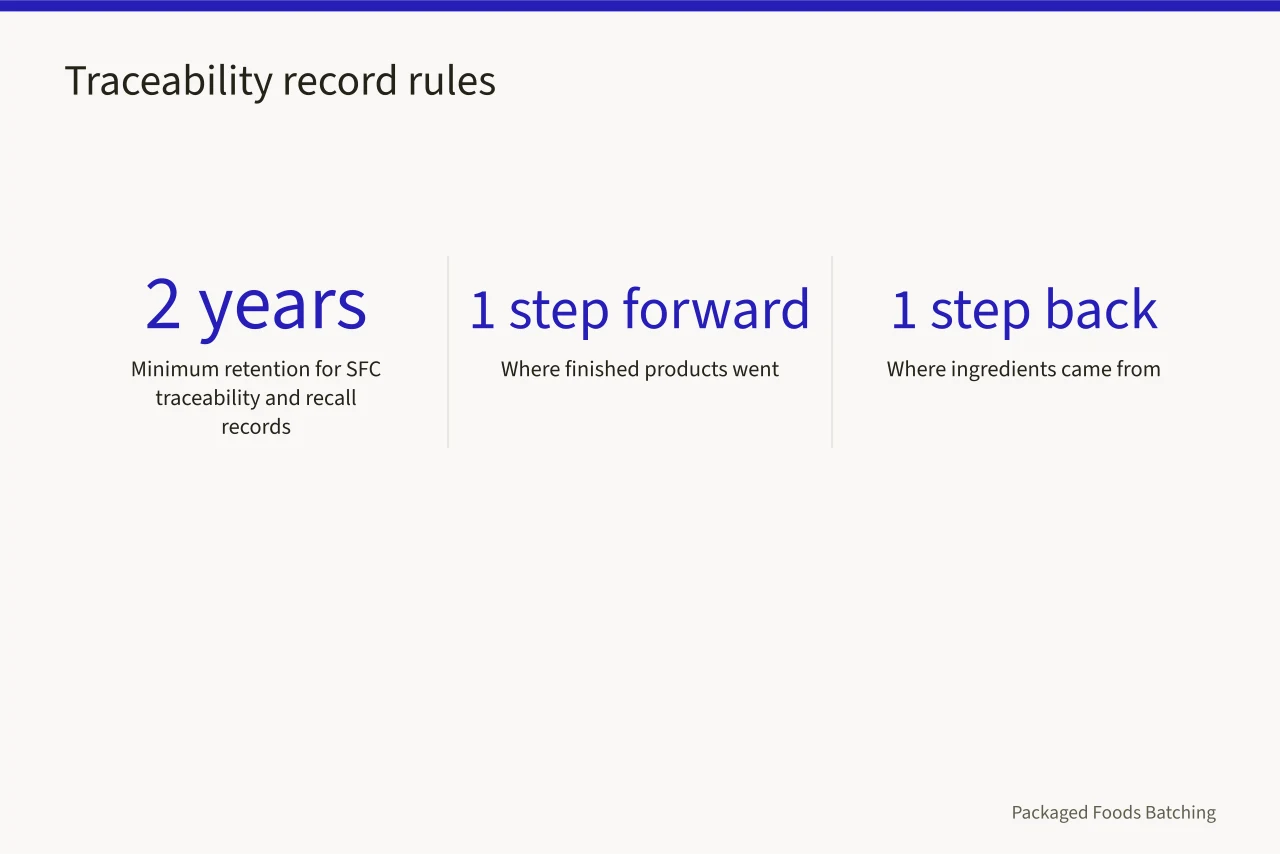
Licensed manufacturers must keep traceability records one step forward and one step back. That means records of where ingredients came from and where finished products went. Most SFC traceability and recall records must be kept for at least two years. Also keep complaint records, recall simulations, and preventive control plan updates.
If you also sell the same product into the US, the nutrition and allergen rules change. US nutrition labelling and allergen rules for packaged foods covers the federal requirements south of the border.
What happens if you skip it
Manufacturing and selling across a provincial border without a required SFC licence is a violation. CFIA inspectors can detain product, issue a recall, suspend or cancel a licence, and refer the case for prosecution. A mandatory recall is not a suggestion; it removes product from the market and creates a public record. The failure can stay on the CFIA enforcement record for years, which matters when a distributor checks compliance history.
Example: a granola maker in Guelph
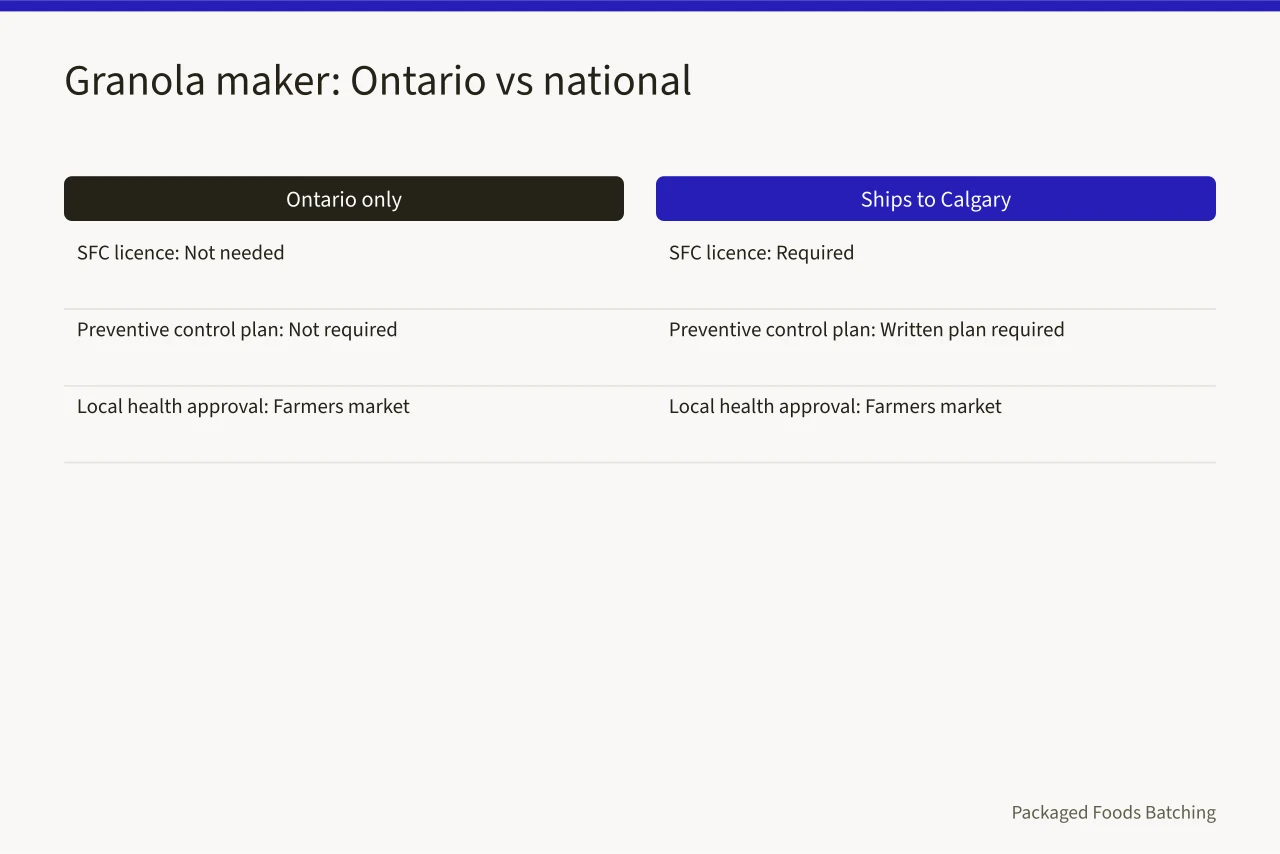
A granola maker in Guelph sells online within Ontario only and ships to Toronto, Ottawa, and London. No federal SFC licence is needed because the food does not leave Ontario. The same maker lists on a national grocery chain and ships to a distribution centre in Calgary, so a federal licence and a written preventive control plan become mandatory. The maker also needs local public health approval if selling at a Guelph farmers market.