Guides
Which cleaning chemicals need Health Canada compliant labels?
Health Canada chemical labelling splits consumer cleaners from workplace chemicals, and a carpet cleaning business can carry duties under both streams.
What to take away
- Two hazard-labelling regimes cover cleaning chemicals in Canada: the Consumer Chemicals and Containers Regulations, 2001 for products sold to the public, and WHMIS for products used at work. A pre-spray sold to a homeowner and the same chemistry poured into a crew sprayer fall under two different rulebooks.
- A cleaner that claims to disinfect or sanitize a surface is also a biocide: since May 31, 2025 it needs a market authorization from Health Canada under the Biocides Regulations, with its 8-digit identification number on the label.
- The consumer regime is made under the Canada Consumer Product Safety Act (CCPSA); the workplace regime comes from the Hazardous Products Act (HPA).
- Consumer cleaners you bottle or rebrand fall under the Consumer Chemicals and Containers Regulations, 2001, and you become the responsible party for the label.
- A consumer label needs a hazard symbol, a signal word where the category requires one, and first aid text, in English and French.
- A hazardous product decanted out of its supplier container needs a workplace label: product identifier, safe handling information, and a reference to the safety data sheet.
- Safety data sheets must be current, reachable during the shift, and matched to every hazardous product on the van.
- If a consumer product you sell harms someone, the reporting duty sits with the seller, not the supplier.
Chemical labelling is one of the compliance layers that sits on top of a business licence. A licence, a permit or a passed inspection does not replace the label and safety data sheet duties that attach to the chemicals you sell or use.
Canada splits those duties between the Consumer Chemicals and Containers Regulations, 2001 for products sold to the public and WHMIS for products used at work. The United States splits them the same way, between consumer product labelling and OSHA's workplace hazard communication rules. This article works through the Canadian regimes by name, then sets out the US counterparts.
If you bottle, rebrand or sell cleaning chemicals, label and safety duties attach to your business. The two streams below are the streams a US operator meets as well: a consumer product stream and a workplace stream. Find your licence first, then your labelling duty in each stream, and confirm both where you operate.
Which cleaning chemicals fall under Health Canada labelling rules
The rule that applies to a bottle depends on who ends up holding it. A pre-spray sold to a homeowner at retail is a consumer chemical product. The same pre-spray bought in a 20 litre drum and poured into a crew sprayer is a workplace chemical.
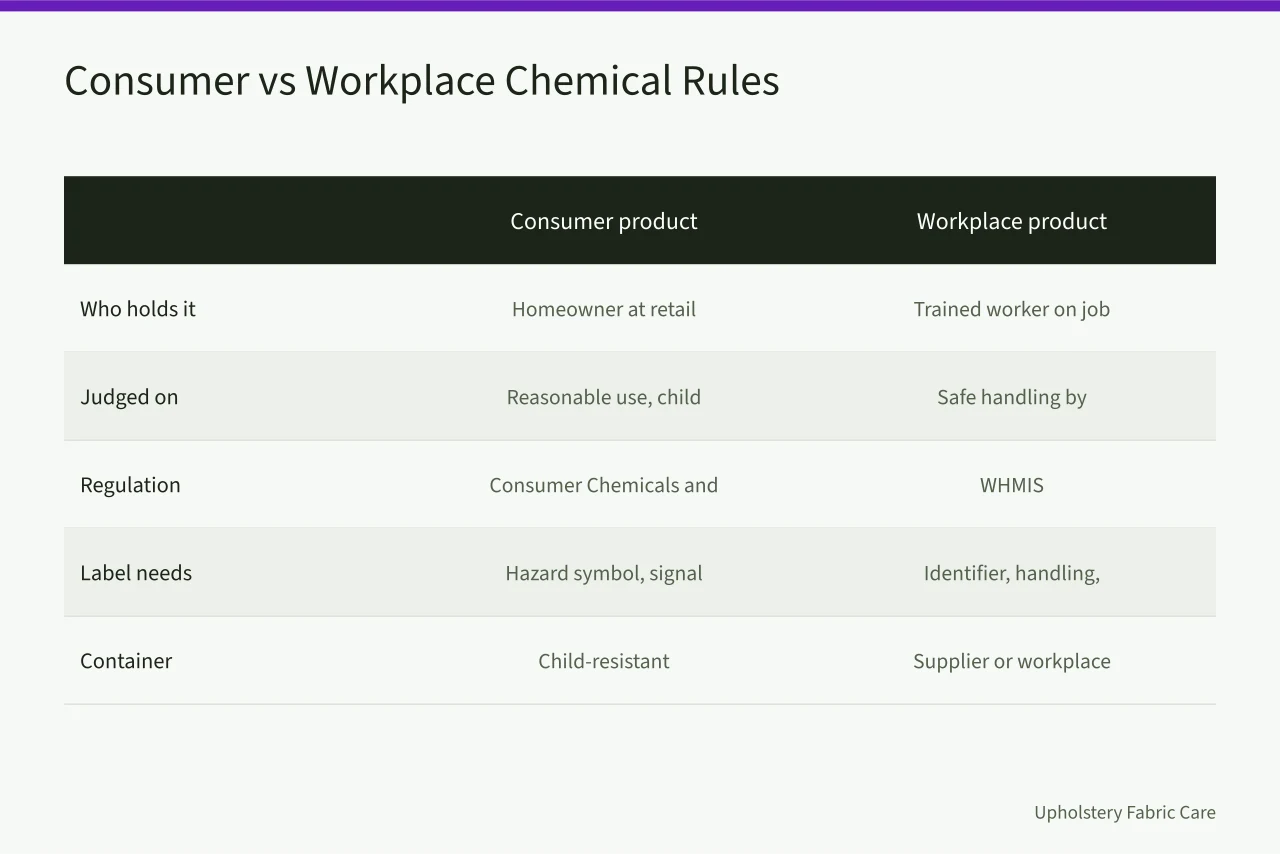
That split catches new owners off guard. You can be fully compliant on the workplace side and still be breaking the law on the retail side, or the reverse.
Consumer products are judged on how a reasonable person would use them, including foreseeable misuse by a child. Workplace products are judged on what a trained worker needs to handle them safely.
Some products sit in both worlds. Sell to homeowners and also run the same product on the job, and you carry obligations under each stream.
A short list of chemicals drives most of these cases:
- Sodium hypochlorite, the active ingredient in chlorine bleach and in bathroom, tile and toilet cleaners.
- Quaternary ammonium compounds, the standard disinfectant in commercial and retail sanitizers.
- Acids, including hydrochloric, phosphoric, citric and oxalic products for descaling, grout and rust.
- Solvents such as d-limonene, glycol ethers and isopropyl alcohol in degreasers and spot removers.
- Caustic alkalis, sodium hydroxide and potassium hydroxide, in oven, drain and floor stripping products.
Sell any of these to a homeowner and the consumer regulations apply. Decant the same product for your crew and WHMIS applies, with a supplier label and a safety data sheet.
Disinfectants and sanitizers: the authorization layer
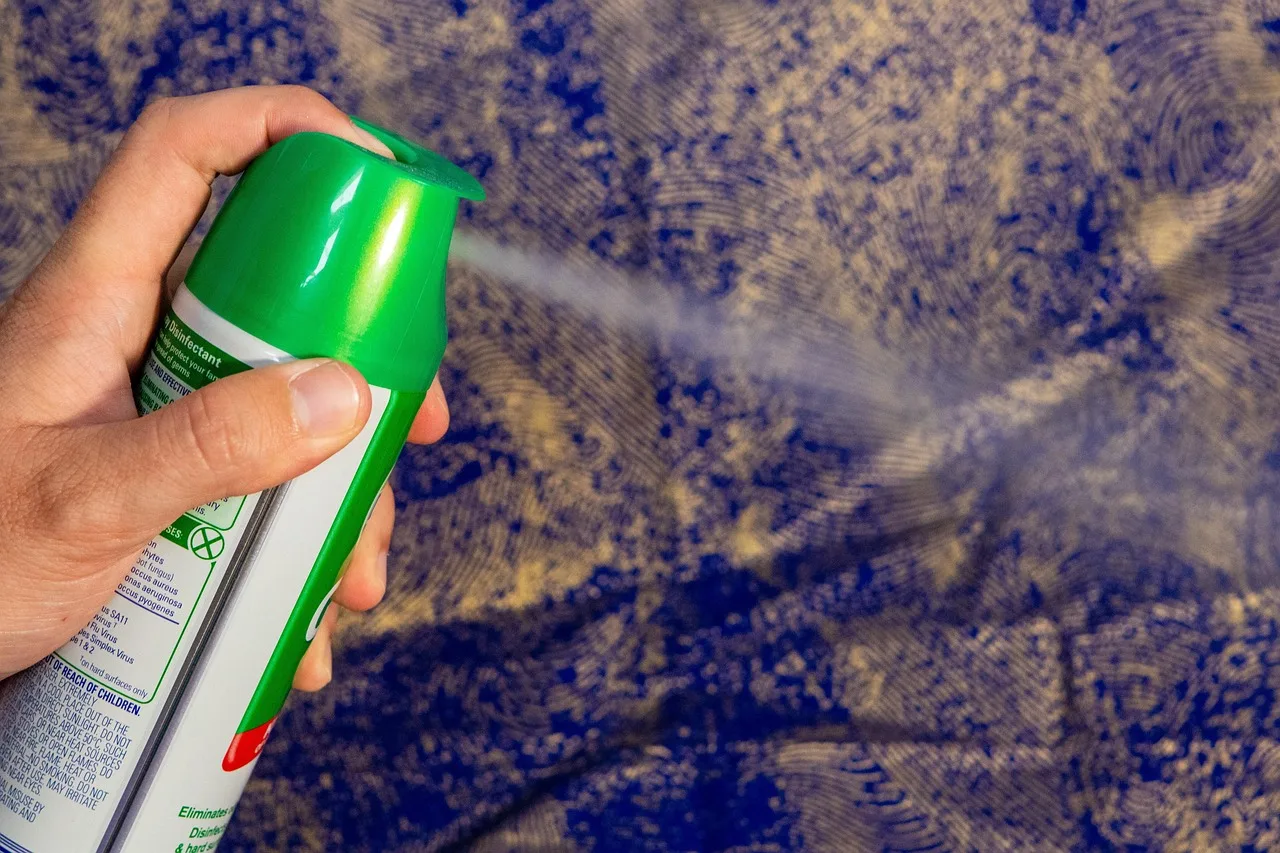
A product on that list that claims to disinfect or sanitize, such as a quaternary ammonium disinfectant or a bleach cleaner sold as a sanitizer, carries one more requirement. Health Canada calls surface disinfectants and sanitizers biocides. Before May 31, 2025 they were authorized separately: surface disinfectants under the Food and Drug Regulations, with a drug identification number (DIN) on the label, and surface sanitizers under the Pest Control Products Act, with a registration number from the Pest Management Regulatory Agency.
The Biocides Regulations replaced that split with a single framework under the Food and Drugs Act, in force since May 31, 2025. A biocide must go through a pre-market assessment and receive a market authorization before it can be imported, sold or advertised in Canada, and the 8-digit identification number assigned with that authorization must appear on the label. Rebrand a disinfectant concentrate under your own name and that authorization question becomes yours, on top of the hazard label.
Start with the supplier. Ask for the safety data sheet and the current label before you buy, and keep both. A supplier who cannot produce them is telling you something about the rest of their paperwork.
New owners often work through a carpet cleaning compliance checklist before their first paid job, and chemical labelling belongs on it.
Consumer product labels under the Consumer Chemicals and Containers Regulations
The Consumer Chemicals and Containers Regulations, 2001, made under the Canada Consumer Product Safety Act (CCPSA), set out how consumer chemical cleaning products are classified, labelled and packaged in Canada. They apply to products sold to the public, which includes anything you bottle, rebrand or repackage for retail or direct sale. They do not apply to the same chemical sold only into workplaces.
Classification comes first. Consumer chemical product legislation covers five main hazard classes: toxic products, corrosive products, flammable products, quick skin-bonding adhesives, and pressurized containers. Within those classes the regulations sort a product by category name — very toxic, toxic, corrosive, very flammable, flammable, combustible, quick skin-bonding adhesive, or pressurized container — and the category drives the label content and the container requirements.
The cut-offs are measured values. Oral toxicity is the clearest: a product is very toxic when the oral LD50 in rats is 50 mg/kg or less, and toxic above 50 and up to 500 mg/kg. Corrosivity rests on skin corrosion data and on the pH of the product as sold, and flash point settles the flammable and combustible categories.
The common cleaners usually land in the same places, though the supplier's data sheet is what settles any single product. Sodium hypochlorite cleaners and the caustic alkalis, sodium hydroxide and potassium hydroxide, are typically corrosive. Hydrochloric and phosphoric acid descalers are corrosive as sold. Solvent degreasers built on d-limonene or glycol ethers are typically flammable or combustible, while quaternary ammonium disinfectant concentrates are typically toxic at full strength.
Labels must carry specific elements: the hazard symbol for the category — the skull and crossbones for toxic products, the corrosion symbol, the flame for flammable products, or the pressurized container symbol — a signal word where the category requires one, such as DANGER, WARNING or CAUTION, primary hazard statements, and first aid or handling instructions. Bilingual English and French text is the norm for consumer products sold in Canada.
The container matters too. Some hazard categories require child-resistant closures or restricted container sizes. A product that is fine in a professional drum may be non-compliant in a 500 ml trigger bottle.
Health Canada's guidance on meeting consumer product and cosmetic safety requirements walks through the general obligations that sit alongside the regulations.
Import a concentrate and rebrand it, and you are the responsible party for the label. The overseas manufacturer's label does not transfer that duty to them.
The practical test is simple. Read your own label as a first-time buyer with no training. If the hazards and first aid are not obvious, it needs work.
| Product situation | Which labelling stream applies |
|---|---|
| Retail trigger spray sold to homeowners | Consumer Chemicals and Containers Regulations, 2001 |
| 20 litre drum used by your crew only | WHMIS supplier label, plus a workplace label after decanting |
| Concentrate you rebrand for retail | Consumer regulations, and you are the responsible party |
| Product sold to commercial clients only | WHMIS supplier label and safety data sheet |
| Sample bottle given free to a homeowner | Treated as a consumer product |
WHMIS supplier labels and workplace labels explained
WHMIS is the workplace hazard communication system, established under the Hazardous Products Act, and it runs on labels and safety data sheets working together. Health Canada administers the Hazardous Products Regulations behind it, and provincial workplace regulators enforce the duties on the ground.
A supplier label arrives on the product from the manufacturer or importer. It carries the product identifier, supplier contact details, hazard pictograms, signal word, hazard statements and precautionary statements.
CCOHS explains the full set of WHMIS supplier and workplace label requirements without jargon, and it is the reference most cleaning owners end up using.
A workplace label is the one you create. It applies when a hazardous product is transferred out of its supplier container into something else, like a spray bottle, a pail or a squeeze bottle for spot treatment.
A workplace label needs three things: the product identifier, safe handling information, and a reference to the safety data sheet. It does not need the full pictogram set.
Classification follows the Hazardous Products Regulations. A mixture is classified when a hazardous ingredient is present at or above the GHS cut-off. That cut-off is typically 1 percent by weight for most health hazards and 0.1 percent for carcinogens, germ cell mutagens and reproductive toxicants. Below those levels the ingredient does not trigger classification on its own.
Narrow exceptions exist, such as a product used immediately by the person who decanted it. Do not stretch that exception across a shift.
Unlabelled spray bottles are the most common WHMIS failure in small cleaning operations. A bottle of diluted degreaser with no identifier is a violation, even if everyone on the crew knows what is in it.
The broader carpet cleaning licensing requirements across provinces sit alongside WHMIS, not instead of it. Licensing does not replace chemical labelling.
Provincial regulators enforce this differently. WorkSafeBC, Ontario's Ministry of Labour, Immigration, Training and Skills Development, and the other provincial boards all expect the same core label and SDS discipline.
Safety data sheets and employer duties for a cleaning business
A safety data sheet is the technical companion to the label. It carries the full hazard detail, first aid measures, handling and storage advice, and emergency information.
Supplier sheets must follow the GHS format used in Canada, with sixteen standard sections. Older sheets in the pre-GHS layout should be replaced as suppliers update them.
CCOHS maintains a WHMIS, GHS and SDS reference that sets out what employers are expected to keep and provide.
Your obligations as an employer come down to four things: obtain a current sheet for every hazardous product, keep the sheets accessible to workers, train workers on how to read them, and update them when a product or supplier changes.
Accessible means reachable during work, not locked in an office. A binder in the van or a folder on every technician's phone both work.
Training is the part that gets skipped. A new technician who has never been shown where the sheets live or what a pictogram means has not been trained, whatever the sign-off sheet says.
A carpet cleaning license requirements record that covers chemical handling, spill response and label reading will satisfy most provincial inspectors far more easily than a stack of unsigned sheets.
Spill response deserves its own line. The sheet tells you what to do, but your crew needs to know where the spill kit is and who to call.
- Current safety data sheet on file for every hazardous product
- Sheets reachable by workers during the shift, not locked away
- Workplace labels on every decanted bottle and pail
- Supplier labels intact and legible on original containers
- Training records showing chemical handling instruction
- Spill kit stocked and crew knows its location
- Product list reviewed whenever a supplier or formula changes
Reporting a consumer product incident as an industry seller
If you sell consumer chemical products, you carry an incident reporting duty. Health Canada's page on reporting an incident involving a consumer product sets out what industry must report and how.
The duty covers incidents involving a product you manufacture, import or sell. That includes a homeowner injured by a cleaner you bottled, or a serious reaction traced to your product.
Reporting is not an admission of fault. It is a safety signal that feeds into Health Canada's monitoring of consumer products on the Canadian market.
What counts as reportable is broader than a hospital visit. Serious injury, serious illness, and incidents that could reasonably have led to either are all in scope.
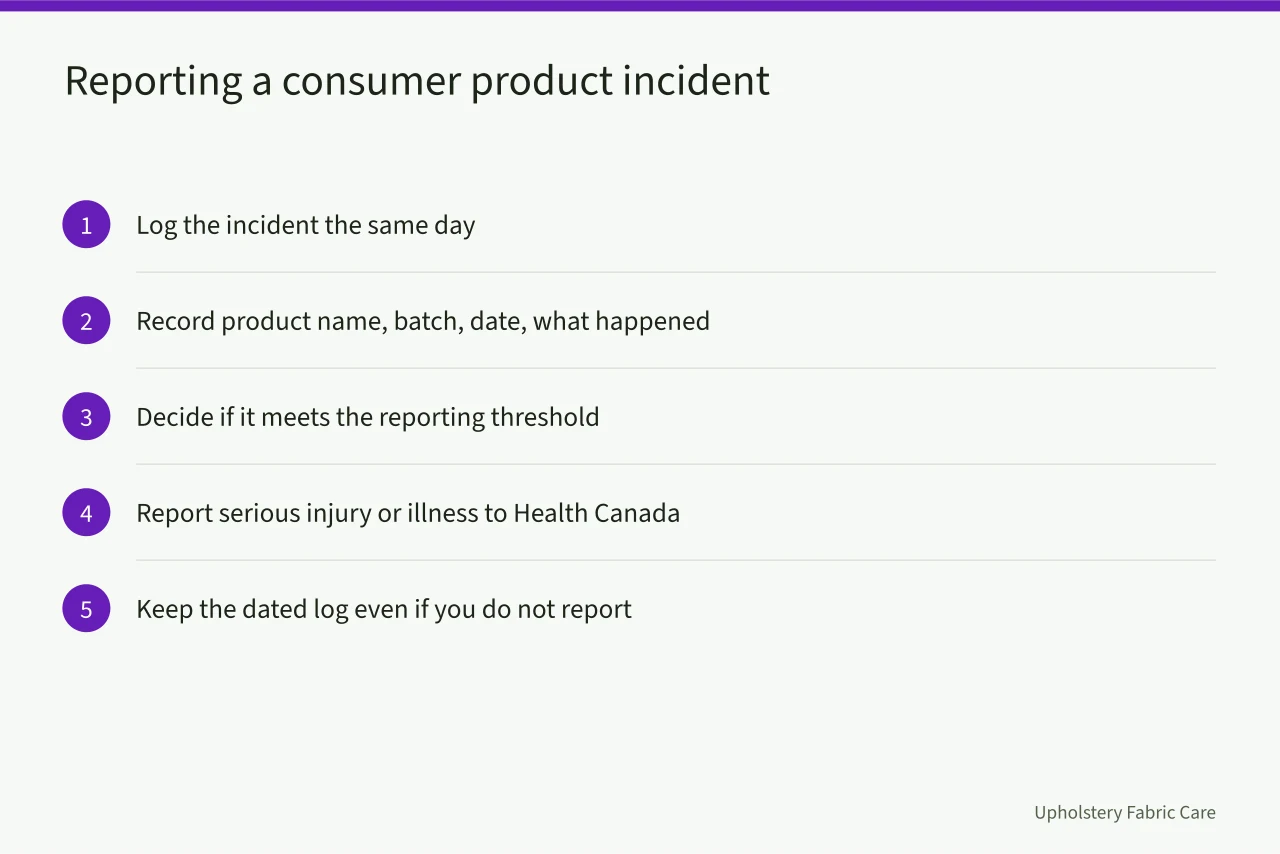
Set up a simple internal path. Anyone who hears about an incident logs it the same day, with the product name, batch, date and what happened. Then decide whether it meets the reporting threshold.
Keep the record even if you decide not to report. If Health Canada asks later, a dated log shows you took the matter seriously.
Retailers and resellers are not automatically off the hook. Put your own brand on the product and you are the seller for reporting purposes.
Building a label and SDS binder for a cleaning van
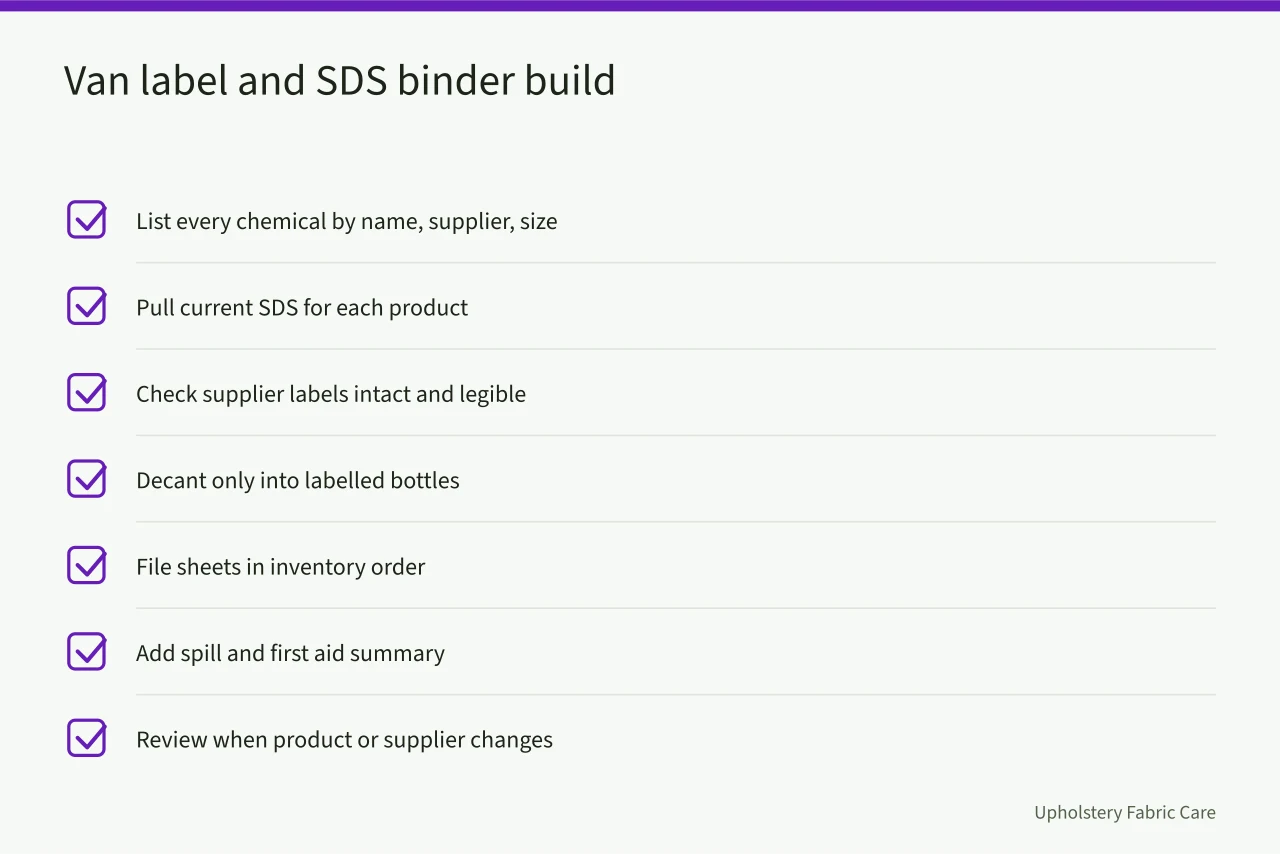
A van binder is the cheapest compliance tool you will ever build. It takes an afternoon and it answers most questions an inspector or a client will ask.
Start with a product inventory. List every chemical on the van by product name, supplier and container size. This becomes the index for everything else.
Printed labels or durable stickers hold up better in a hot van than a marker scrawl that wears off.
Keep the binder bilingual where your crew or clients need it. Quebec operations in particular should not assume English-only labelling is enough.
Your carpet cleaning equipment checklist should list the binder, the labels and the spill kit alongside the wand and the extractor. They are working equipment.
Review quarterly. Suppliers reformulate, sheets expire, and new products arrive without anyone updating the file.
The US equivalents to check at home
A US cleaning business meets the same two streams with different enforcers. Workplace labels and safety data sheets come from OSHA's Hazard Communication Standard, 29 CFR 1910.1200, which uses the same GHS pictograms and signal words that WHMIS uses. Consumer products fall under the Consumer Product Safety Commission and the Federal Hazardous Substances Act, which requires cautionary labelling on hazardous household chemicals, with child-resistant packaging added by the Poison Prevention Packaging Act.
A cleaner that claims to disinfect, sanitize or kill pests moves to the Environmental Protection Agency, which registers antimicrobial pesticides under FIFRA. Your state or city business licence, your permits and your inspections sit on top of all of it, and none of them replaces a compliant label.
Common questions
Do I need a WHMIS label on a spray bottle I mix myself?
Yes, if the product is hazardous. Once it leaves the supplier container, it needs a workplace label with the product identifier, safe handling information and a reference to the safety data sheet.
Do consumer labelling rules apply if I only sell to other businesses?
No. Products sold only into workplaces fall under WHMIS, not the Consumer Chemicals and Containers Regulations, 2001. If you also sell to homeowners, the consumer rules apply to those sales.
How often do safety data sheets need updating?
There is no fixed calendar. You must have a current sheet for each product, so replace them when the supplier issues a new version or when you change products.
Who enforces chemical labelling in a cleaning business?
Provincial workplace regulators such as WorkSafeBC and Ontario's labour ministry enforce WHMIS duties. Health Canada handles consumer product labelling and incident reporting.
Can I keep safety data sheets on a phone instead of paper?
Yes, as long as workers can reach them during the shift. The requirement is accessibility, not paper.