
Rules
Agency licensing and SEC disclosure review: two rulebooks
Agency licensing and SEC disclosure review: two rulebooks. Strategy blueprints for business registration, renewal calendars and claim review.
What to take away
- These strategy blueprints start with the licensean agency needs its own business license, and a public client's copy can still pull the agency into disclosure review.
- The license comes firstentity registration, a general business license, and any city or state permit tied to the work.
- Renewal dates are set by the licensing body, so build a calendar rather than trusting memory.
- Factual claims in client copy, such as rankings or growth numbers, need a named reviewer before publication.
- Keep one owner for final clearance and one written record per asset.
Two rulebooks, one agency
An agency in the United States answers to two sets of rules at once. The first is licensing: the city and state permissions that let the business operate. The second is disclosure, which arrives through the client.
A note on wording: public clients here means publicly traded clients, not public-sector buyers. The disclosure layer comes from the securities side, not from procurement.
A public company reuses marketing language in filings. A tagline written on Monday can appear in a quarterly report by Friday. That is how agency work inherits a compliance layer it never asked for.
Licensing is the part the agency controls directly. It is also the part most often neglected, because it looks like paperwork rather than client work.
Where an agency's licensing duties start
Start with the entity. A limited liability company or corporation registers with the state where it is formed. That registration is not a license to trade.
Next comes the general business license, issued by the city or county where the office sits. Requirements vary by jurisdiction, and how a city classifies advertising or consulting work decides whether a separate permit applies.
New York City, for example, lists business licenses and permits through its Department of Consumer and Worker Protection, which licenses more than 45,000 businesses in over 45 industries. The NYC business licenses overview is the starting point for checking what a Manhattan or Brooklyn office needs.
Agencies with staff in Canada face a similar split. The federal Canada Business permits and licences page links to provincial and municipal requirements, including Vancouver.
Renewal dates and the calendar
License terms are fixed by the issuing body, not by the agency. Some run one year, some two.
New York City shows how concrete those dates become. DCWP mails a renewal package approximately three months before a license expires, and the license must be renewed before it expires to keep operating and avoid fines.
A workable calendar lists four fields per license: issuer, license number, renewal date, and the name of the person who renews it. Anything less gets missed.
Treat the calendar as a live document. When the office moves or a new service line starts, the license list changes with it. For a wider look at how these schedules decay, see why compliance calendars go stale.
Where disclosure rules enter agency work
Disclosure rules govern what a public company tells investors. In the United States the authority is the Securities and Exchange Commission (SEC), and under Regulation S-K the standard for what must be disclosed is materiality. Agency copy becomes part of that system when the client repeats it in a quarterly report on Form 10-Q or an annual report on Form 10-K, and the risk sits in specifics: numbers, rankings, dates, and promises.
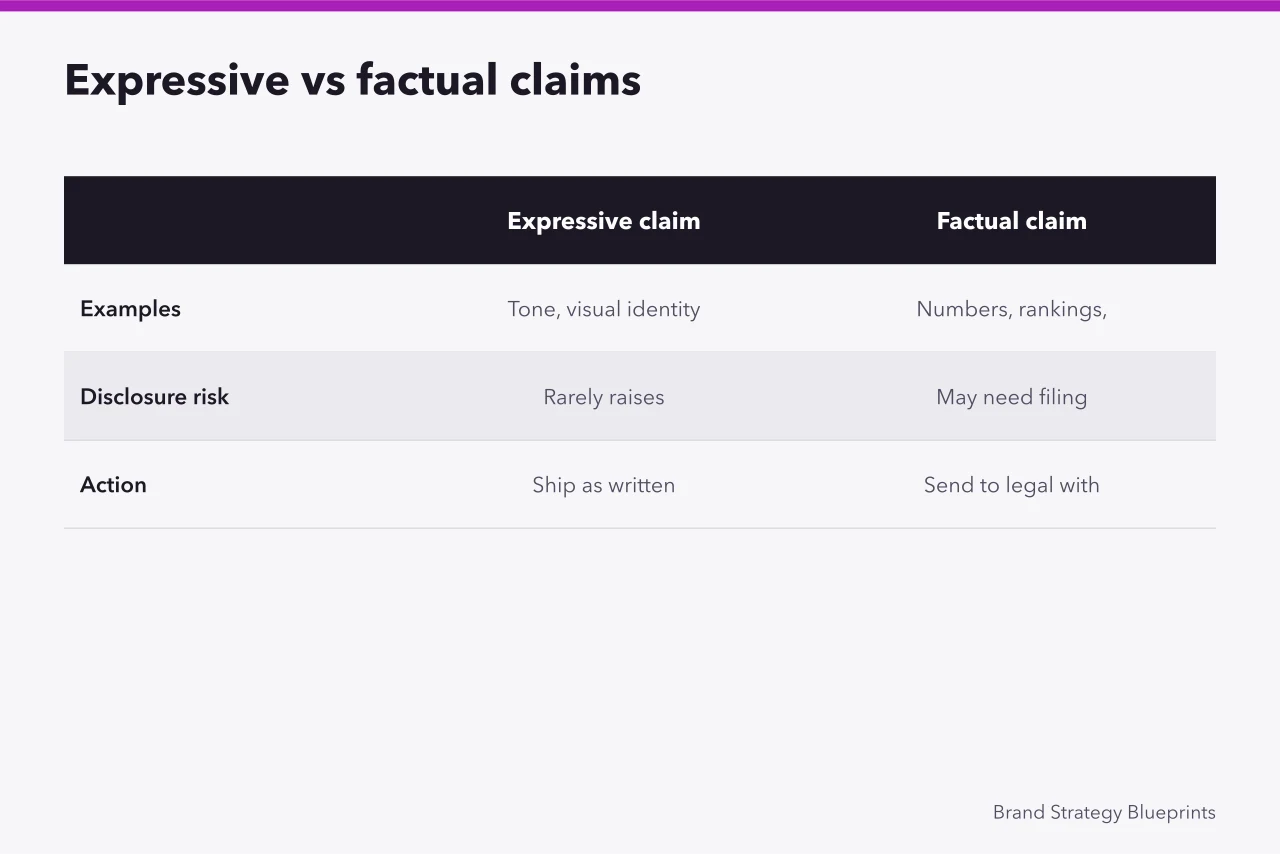
A claim like fastest growing platform in its category is a factual assertion. A tone or a visual identity usually is not. Sorting claims this way takes minutes and prevents most escalations.
Forward-looking statements need the same treatment. A launch date or a growth target implies future performance, so it waits for the client's legal or investor relations contact.
Work on an unreleased earnings campaign can also put agency staff near material nonpublic information, where the client's trading rules apply. Under the Exchange Act, Rule 10b5-1 offers a defense from insider trading liability under Rule 10b-5.
Example: two sign-off workflows
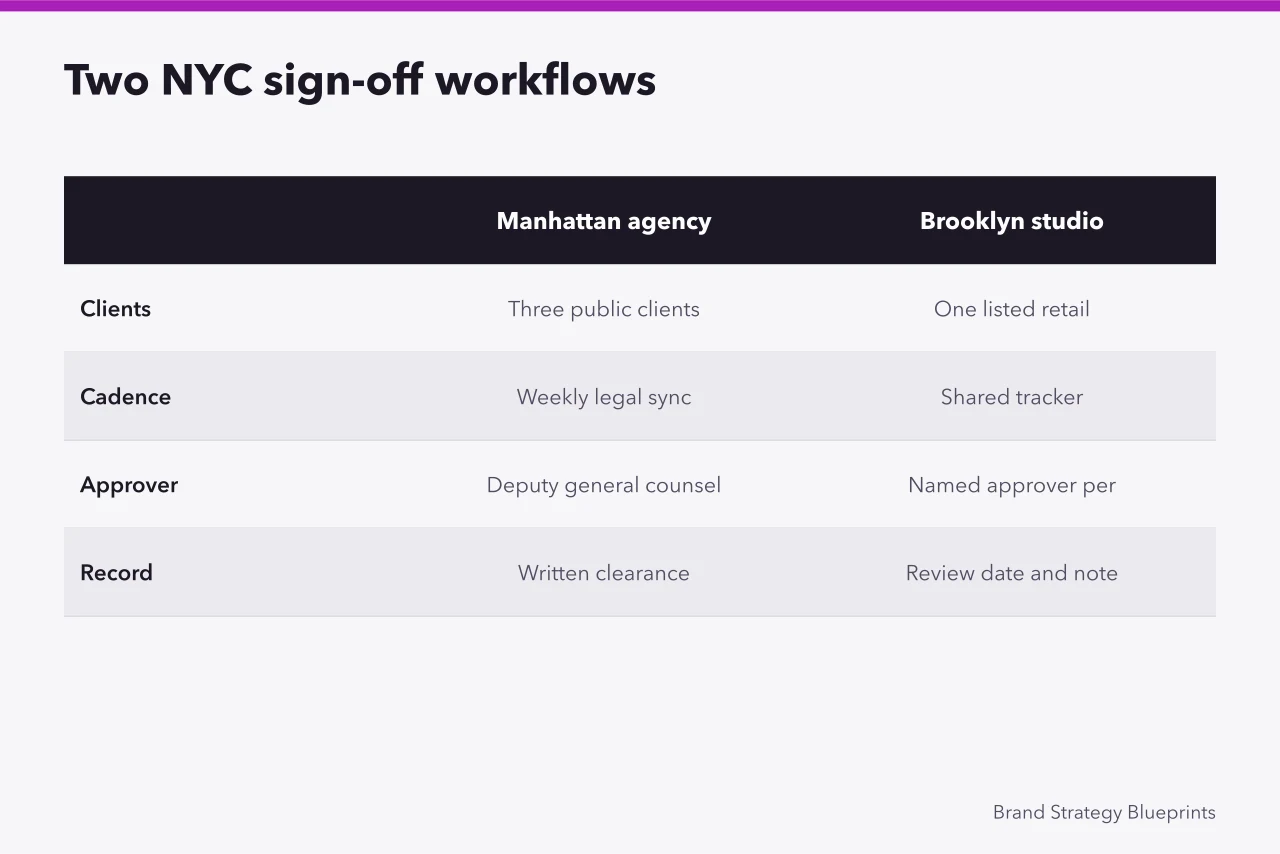
Example one: a mid-size agency with three public clients runs a weekly legal sync. Every deliverable carries a status label, and factual claims queue for the client's deputy general counsel.
Example two: a smaller studio serving one listed retailer uses a shared tracker. Each asset has a named approver, a review date, and a note on whether the claim looks forward.
Both share one feature. A single person owns the final clearance decision, because diffuse approval is where mistakes hide.
Records, contracts and client data
Contracts should name who reviews claims and how fast. A review window of two business days is common. Silence should never count as approval.
Keep one version record per asset. The record shows what was approved, by whom, and when. That file is the agency's defense if a claim is questioned later.
Client data adds another layer. Campaign lists and audience files fall under privacy rules, and the provincial patchwork differs from the federal baseline. Provincial privacy rules for campaign data explains how PIPEDA, Quebec Law 25 and Alberta PIPA diverge. Each has its own regulator: the Office of the Privacy Commissioner of Canada for PIPEDA, the Commission d'accès à l'information for Quebec Law 25, and the Office of the Information and Privacy Commissioner of Alberta for provincial PIPA.
Smaller shops can start with a one-page checklist: license current, claim tagged, reviewer named, record saved.