

Costs
License Compliance Consent Order Duties and Steps
A license compliance consent order sets duties, dates and evidence. Here are the steps from citation to signature and the duties that follow.
What to take away
- A license compliance consent order is a contract with a regulator. It sets duties, dates and evidence, not only a fine.
- The fine, where one applies, comes from the licensing statute and the agency's penalty schedule. It is a single line in the budget.
- One-off lines buy readiness. Recurring lines buy proof that the controls still hold.
- Illustrative program costs for one two-year cycle run from 80,000 to 565,000 USD, penalty excluded, with each recurring line counted in every reporting period the order names.
- Read the order itself before any summary. Summaries drop dates and scope.
What a business license consent order requires
State licensing agencies settle most disciplinary cases before a hearing. The authority is the administrative procedure act that governs the agency — a state APA such as New York's State Administrative Procedure Act, or California's Administrative Procedure Act (Government Code section 11500 et seq.) for boards such as the CSLB — together with the licensing statute, the agency's own hearing rules and, for city agencies, the local administrative code. The order that follows is a working document. It names a compliance period, a monitor or self-reporting, a report frequency and a records duty.
Retention is the duty that outlives the order. Defined retention rules and audit logs cut the rebuild later, as this review of document management software for law firms explains.
The New York City Department of Consumer Affairs lists the licenses it issues and the hearing route a violation follows (NYC business licenses); licensing cases are heard by the city's central tribunal, the Office of Administrative Trials and Hearings (OATH), under the New York City Administrative Code. That page is the fastest read on what a stipulation looks like in practice.
The duties an order actually names
- A compliance officer or responsible party.The order names one person, with a title and a contact point, who answers for the program between reporting dates.
- Monitor or self-report.Some orders install an approved third-party monitor; others accept self-reporting, usually with an officer's certification attached to each submission.
- Report frequency.Monthly, quarterly or annual reports, each tied to the period it covers and to a fixed filing date.
- Certification form.Most orders require the agency's own form, signed by an officer, stating that the report is complete and accurate.
- Records.Which documents, in what form and for how long the order requires them to be kept. The period is set in the order and in the agency's records rule.
- Compliance period.The length is written in the order, and a new finding can restart it.
- The file.The signed order and each report go into the licensee's record at the agency, which is what an inspector or renewal reviewer reads at the next review.
The route from citation to signed order
- Read the accusation or citation in full, including every exhibit.
- Map each alleged violation to the section of the license code it names.
- Ask the agency for its standard settlement terms before you counter.
- Turn each duty into a calendar entry with an owner and a date.
- Sign only when every duty has a budget line behind it.
The date on the citation controls the response, not the day you opened the envelope. Miss it and the agency decides on its own terms.
Cottage food sits outside this route in some states. Florida exempts certain home bakeries from a permit while capping annual sales (FDACS cottage food). The sales cap and the product list decide whether the exemption still applies, as this guide to the home bakery license in Florida explains.
Line by line: what each duty costs
Each duty in the order becomes a cost line. The ranges below are planning placeholders for a mid-size US operator, not quoted market rates; build the real numbers from your own counsel, auditor and vendor quotes.
| Cost line | Basis | Illustrative USD |
|---|---|---|
| Counsel review of the order | One-off | 8,000 to 30,000 |
| Records and evidence rebuild | One-off | 15,000 to 90,000 |
| Independent compliance audit | Recurring, every two years | 25,000 to 150,000 |
| Quarterly reports and owner certification | Recurring, yearly | 12,000 to 45,000 |
| Customer notice, retraining and remediation | One-off | 20,000 to 250,000 |
One-off lines buy readiness: a legal read, a records index, a customer notice. They are paid once and stop.
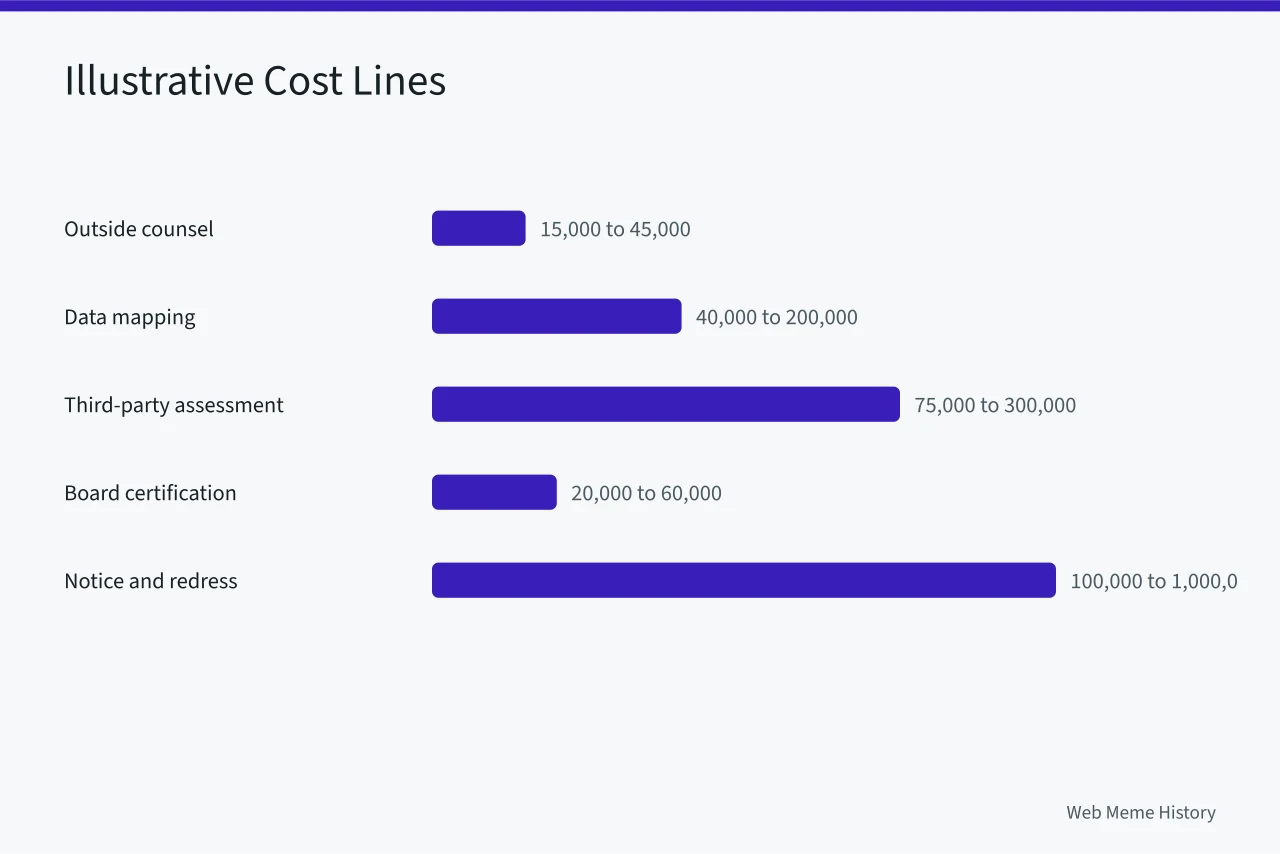
Recurring lines buy proof, in every period the order names, that the controls hold. An agency reviewing a renewal reads the report history, not the invoices.
Example: a two-year plan for a contractor
Year one carries counsel, the evidence rebuild and the first audit. Year two carries the reports and a training refresh, plus any repair a finding demands.
Orders usually name a review period. A finding can reset the clock, so the second audit gets booked before the first one closes.
A monitor costs more than a self-report. Most orders let the agency pick which one applies, so assume the monitor.
The CSLB publishes the exam and fingerprinting steps an applicant clears before a license issues (CSLB applicants). That same file is what an order later inspects.
Repairs need evidence, not assurances. Photographs, invoices and sign-off sheets are what an agency reads at the next reporting date.
Filing cleanly the first time avoids much of the second-year cost, as this walkthrough of a California contractor license application sets out.
A consent order is an operating manual with a regulator attached. The fine is the entry fee; the manual is the rent.
Where the budget leaks
- Records pulled by hand, one custodian at a time
- Audit window booked late, at a premium
- Findings left open past the date written into the order
- Training repeated because completion records were never filed
Leaks rarely come from the headline lines. They come from routine work nobody owns. The fix is a calendar with dates, owners and evidence attached to each duty.