
Guides
Toronto salon licensing and WSIB coverage, a practical overview
Nail salon operations in Toronto need a Municipal Licensing and Standards licence, zoning clearance and WSIB coverage, taken in the right order.
What to take away
- A City of Toronto personal service licence is issued to the address, not to you, so moving the salon means a new application.
- Zoning decides whether the address can host a salon at all. Check it before you sign a lease, because a minor variance adds months.
- WSIB registration is triggered by hiring, and a clearance certificate is what landlords and commercial clients ask to see.
- The Employment Standards Act and the Occupational Health and Safety Act apply to your staff whether or not your licence is current.
- Keep licence, WSIB, payroll and inspection records in one binder and one folder, updated the day something changes.
What Municipal Licensing and Standards requires
Municipal Licensing and Standards licenses and inspects personal service businesses in Toronto, and a nail salon sits in that group. The rules are in Toronto Municipal Code Chapter 545, Licensing, Article XLIV, Personal Services Settings, which defines personal services to include manicure and pedicure, alongside aesthetics, hairstyling and electrolysis. The licence attaches to the premises. If you move two blocks, you are applying again.
Register the business name if you trade under one. Incorporate and the corporation holds the licence, though the City still wants the operator named on the file. A sole proprietor can hold it personally.
Toronto Public Health inspects separately, for infection control and sanitation. Two inspectors, two sets of findings, one address.
Work through the nail salon licences and compliance sequence before you commit to a unit, because zoning and health review routinely outlast the licence itself.
A personal service licence is not the whole paper trail. A sign permit covers storefront changes, and recorded music played commercially needs its own licence.
Sort the permits a nail salon needs by which level of government issues them. City permits and provincial registrations move at different speeds, and mixing them up is the usual cause of a delayed opening.
Renewal and the inspection sequence
The City's Personal Services Settings licence page lists a non-refundable application fee of $211.73, due with a complete application, and a licence fee of $239.18, due on approval, for a total of $450.91. The licence expires annually on the anniversary of the date it was first issued, and the renewal fee is $296.45. The underlying fees sit in the City's fees and charges schedule, Municipal Code Chapter 441, which is revised most years, so check the page before you budget.
Applying before you operate usually costs less than being found open without a licence. Inspection fees can be added on top, so the licence fee is not always the final bill.
Renewal is annual. The City mails a notice; the duty to renew is yours, and a lapsed licence reads the same as no licence to an inspector.
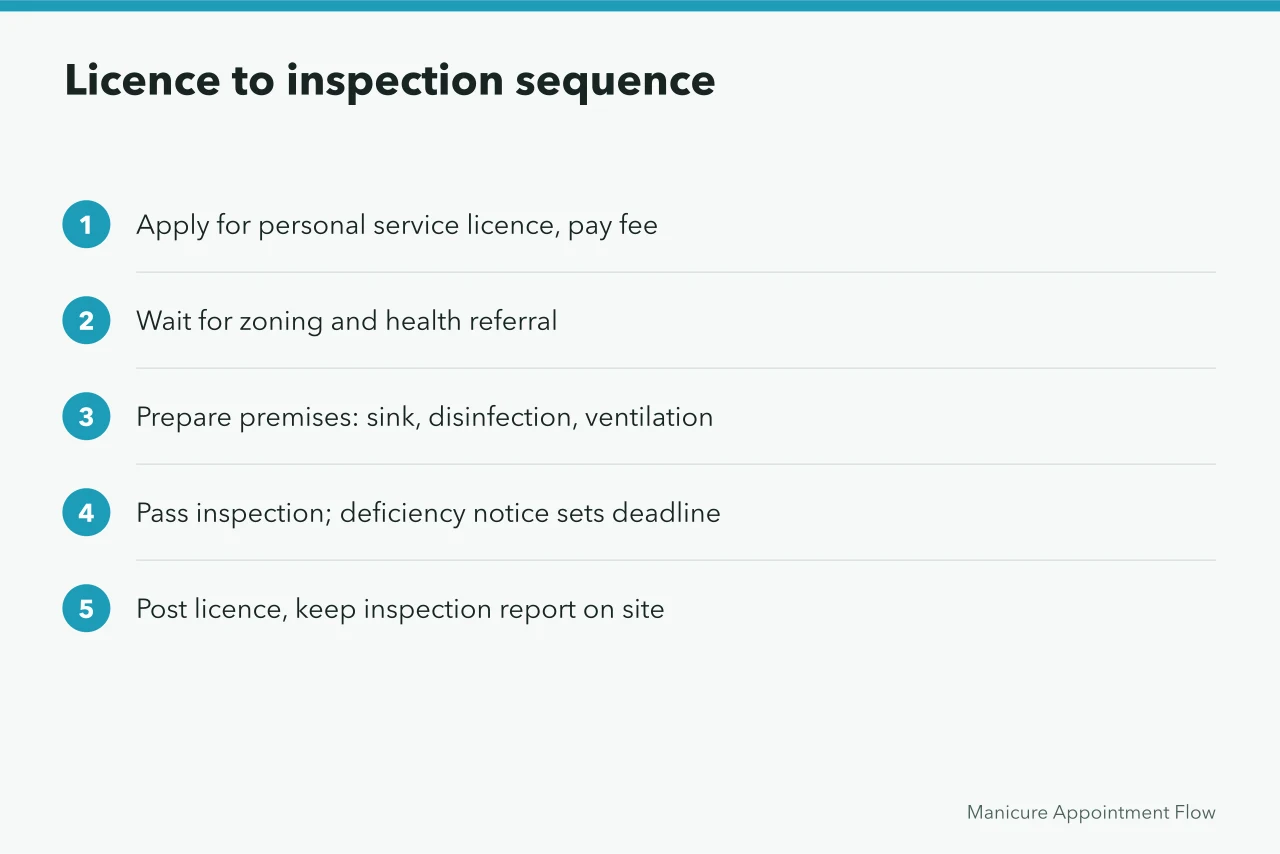
The sequence usually runs like this.
- Apply for the Personal Services Settings licence online or at the Licence and Permit Issuing Office, 850 Coxwell Avenue, with the Occupancy Declaration Form, the Operating Information Questionnaire and the Personal Service Settings Owner Declaration Form, then file the receipt and application number.
- Wait for the zoning and health referral. MLS may pass your file to Toronto Public Health and to zoning staff.
- Prepare the premiseshand wash sink, disinfection area, ventilation, waste handling.
- Pass the inspection. A deficiency notice sets a deadline, and the clock starts when it is issued.
- Post the licence where clients can see it and keep the inspection report on site.
A failed inspection is recoverable. A second failure, or an ignored deficiency notice, can bring charges under the licensing bylaw. Correct in writing and keep the proof.
Run a nail salon compliance checklist before the visit so the inspector is confirming your work rather than finding it.
Zoning decides the address before the lease does
Toronto's city-wide zoning bylaw, Zoning By-law 569-2013, separates commercial, mixed use and residential zones, and a nail salon is not permitted everywhere. Mixed use and commercial corridors often allow personal service shops, sometimes as of right and sometimes with conditions.
Purely residential zones generally exclude the use unless the address already carries a commercial permission or holds a minor variance.
Frontage and floor area limits matter too. Some zones cap the storefront width, the seat count, or the share of ground floor given to personal services, which can fail a large salon in a small strip.
Parking minimums can rule out a unit with no rear access. Confirm the zoning for the exact address before signing. For a salon in your home, the City asks for Zoning approval before you request the health inspection or apply for the licence, and its Zoning Review for Business Licence confirms the use for a fee. A borderline address can go to the Committee of Adjustment, but that route costs months.
Toronto rewards salons that get nail salon workflow and operations right from the first week, and that starts with a location that is legal for the use.
WSIB coverage and who counts as a worker
WSIB coverage is mandatory in Ontario for most businesses once they employ workers. The Workplace Safety and Insurance Act sets the framework and WSIB administers it.
Contractor arrangements are where owners get caught. If someone works only for you, on your equipment, at hours you set, WSIB can treat them as a worker no matter what the contract calls them.
Register within 10 calendar days of the day you hire your first employee. You report payroll, pay premiums, and your rate follows your rate group and claims history.
The WSIB guide for new businesses sets out the routine. Premium rates are based on the shared risk profile of all businesses in your class and on your own risk within that class. Payroll, called insurable earnings, is reported before the premium is paid, and you must report even if your payroll is zero. Most newly registered businesses that need a clearance certificate at registration make an initial advance payment of $250, credited to future premiums. Changes in ownership, name, address or type of work go to the WSIB within 10 calendar days, and an injury that needs treatment or costs time off is reported within three business days of learning about it.
A clearance certificate proves the account is in good standing, and landlords and commercial clients ask for one. A clearance is created automatically while payments and reporting are up to date, and you can request one through WSIB online services. Keep it current rather than requesting it under deadline.
Report a workplace injury to WSIB and cooperate with return to work. A salon with a written return to work plan moves through a claim faster than one that improvises.
WSIB is not nail salon insurance coverage. General liability, property and business interruption sit with an insurer, and most salons carry both.
Employment standards and health and safety duties
A Toronto licence says nothing about how you employ people. The Employment Standards Act sets minimum wage, hours, overtime, breaks, vacation pay and termination notice for salon staff.
The Employment Standards Act guide covers scheduling and split shifts, which salon owners meet constantly.
The Occupational Health and Safety Act requires every reasonable precaution for worker safety. In a salon that means chemical handling, ventilation, acetone storage, and training for exposure.
The Occupational Health and Safety Act guide sets out workplace duties, the right to refuse unsafe work, and when a smaller workplace needs a health and safety representative.
Payroll brings the Employer Health Tax. Ontario's Employer Health Tax exemption is currently $1 million of annual Ontario payroll, and no exemption can be claimed once the associated group's payroll is over $5 million, so model it before you set commission rates.
The federal Business and industry hub gathers GST/HST registration and payroll deduction requirements in one place.
For the statutes themselves, the Justice Laws Website carries the exact wording of federal law.
Records that survive an inspection
Inspections go quickly when the paperwork already sits in one place. Keep a binder and a digital folder with identical contents, and update both the day something changes.
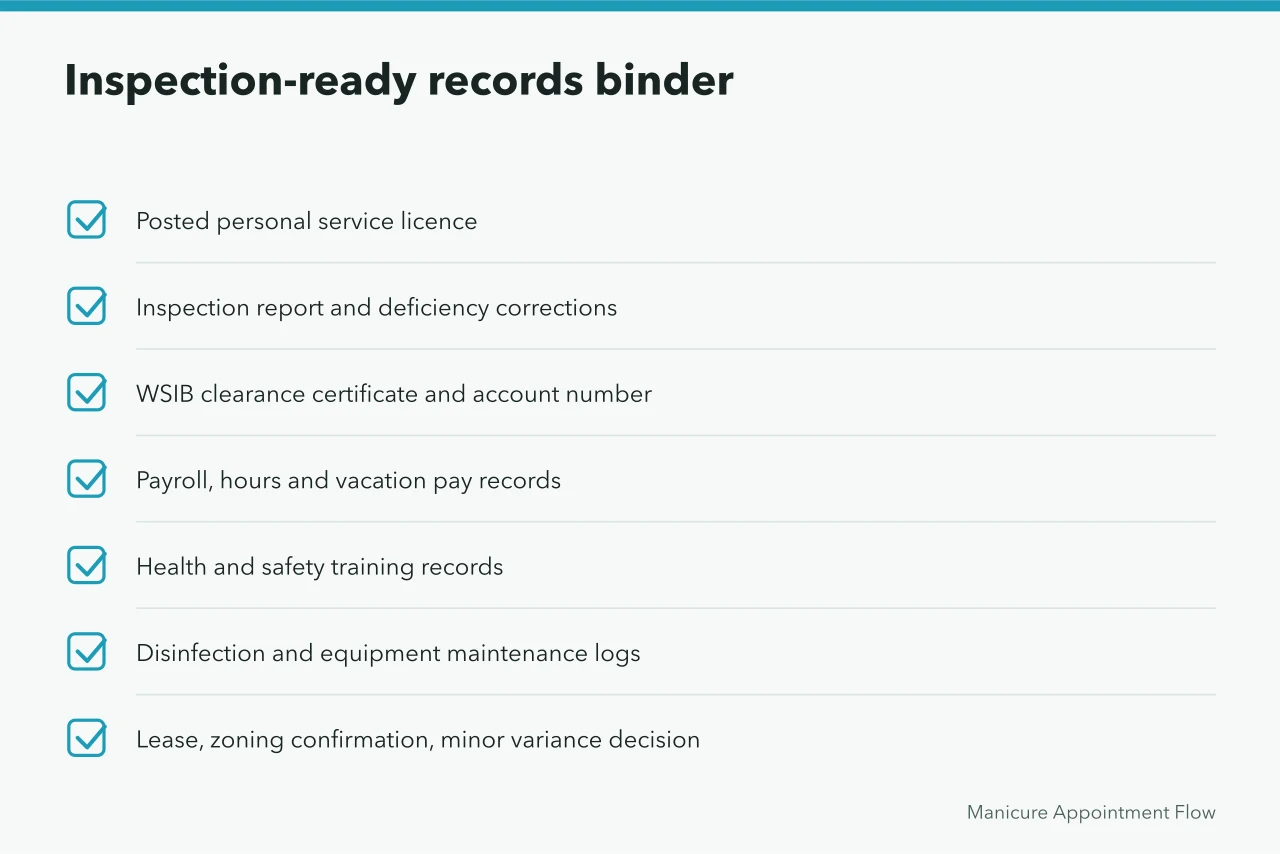
- Current personal service licence posted where clients can see it.
- Latest inspection report and any deficiency notice with proof of correction.
- WSIB clearance certificate and account number.
- Payroll records, hours worked and vacation pay calculations for the year.
- Health and safety training records and your representative's name.
- Disinfection logs and equipment maintenance records.
- Lease, zoning confirmation and any minor variance decision.
Hold records for the period the law requires. Employment records run several years and WSIB records have their own retention rule, so shred on a schedule, not on a hunch.
When staff change, update the WSIB payroll estimate and the employment records together. The missed update is what turns a routine visit into a penalty.
Common questions
Do I need a City of Toronto licence to run a nail salon?
Yes. Municipal Licensing and Standards issues a personal service licence for the location, and it renews annually. The licence follows the address, so a move means a fresh application.
Is WSIB coverage mandatory for a Toronto nail salon?
For most salons with employees, yes. Register once you hire, report payroll, and keep a clearance certificate on file for landlords and commercial clients.
Can I open a salon in a residential zone in Toronto?
Usually not. Personal service uses generally sit in commercial and mixed use zones, so confirm the zoning for the exact address before signing a lease.
Does a licence cover employment standards and health and safety?
No. The Employment Standards Act and the Occupational Health and Safety Act apply separately, and holding a current licence does not replace either duty.