Rules
Hospitality Property Requirements to Verify Before Leasing
Hospitality property requirements vary by address. Verify occupant load, local approvals, lease conditions, and required documents before signing.
Hospitality property requirements for a restaurant, bar, or venue start with how many people may be inside at once. The building official determines that figure, the occupant load, from the floor plan and the applicable local code.
It drives exits, restrooms, ventilation, sprinklers and license conditions. Design the room before you know the number and you will design it twice.
A hospitality opening can involve the local authorities responsible for zoning, building, food safety, fire, alcohol, and entertainment or noise, plus the landlord. Which offices apply depends on the operation and address; each handles separate approvals, so ask each directly what it requires.
What to take away
- Get the occupant load determined early. Most of the physical requirements follow from it.
- List every authority with a say over your address, what each decides, and what each needs from you. Then sequence them.
- The use table for the address and the licensing rules for your operation are local. Ask the offices, in writing, before the lease binds you.
Everything starts from the occupant load
Ask an architect or the building department, early, what occupant load the space would support with your intended layout. Request the calculation and the locally adopted code provision in writing. There is no single nationwide square-foot-per-person ratio for every hospitality room: use classification, room use, and layout matter. Ask how the official treats each distinct area, including whether the floor area is counted as net or gross.
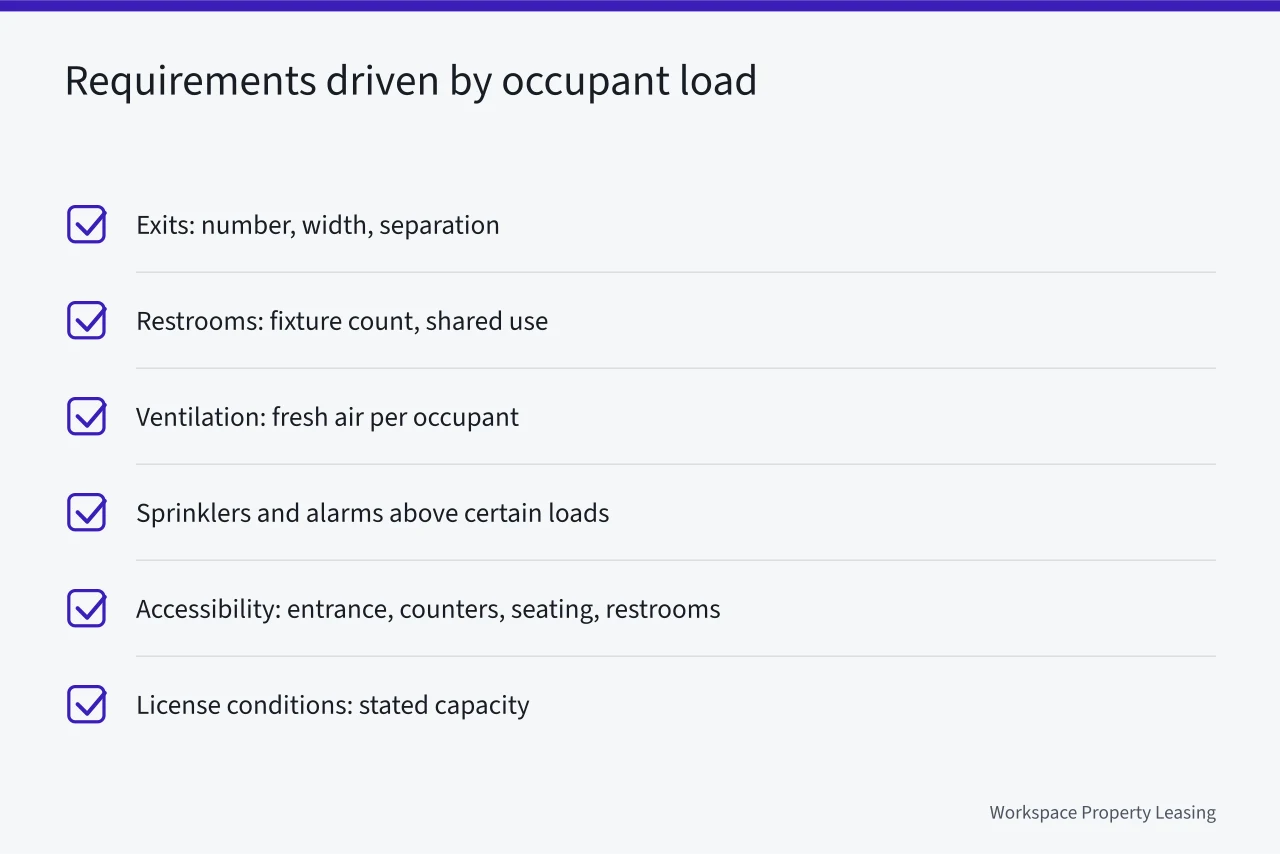
- Exits.The number, width, and separation of exits depend on the load. Depending on local adoption, requirements may draw on the International Building Code (IBC) and the National Fire Protection Association's Life Safety Code. A room that seats what you hoped may need a second exit the unit does not have.
- Restrooms.The count of fixtures, and whether customers and staff can share them, is set by the load and by the local code.
- Ventilation.Fresh air for the dining room is calculated per occupant. Extract for the kitchen is calculated from the cooking line. The National Fire Protection Association's Standard for Ventilation Control and Fire Protection of Commercial Cooking Operations may apply to kitchen exhaust and fire protection. Confirm the locally adopted requirements and how supply air must balance with exhaust.
- Sprinklers and alarms.Above certain loads, or for certain uses, the fire code requires systems the shell may not have. Ask the local fire authority which adopted code provisions apply.
- Accessibility.The Americans with Disabilities Act (ADA) applies to public accommodations. The U.S. Department of Justice enforces federal ADA requirements, while local building officials review accessibility provisions in construction under adopted building codes. Entrance, circulation, counters, seating, and restrooms must work for customers with disabilities, and obligations shared between landlord and tenant should be written into the lease.
- License conditions.Alcohol and entertainment licenses are often issued for a stated capacity, which may be lower than the building's load.
If the load the building can support is below what your business plan needs, the site is wrong, however good the street. That is a first-visit question, not a design-stage one.
The bodies that have a say
| Authority | What it decides | What it needs from you | When to ask |
|---|---|---|---|
| Planning or zoning office | Whether the use is permitted at the address, hours, outdoor seating, signage | Description of the operation, hours, seating, any entertainment | Before the offer |
| Building department | Occupant load, exits, structure, permits for the works | Plans, engineer's drawings, contractor details | Before design is fixed |
| Health or food safety authority | Kitchen layout, surfaces, sinks, storage, waste, food handling | Kitchen plan, menu, equipment schedule, process description | Before the kitchen is designed |
| Fire authority | Exits, extinguishing systems, hood suppression, occupancy limits | Plans, hood and suppression details, seating layout | Alongside building review |
| Licensing authority for alcohol | Whether a license will issue for the premises and operator, and with what conditions | Floor plan, ownership details, hours, security plan, sometimes a hearing | As soon as the site is identified |
| Entertainment or noise licensing | Music, late hours, outdoor sound | Description of events and hours, sometimes an acoustic report | With the alcohol application |
| The landlord | Design, hours, exhaust route, roof rights, deliveries | Design package, services plan, insurance | Throughout |
State and local health departments enforce food-service rules, commonly based on the FDA Food Code with local amendments. Ask the health department serving the property which edition and amendments apply, and whether it requires plan review before construction. The FDA Food Code is a model code; do not assume its provisions apply locally without adoption.
Use the planning enquiry to ask the planning or zoning office, in writing, whether your proposed use is permitted and what approval it requires. Make the lease conditional on the required approvals, with an outside date, rather than relying on a verbal assurance.
How to find out what the address permits
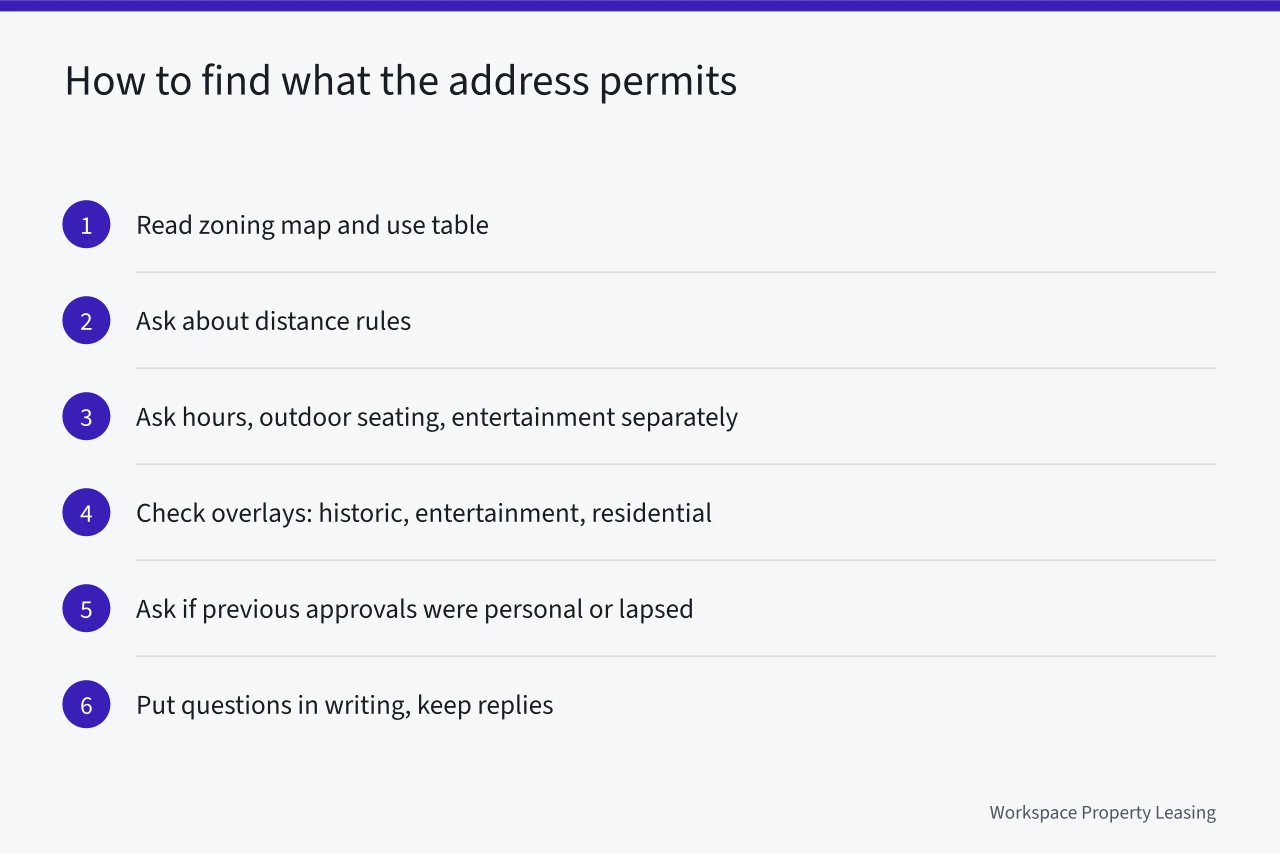
- Send the planning or zoning office the property address and a short description of your proposed operation. Ask whether the use is permitted and whether it requires a hearing, conditional approval, or another local approval; request the answer in writing.
- Give the building department a floor plan showing the intended layout and ask for the occupant-load calculation, applicable adopted code provisions, and building-permit application checklist.
- Contact the health department serving the address before construction. Ask about food-service plan review and what it needs about the menu, equipment, and kitchen layout.
- Ask the local fire marshal or fire department about exits, alarms, sprinklers, and kitchen fire protection. Contact the state alcohol regulator and the local office responsible for entertainment or noise permits if your operation needs those approvals.
- Ask each office which application forms and supporting documents to use, what fees apply, how long its review typically takes, and which approvals must come first. Confirm landlord consent and put unresolved approval requirements into the lease.
If any answer is uncertain when the lease is ready, the lease should be conditional on it with an outside date. A verbal assurance from anyone in the deal is not a substitute.
What the building must be able to give you
For each item in the checklist below, record the responsible official, the locally adopted requirement, the evidence needed to verify it, and whether the landlord or tenant must complete the work. Ask the official to confirm capacity and requirements in writing rather than relying on an estimate.
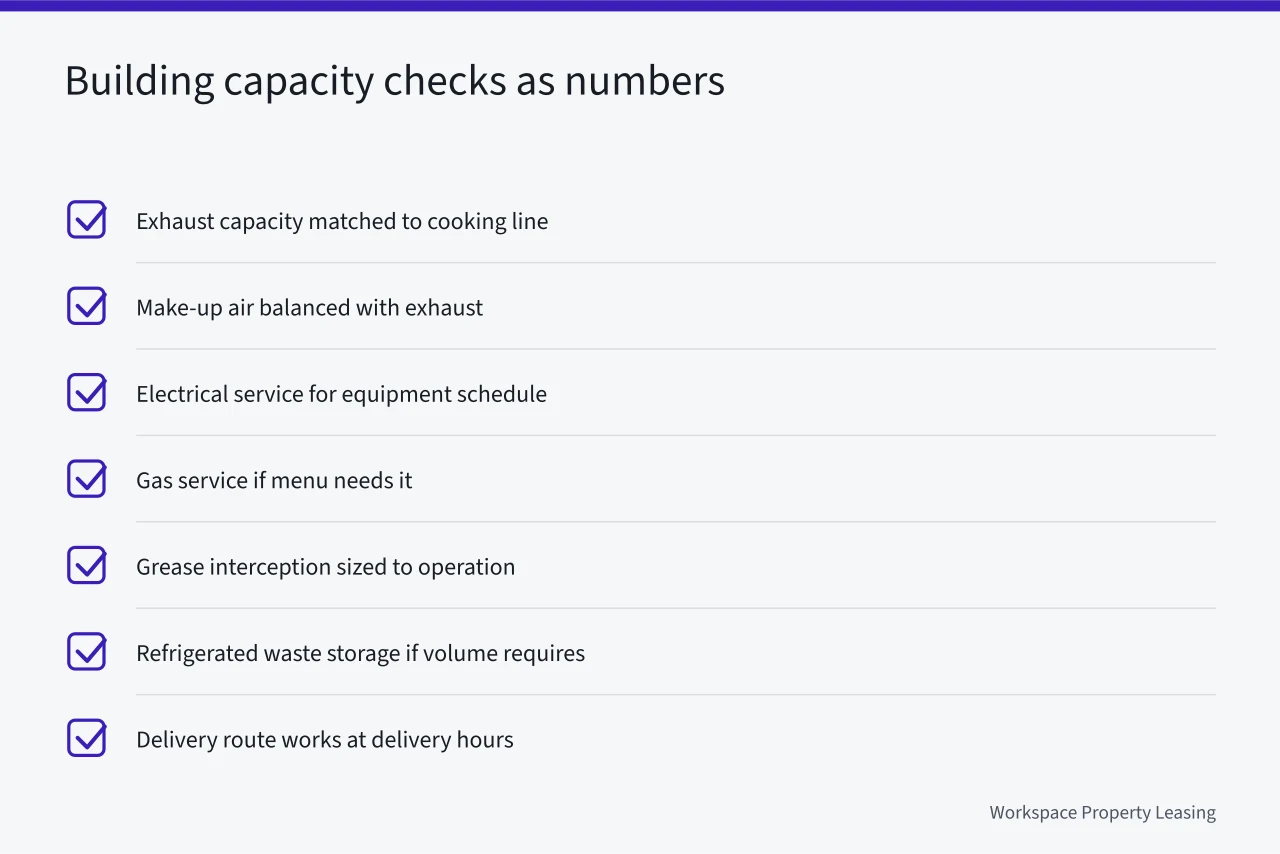
For your cooking line, size exhaust capacity and make-up air to match. Specify electrical service for the equipment schedule, plus gas if the menu needs it. Size grease interception to the operation and refrigerated waste storage if volume requires it, then confirm a delivery route works at delivery hours.
Bring the equipment schedule and the menu to the first visit. An engineer can tell from those whether the shell is capable, and that answer rules sites out before any design fee is spent.
The documents you will be asked for
Prepare these before you make an offer, because several authorities and the landlord will each want a version.
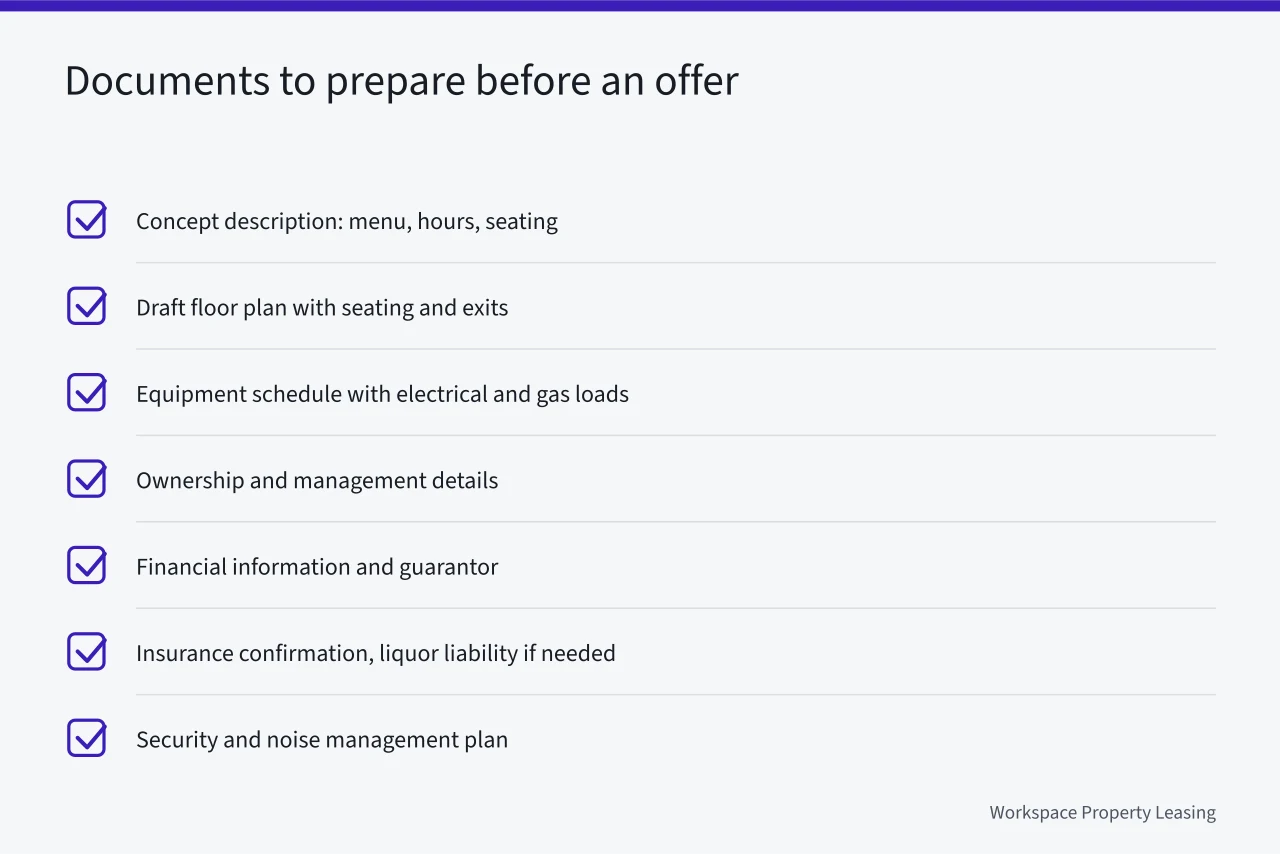
Gather a working document packet before making an offer, then confirm each office's exact requirements. Ask whether you will need:
- The property address and parcel information, plus a description of the proposed use and operating plans.
- A dimensioned floor plan and site plan showing seating, customer areas, kitchen, exits, and proposed occupant load.
- Architectural and building-system plans, including equipment schedules and details for kitchen exhaust, ventilation, and fire protection.
- The proposed menu and food-service plan for health-department review.
- Business and operator information, landlord authorization, and any existing permits, inspection records, or occupancy documents available for the space.
Application forms, required attachments, and fees vary by jurisdiction and approval. Get the current forms and document checklist from the specific city, county, or state office handling each approval.
If the customer-facing site is a shop with limited food preparation rather than a restaurant, ask the health authority which food-service requirements change; do not assume restaurant requirements apply unchanged. Once approvals are clear, put responsibility for required work, access, and approval contingencies into the lease.
Common questions
What is the first thing to ask about a site?
The occupant load it can support with your layout, and whether the exits, restrooms and services follow. If the number is below your plan, stop there.
Do I need the license before I sign the lease?
Ideally, or a lease conditional on it. Licenses attach to premises and operators on a timetable set by the licensing authority, and a lease signed on the assumption that one will follow is the most common way a hospitality business pays for space it never opens.
The last tenant was a restaurant. Which approvals carry over?
Possibly none. Building infrastructure transfers; approvals may be personal, may have lapsed, or may carry conditions from the last application. Ask each authority about your operation at that address.
How many separate applications is a typical opening?
Commonly five or more: planning, building permit, health, fire and licensing, plus landlord consents. Sequence them, because several cannot start until another has finished.