
Rules
Part of Which activities actually trigger a federal license requirement
Federal licenses policy template: a planning outline
This federal licenses policy template is a planning outline for assigning an owner, logging inquiries, and setting triggers; it does not list rules.
A federal licenses policy template cannot tell your business what the law requires. What it can do is decide, in advance, who asks, when they ask, and what happens to the answer. That is worth writing down, because the failures at this layer are almost never disagreements about a rule. They are changes that nobody put to anybody.
Below is a skeleton you can copy into a document and fill in. Square brackets mark the parts only you can supply.
What to take away
- The policy owns your behavior, not the law. It says who asks and when, and states no requirement.
- Name one person. A duty assigned to a department is assigned to nobody.
- The trigger list is the working part. Everything else is scaffolding around it.
- Record answers, including the answers that were "nothing at our level". Those are the ones you will need to prove later.
The skeleton
1. Purpose. This policy sets out how [business name] identifies whether any federal regulator has an interest in what we do, and how we keep that assessment current. It does not state what is required of us. Requirements are determined by the relevant agency and, where consequential, by our counsel.
2. Scope. Applies to [all sites, vehicles, products, and activities], including work performed by contractors on our behalf.
3. Owner. [Named person, role]. Responsible for maintaining the activity description, making enquiries, holding the record, and reporting to [named person] at each review.
4. Our activity description. Maintained as a single document and reviewed at each cycle. It states: what we handle and what it is made of; quantities and the units we measure in; origins and destinations, including any state or national border crossed; how goods move and who is responsible in transit; what we store, in what amounts, and where; what we emit; the claims made on our labels and marketing; whether we ever hold funds belonging to others; and who performs the work.
5. Enquiry procedure. Before any activity in section 4 begins or changes, the owner identifies the agencies whose subject matter it touches, reads their published definitions and exclusions, and puts the described activity to each in writing where possible. The question asked is whether that office has a requirement for the described activity, and what would change the answer. For example, the Alcohol and Tobacco Tax and Trade Bureau (TTB) publishes permit lists under the Federal Alcohol Administration Act, including an Alcohol Importer Permit; use that as a prompt to check whether your described activity needs a federal authorization, not as a conclusion about your business.
6. Record. Every enquiry is logged, whether or not it produced a requirement: office and unit, contact and date, the description given, the answer in the office's own words, the fact the answer turned on, and the event that would change it.
7. Change monitoring. For each regime we fall inside, the owner identifies how that agency announces changes and subscribes to it. Announcements are reviewed at each cycle and assessed for whether they touch our description.
8. Escalation. Legal advice is obtained before acting where: our activity sits near a definitional boundary; a notice, order, or enquiry has been received; an authorization is a condition of a contract, lease, or bond; the answer determines whether an individual carries personal exposure; or a wrong answer would stop us operating.
9. Review. Reviewed on [a fixed date the business already observes], and out of cycle whenever a trigger in section 10 occurs.
10. Triggers. Maintain the change triggers and internal notice points listed below; tell affected staff where to find them.
11. Related policies. [Reference your state, local, and employment procedures. This policy covers one layer of four and substitutes for none of them.]
The trigger list
Put this section on one page and give it to the people who would notice first: operations, purchasing, whoever writes the labels. The Small Business Administration's linked licenses and permits material is a useful prompt for building your own version, because it sorts the question by activity rather than by trade, which is how these triggers behave.
Trigger list: tell the owner before
- New product, material, or supplierbefore it is ordered
- Change in how goods movebefore first shipment
- Any import, however smallbefore order is placed
- Different vehicle size or typebefore it is bought
- New label or marketing claimsbefore anything is printed
- Storing new material or morebefore delivery
- Holding money for othersbefore arrangement starts
| Change | Who usually notices first | Tell the owner before |
|---|---|---|
| New product, material, or supplier | Purchasing or production | It is ordered |
| A change in how goods move, including bringing shipping in house | Operations | The first shipment |
| Any import, however small | Purchasing | The order is placed |
| A vehicle of a different size or type | Fleet or the person buying it | It is bought |
| New or changed label and marketing claims | Marketing | Anything is printed |
| Storing a new material, or more of an existing one | Site management | Delivery |
| Any arrangement where we hold money for someone else | Finance | The arrangement starts |
| Equipment that transmits, discharges, or emits | Whoever specifies it | Installation |
The column that does the work is the last one. A trigger reported after the fact is a report, not a control.
Filling it in without inventing anything
Two rules keep this document honest.
Write the question, not the requirement
Write this
- Requirement
- The question and the office
- Dates
- Pointer to agency page
- Review dates
- Your own chosen dates
- Source
- Issuing body
Not this
- Requirement
- What is required
- Dates
- Unconfirmed date
- Review dates
- Agency-set cycles
- Source
- Policy text
Never write a requirement into the policy. Write the question and the office. The moment a policy says what is required, it becomes a source people rely on instead of asking, and it goes out of date silently while looking authoritative.
Never write a date you have not confirmed. If a cycle is set by an agency, write the pointer to the agency's page and the fact the owner checks it. Your own review dates are yours to choose and belong in the document. Anything else belongs in compliance calendars, sourced from the issuing body.
What this policy does not cover
One layer only. State, county, and city layers each need their own procedure, owner, and trigger list. None of the four checks the others, so approval at one is not evidence at another.
Four layers, four separate procedures
Federal
- Procedure
- One layer only
- Owner
- Named in this policy
- Trigger list
- This document
- Cross-check
- None
State, county, city
- Procedure
- Each needs its own
- Owner
- Separate owner each
- Trigger list
- Separate list each
- Cross-check
- None
The federal licenses overview explains why the federal layer behaves differently once you are inside a regime, and license fundamentals sets out the structure of the other three.
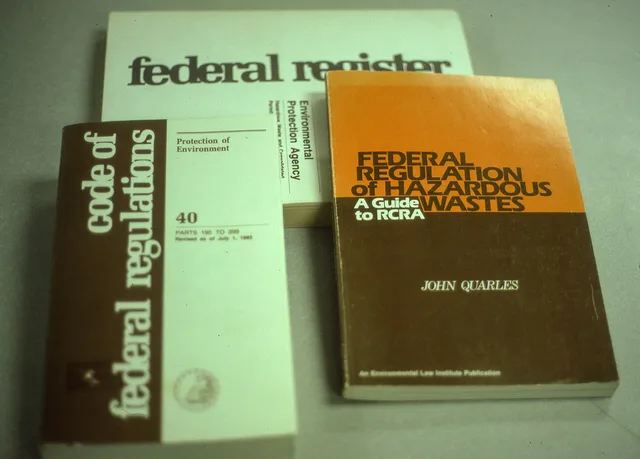
It states no requirement, no threshold, and no consequence. Where a federal regime applies, consult the Code of Federal Regulations (CFR) for its text and record the edition's currency date; agency materials can help explain how that rule applies.
Contractual obligations to customers sit on top of that and belong in a separate contract-and-liability review: a promise about your own compliance status can create legal exposure.
Common questions
Is a policy like this worth having for a business with three people?
The trigger table is, and it fits on a page. The rest can be two paragraphs. The value is that somebody notices before the van is bought, not after.
Should the policy name the agencies we deal with?
Keep the current list of agencies in the record, where it can be updated. The policy can still include a named worked example, like the TTB permit example above, as long as it is clearly illustrative rather than a determination that a permit applies.
Who should own it?
Somebody close to operations, not the most senior person available. The owner needs to hear about a new supplier in the ordinary course of their week.