Costs
Part of Which activities actually trigger a federal license requirement
Federal licenses: rule text, guidance or a phone call?
Federal licenses answers come from three sources of unequal weight: rule text, agency guidance and a phone call. Which to rely on, and what to write down.
Rule text governs, agency guidance explains the agency's position, and a phone call is a lead. When the three seem to disagree, follow that order of authority, and write down which of them you relied on and when.
The hard part at the federal level is working out which agency has the rule, because there is no front door and no directory that maps your trade to your regulator. Once you have an office, the question becomes which of its answers to trust.
What to take away
- Rule text is what applies. It is the hardest to read and the only one of the three that governs.
- Agency guidance is written for non-lawyers and shows how the agency reads the rule. It is the agency's position, not the law itself.
- A person on the phone can tell you which regime your activity falls under. What they say is not binding, and staff change.
- Record every answer with who gave it and when. An undocumented phone call is not evidence of anything a year later.
Three kinds of federal answer
Federal material gets treated as interchangeable when it is not. Use all three, in order of authority, and treat the phone call as a lead rather than a ruling.
Three kinds of federal material
Rule text
- Authority
- Governs
- Readability
- Hardest
- Use it for
- What applies
- Stability
- Stable
Agency guidance
- Authority
- Agency position
- Readability
- For non-lawyers
- Use it for
- How agency reads it
- Stability
- Stable
Person on the phone
- Authority
- Not binding
- Readability
- Conversational
- Use it for
- Which regime applies
- Stability
- Staff change
| Kind of answer | Where it lives | Good for | Not good for |
|---|---|---|---|
| Rule text | The Code of Federal Regulations | Deciding what applies to you | Quick reading; it is the hardest of the three |
| Agency guidance | The agency's own site | Seeing how the agency reads the rule | Settling a dispute; it is a position, not the law |
| A person on the phone | The agency's enquiry line | Naming the regime your activity falls under | Anything you will rely on later; staff change |
Rule text first
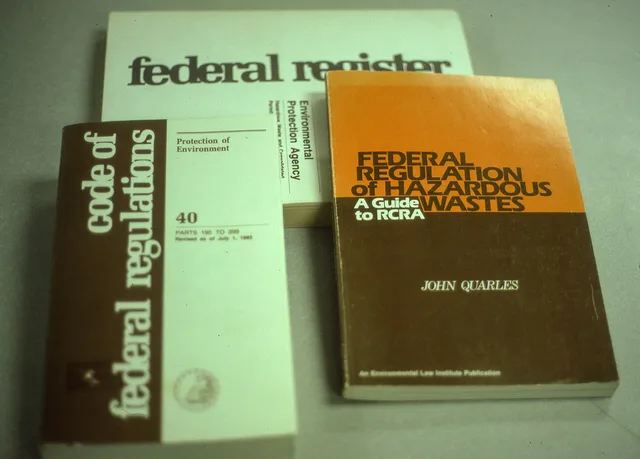
The Code of Federal Regulations contains the complete and official text of agency regulations. Its own reader aid explains what the currency line on a section does and does not promise, so check that line before you rely on a copy.
Regulatory definitions are precise, so they are narrow and sometimes counterintuitive. A word you use loosely may include something you would never call that name, or exclude something you would. Where a regime has a boundary, it is written down, usually in a definitions section followed by exclusions.
Read an agency page in order
- Read the definitions section first
- Then read the exclusions
- Then read the obligations
- Check thresholds on the agency's current page
Read an agency page in this order.
- The definitions, because they decide your answer more often than the rule does.
- The exclusions, because they may settle it at once.
- The obligations, last, once you know they apply.
Most people read them backwards, get alarmed by the obligations, and never reach the exclusion that settles it. The definitions and sources page covers checking where a federal text comes from.
If a threshold, a unit or a category decides whether you are inside or outside a regime, take it from the agency's own current page on the day you need it. Fees and processing times are published regime by regime and revised without much notice, so read the current figure there too.
Guidance second
Agency guidance is genuinely useful. It is written for non-lawyers, it explains the structure of a regime, and it often says what the agency expects to see. Treat it as the agency's reading of the rule.
Where guidance and rule text differ, the rule text governs. That is why a guidance page is a good place to start reading and a poor place to stop. Keep a note of the guidance page and the date you read it, because the page can change without any change to the rule.
The phone call last
A call is worth making because the person can tell you which regime your activity falls under, which is often all you needed. It turns a long search into a named office.
Ask each office the question you actually care about rather than a general one. Then ask whether anyone else at their level typically has an interest in the activity.
Counter staff and public enquiry lines answer that second question willingly, and the referral is worth more than another hour of searching. Before you call, the eight facts worth gathering are listed separately.
If you do not yet know which office to call, list the nouns in your operation instead of your trade label. Trade labels like manufacturer, consultant and distributor describe business models, and federal regimes are built around specific things.
List the nouns you handle
- What you handlesubstance, organism, device, waste
- What you emitsignal, discharge, byproduct
- What you move, and across what
- What you carry it invehicles, vessels, aircraft
- Whose money you hold, even briefly
- What you say on labels or packages
The six are what you handle, what you emit, what you move and across what, what you carry it in, whose money you hold, and what you say about it. Each noun points at a regulator, and the exercise takes half an hour with a notepad.
Two examples of the order at work
A juice bottler shows how the nouns reach the rule text. The drink is a food, so the FDA holds its rules, in Title 21 of the Code of Federal Regulations. Process water leaving for a creek is a discharge, which is the EPA's, in Title 40.
A radio system on the site is a transmitter, which the FCC regulates under Title 47. Trucks leaving the yard in interstate commerce are the Department of Transportation's, largely in Title 49, and line staff are covered by OSHA's workplace rules in Title 29. Money moved for other people is FinCEN's territory, in Title 31.
One activity can therefore have several federal audiences at once, each answering only for itself. A single product can interest one body for what it contains, another for how it is carried, and a third for what the packaging claims. Clearing a federal question leaves the state, county and city questions untouched, as license fundamentals sets out.
Record which answer you relied on
Whatever you are told, capture it in a form that survives staff turnover on both sides. Note whether it came from rule text, guidance or a call.
Fields to record from every enquiry
- The officeagency, unit, number reached
- Who answeredname or reference, date
- What you askedyour words
- What they saidtheir words
- What it depends onmaterial, route, size, claim
- What would change itthe trigger to ask again
Record the answer
| Field | What to write |
|---|---|
| The office | Agency and the specific unit, with the number you reached |
| Who answered | Name or reference, and the date |
| What you asked | Your description, in the words you actually used |
| What they said | Their answer, in their words, including anything they declined to answer |
| What it depends on | The fact that drove the answer: a material, a route, a size, a claim |
| What would change it | The event that means you have to ask again |
That last row converts a one-off enquiry into a standing check. It also makes the record worth keeping, because federal regimes are stable enough that the answer usually holds until something about you changes.
Where the answer decides something expensive, the business law basics principle applies: pay a lawyer for an hour rather than keep researching.
Common questions
How do I know when I have found the right agency?
When the agency's own definition of the regulated activity matches what you do in its terms rather than yours. If you are translating heavily to make yourself fit, you are probably in the wrong regime or on the edge of one, and the edge is where advice is worth paying for.
Is there a list of federally regulated activities?
There are useful orientation pages, and none is complete for your specific case. The Small Business Administration says business activities regulated by a federal agency will need a federal license or permit. They point at categories, and the agency inside the category holds the definition that decides it.
Does none of this apply if I only work in one state?
Working in one state removes some triggers and not others. Materials, products applied to the body, emissions and money held for others do not stop being federal concerns because your customers are local.