
Reviews
Part of Which activities actually trigger a federal license requirement
Federal licenses examples that teach more than the theory
Six invented cases where a federal licenses question appeared without warning, plus the two questions that extract the transferable part of each.
What to take away
These six federal licenses examples come from real agency rules: FMCSA, PHMSA, FCC, CBP, FDA, FinCEN and state banking departments. Each case starts with a change nobody filed under compliance.
- Every situation here begins with a change nobody filed under compliance. It could be a sales channel, a machine, or a supplier. It could be a product line, a payment arrangement, or a vehicle.
- Ask who was carrying the federal question before you took the activity over. Very often a distributor, a carrier, or a supplier was.
- The deciding fact is usually already documented somewhere in your own records: a weight, a composition, an origin, a route, a form of words.
- None of these ends in an answer, because the answer depends on specifics an article cannot hold.
1. A producer who starts shipping their own goods: FMCSA and PHMSA
A small producer has always sold through a distributor. They begin taking orders directly and sending parcels to customers in other states.
FMCSA and PHMSA triggers
Own commercial vehicle?
USDOT number required
no USDOT number
The trap. Nothing about the product changed, so it feels like a sales decision. What changed is that the business now moves goods across state lines. Federal regimes attach to the movement, not to the thing being moved.
The license that usually appears. If the producer uses its own commercial motor vehicle, FMCSA requires a USDOT number under 49 CFR Part 390. The number is free to obtain.
If the vehicle is a for-hire carrier, FMCSA also issues operating authority, an MC number, with a $300 application fee. If the parcels contain hazardous materials, PHMSA requires hazmat registration under 49 CFR 107.601. Recent annual fees ran $250 for small operations and $2,575 for larger ones.
What decides it. What is in the parcel, how it is packed, and whether anything in it is restricted in transit. Also whether the carrier's own authorizations were doing work the business assumed were its own.
Who answers. PHMSA for the material, FMCSA for vehicle and operating authority, and separately the carrier, whose acceptance conditions are a practical filter even where they are not the legal test.
2. The used machine that transmits: FCC equipment authorization
A workshop buys second-hand equipment. Somewhere in it is a component that communicates wirelessly.
The trap. Treating the purchase as a capital decision. Radio spectrum is a shared national resource and its use is coordinated centrally. The question is not whether you built the device but whether you are operating something that transmits.
The license that usually appears. The FCC authorizes radio equipment under 47 CFR Part 15. Unlicensed devices carry an FCC ID that can be looked up in the FCC's Equipment Authorization database. A business radio system needs a Part 90 station license, and the FCC publishes its application fees in 47 CFR Part 1, Subpart G.
What decides it. What the device actually emits and at what power, and whether it belongs to a category that is treated as unlicensed for ordinary use. That is a technical question with a documented answer, usually held by the equipment's manufacturer.
Who answers. The FCC for spectrum and licensing, and the manufacturer for the technical specification you will be asked for.
3. Buying the component direct: CBP entry and partner agencies
A business that has always bought a finished part from a domestic supplier starts importing the same part itself to save money.
The trap. Assuming that because the part was legally in the country before, importing it is a purchasing change. Importing makes you the importer of record, and importer duties are a category of their own.
The license that usually appears. CBP requires an entry to be filed, usually on CBP Form 7501, within 15 days of the goods arriving. The importer of record needs a customs bond. A continuous bond typically costs a few hundred dollars per year.
Partner agencies add their own approvals: FDA prior notice for food, EPA TSCA certification for chemicals, USDA APHIS permits for plants and animals.
What decides it. What the item is made of and where it comes from; whether anything in it is of animal, plant, or biological origin; and whether the product is one that gets examined at the border for reasons unrelated to its price.
Who answers. CBP for entry, plus whichever agency regulates the material itself: FDA, EPA or USDA. These are separate conversations and the first will not conduct the second for you.
4. Adding something that goes on the skin: FDA cosmetic or drug
A business that sells household goods adds a product customers apply to themselves.
The trap. Thinking of it as one more item in the catalog. Anything eaten, applied, implanted, or injected sits in a federal category built around what happens when it goes wrong. The packaging claims can move it between categories.
The license that usually appears. Under the Modernization of Cosmetics Regulation Act of 2022, a cosmetic facility must register with FDA and list each product. Registration and listing are free and must be renewed every two years.
If the label claims the product treats or prevents a disease, it is a drug. FDA drug establishment registration carries an annual facility fee published each fiscal year, often in the five figures. The FTC polices advertising claims for both.
What decides it. The composition, and just as much the wording. A claim that a product treats or prevents something can change which regime it belongs to, even where the formula is unchanged.
Who answers. FDA's Center for Food Safety and Applied Nutrition for cosmetics, FDA's Center for Drug Evaluation and Research for drugs, and the FTC for ads. Whoever writes your labels needs to be in that conversation.
5. Holding the customer's money for a week: FinCEN MSB registration
A service business starts collecting payment from customers, then paying a supplier or a subcontractor out of it a few days later.
The trap. It looks like a cash-flow convenience. Handling money that belongs to someone else, even briefly, is one of the oldest federal and state concerns. It is a different activity from being paid for your work.
The license that usually appears. FinCEN treats a money transmitter as a Money Services Business under 31 CFR 1022. The business must register on Form 107 and renew every two years by December 31 of even-numbered years. Registration is free.
Most states also require a money transmitter license, with surety bonds that often run from tens of thousands to low millions of dollars.
What decides it. Whether the funds are yours on receipt or held on behalf of another party; how they are accounted for and where they sit; and whether you are effectively transmitting money between two other people.
Who answers. FinCEN for the federal registration, state banking departments for the state licenses, and an accountant or a lawyer. The structure of the arrangement is what decides the answer, so get advice before you build it.
6. Driving the bigger van: FMCSA USDOT number and CDL
A contractor replaces a van with a substantially larger vehicle and starts driving it themselves.
The trap. The work is identical and the vehicle feels like equipment. Transport rules turn on the vehicle and its use, not on the trade of the person driving it. The change in size is exactly the kind of fact that moves an operation across a line.
The license that usually appears. FMCSA requires a USDOT number for interstate commercial vehicles with a gross vehicle weight rating over 10,001 pounds. The number is free. A commercial driver's license is required at 26,001 pounds or more, and a hazmat endorsement is required to carry certain materials. State fees for a CDL typically run $50 to $200.
What decides it. The vehicle's rated weight and configuration, what is being carried, and whether the routes cross a state line. Every one of those is a documented fact rather than a judgment.
Who answers. FMCSA for the interstate question, and the state's own motor vehicle authority for driving and registration. These are separate systems that do not check each other.
The pattern under all six
Each case begins with a change nobody thought of as a compliance change. In every one, a federal question already existed and was previously being answered by somebody else, or did not exist before and does now. The federal licenses overview covers why regimes at this level behave differently from local ones once you are inside them.
Two questions extract the value:
- Who was carrying this before?A distributor, a carrier, a supplier, a domestic importer. When you take over their role, you take over their questions. The federal guide to licenses and permits is organized the same way, by activity and by level of government rather than by trade.
- What documented fact decides it?A weight, a composition, an origin, a wording, a route. These are things you can look up in your own records before you speak to anyone.
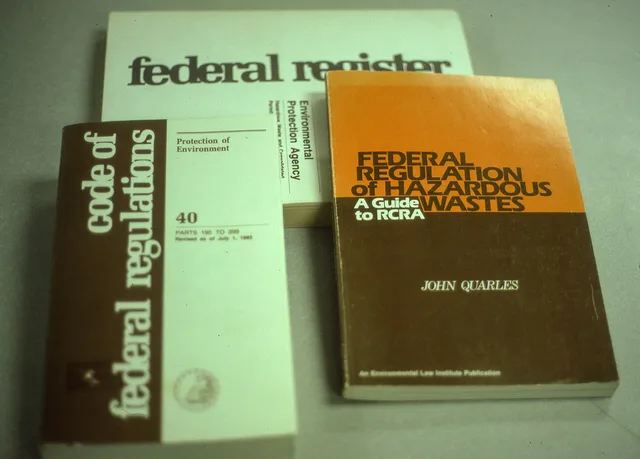
The text behind any of these regimes lives in the code of regulations, not an agency's guidance page. The reader aid to that code explains how current your version is.
Both questions are answerable at your desk, and both belong on paper before you call anybody. The preparation checklist is the sheet to fill in.
Common questions
Can you tell me which of these needs a federal authorization?
No, and neither can any other page. FMCSA, PHMSA, FCC, CBP, FDA and FinCEN each decide on facts specific to the business: the material, the units, the route, the wording. That is not evasion, it is the actual structure of the system.
These all involve a change. What if nothing has changed?
Then you are probably stable, which is the useful news. Federal exposure moves when your activity moves. A business doing the same thing in the same way is not quietly drifting into a new regime.
Where does the same reasoning apply to the other layers?
The habit of putting a narrow, described question to a named office is the whole method, and it is set out in license fundamentals. Worked examples runs it across state and local situations, where the deciding facts are addresses and scope wording rather than materials and routes.