Rules
Tattoo Studio Zoning Requirements Georgia: 10 Questions
Tattoo studio zoning requirements Georgia: the 10 questions to ask city and county planning staff, the documents to file and the written reply to get.
What to take away
Tattoo studio zoning requirements Georgia cities and counties apply are parcel-specific, so the only dependable answer comes from the office that regulates your address. This page lays out the exact questions to put to planning staff, the documents to file, and the written confirmation to get before you commit to a lease.
- Georgia sets state body art rules, but city and county zoning decide where a studio may operate.
- Atlanta and several Georgia cities enforce distance buffers from schools, churches, homes, or other regulated uses.
- Local zoning boards interpret the phrase "tattoo studio" differently, so one parcel can be approved in one jurisdiction and denied next door.
- Zoning approval happens before a state permit is final in most Georgia counties.
- Skipping zoning approval can lead to a stop-work order or business license revocation, even with a state body art permit.
State permit versus local zoning
Tattoo studio zoning requirements in Georgia come from three layers of rules. The state governs body art sanitation and permitting. The city or county governs where the business may sit. The landlord or shopping center may impose private restrictions on hours, signs, or subletting. The Georgia Department of Public Health body art program page lists state permit requirements for fixed studios. That state permit does not decide your street address.
The state body art framework is Georgia Department of Public Health Rules and Regulations, Chapter 511-3-8, Body Art. Keep that sanitation and permitting review separate from the local zoning inquiry: ask planners to identify the ordinance section governing the proposed use and address.
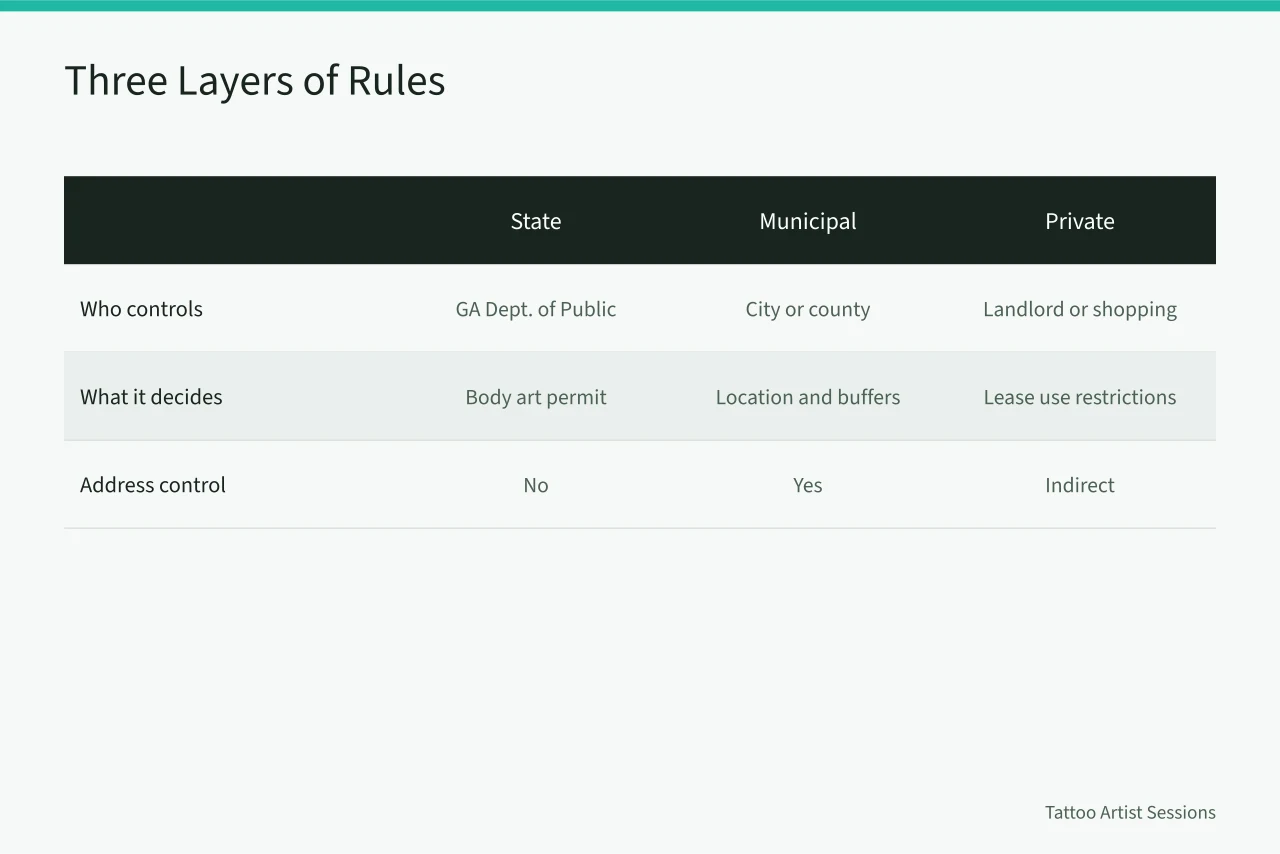
Who controls
- State
- Georgia Department of Public Health
- Municipal
- City or county planning and zoning
- Private
- Landlord, shopping center covenants
What it decides
- State
- Body art permit, infection control, operator records
- Municipal
- Location, distance buffers, special use permit
- Private
- Lease use restrictions, signage, operating hours
Which local office decides in Georgia
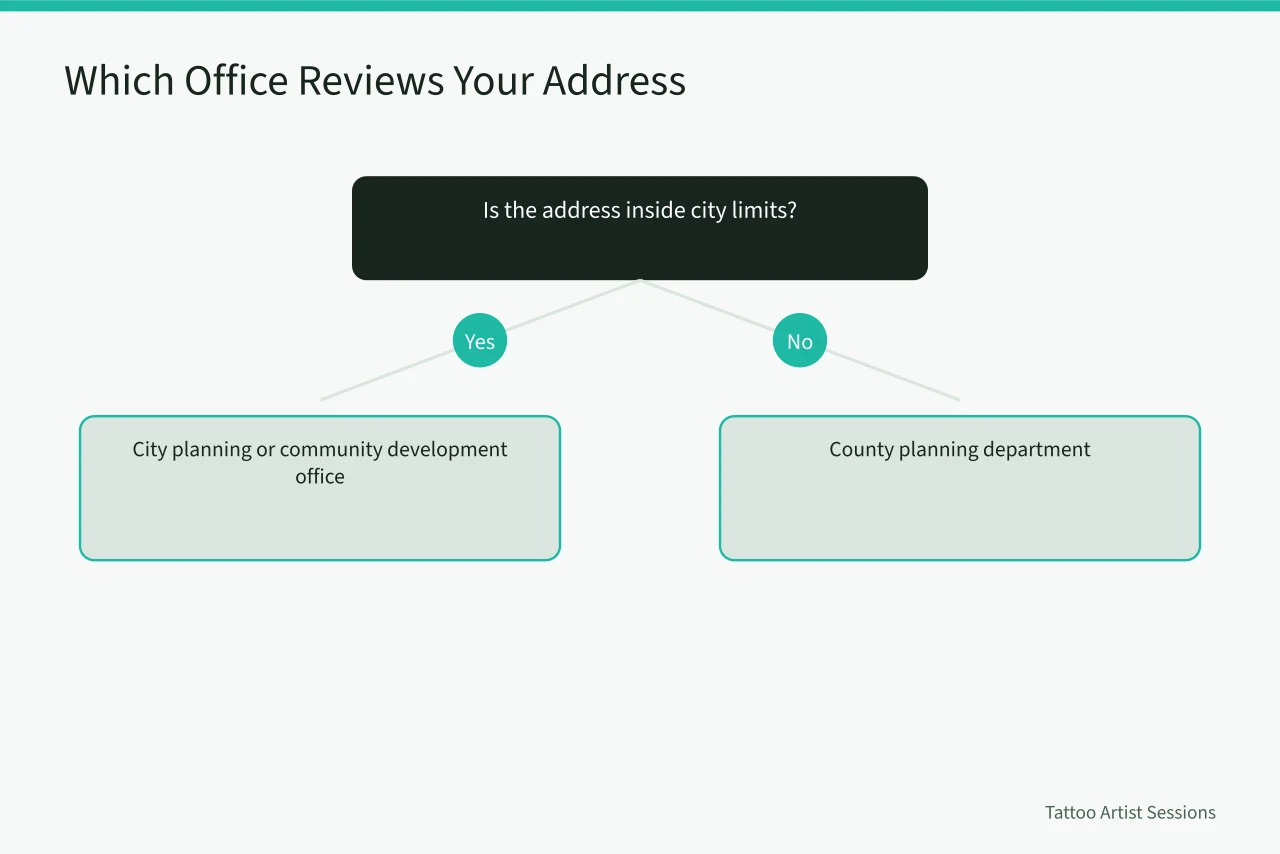
Tattoo shop zoning Georgia rules vary more by county than by state. If the studio sits inside city limits, the city planning or community development office reviews zoning. If the address is in unincorporated county land, the county planning department makes the call. Some Georgia cities list tattoo studios under "personal services" and allow them by right in commercial districts. Others classify them as "regulated uses" or "adult uses" and require a special use permit.
You cannot rely on a neighboring city's interpretation. A shop that opens legally in Decatur may need a different approval two miles away in DeKalb County. Federal small-business resources point to local planning offices as the approval layer for zoning uses. Ask the office responsible for your parcel to confirm its use classification in writing.
Documents to ask the planning office about
A complete zoning application for a Georgia tattoo studio typically includes a site plan, floor plan, and a signed lease or letter of intent. Many cities also want a distance diagram showing the nearest school, church, park, or day care center. If the district requires a special use permit, include a narrative explaining hours of operation, waste disposal, and noise control.
The city may ask for the state body art permit application number as proof of intent. Some Georgia cities ask for an occupancy load statement, which building officials cross-check against NFPA 1 Fire Code requirements. Use a checklist before you submit.
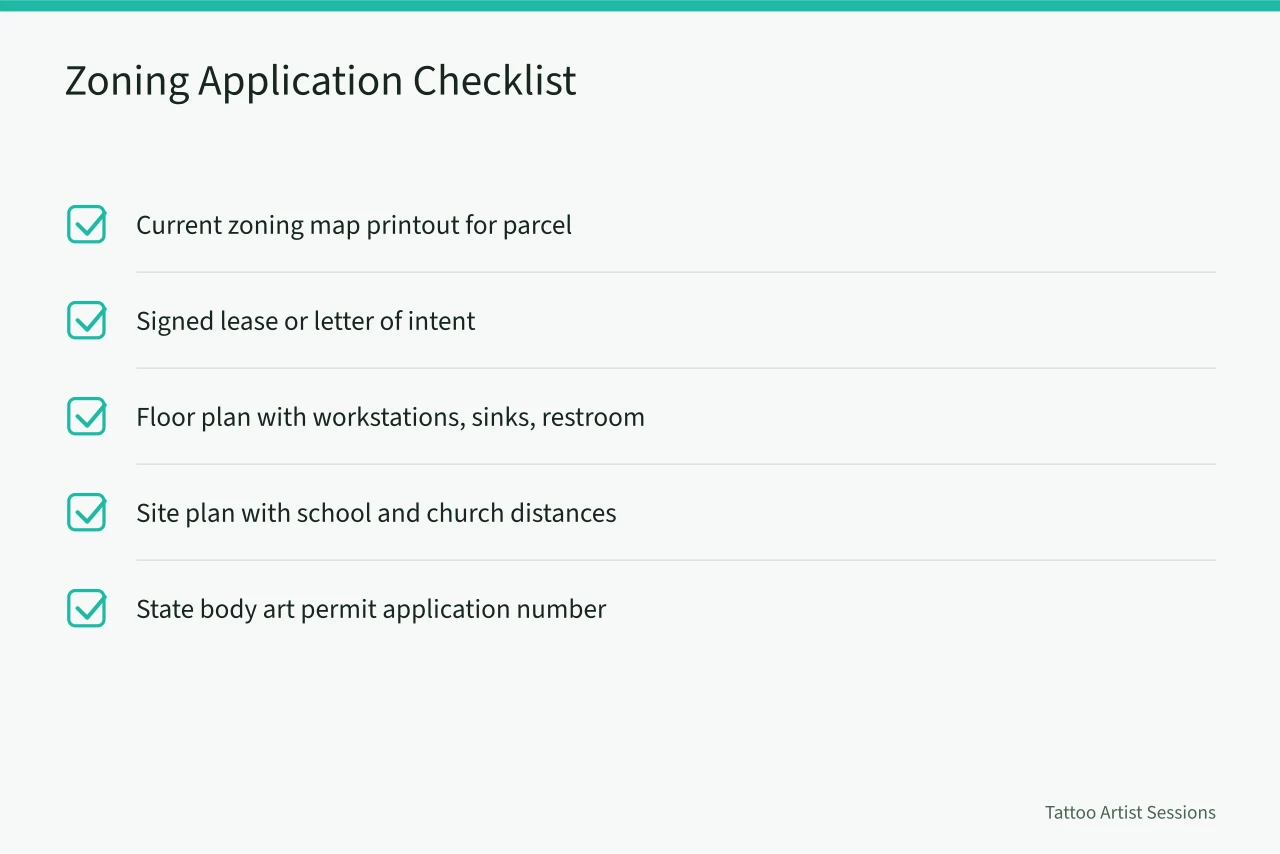
- Confirm the property's zoning district with the local planning office.
- Request a zoning verification letter or pre-application meeting.
- File a special use permit application if the code requires one.
- Submit site plan, floor plan, and distance diagram from schools and churches.
- Attend the public hearing or board meeting if scheduled.
The questions to put to the planning office
Put these ten questions to the planner who handles your parcel, and ask for the answers in writing. The wording matters less than covering every item, because one missing answer is what stalls an application.
- What is the zoning classification of the parcel at [your address], and does the code allow a tattoo or body art studio there by right?
- Which section of the city or county code governs tattoo and body art studios, and may I have a copy of it?
- If the use needs a special use permit, what criteria does the board apply, and what is the application form number?
- What buffer distance applies from schools, churches, parks, day care centers, or homes, and is it measured property line to property line or building to building?
- What is the filing fee, the special use permit fee, and any hearing or public notice fee?
- What is the next hearing date, and what is the submission deadline to reach that agenda?
- If the parcel falls inside a buffer, what is the variance procedure, the criteria, and the deadline to apply?
- If the request is denied, what is the appeal path and how many days do I have to file it?
- What state body art permit number or application reference do you want attached to the zoning filing?
- What does a complete application package include, and will you confirm the zoning answer for this address in writing?
Carry the current application form, the fee schedule, and the hearing calendar back with you.
What to ask about the approval timeline
Approval length depends on whether the use is allowed by right or needs a public hearing. A staff-level zoning review may take two to four weeks. A special use permit with a public hearing may take two to three months because the board meets monthly. Large cities like Atlanta can add a second layer of review when the site sits in a historic district or near a transit station. Ask the planning office for a written timeline before you commit to a lease. Confirm submission deadlines and whether an incomplete application will miss the next hearing.
When a site sits close to a school
A commercial corner in Clayton County that falls inside the local buffer from an elementary school is the problem case to plan for: the county treats tattoo studios as a regulated use and requires a set distance from schools and churches, so the applicant either asks the zoning board for a variance or finds another parcel. None of that is a state-level decision. County planners measure from property line to property line rather than from the front door, so confirm the distance stated in the code section that applies to your parcel, the measurement standard used, and the deadline to file a variance request before you pay for a survey or sign a lease.
What happens if you skip zoning
Opening without local zoning approval invites a stop-work order. The city can post the shop, revoke a certificate of occupancy, and fine the owner daily until the use ends. A state body art permit stays valid, but it does not authorize an unapproved address. Landlords may also terminate the lease for an illegal use.
A state body art permit does not override a city stop-work order. Georgia cities can fine a shop daily until the use is removed.
Keep local permit checks tied to the business and jurisdiction they describe. For a Georgia tattoo studio, obtain the zoning office's written response for the proposed address rather than relying on another state's permitting process.
Common questions
Does a Georgia state body art permit replace city zoning approval?
How far must a tattoo studio be from a school or church in Atlanta?
Request a parcel-specific answer from the City of Atlanta Department of City Planning. Give the address and the proposed use, ask for the applicable code section, any minimum distance, and the measurement method, and keep the written reply with your lease file.