
Rules
Vending machine licences in Canada: Ontario and BC questions
Vending machine licences in Canada: questions Ontario and BC operators should ask municipal licensing offices, health authorities and property owners.
What to take away
Vending machine licences in Canada depend on local rules and the products sold.
- Ontario and BC do not issue a single provincial vending machine licence; each city and health unit applies its own permit rules.
- Private property owners add a second layer of placement consent on top of any municipal permit.
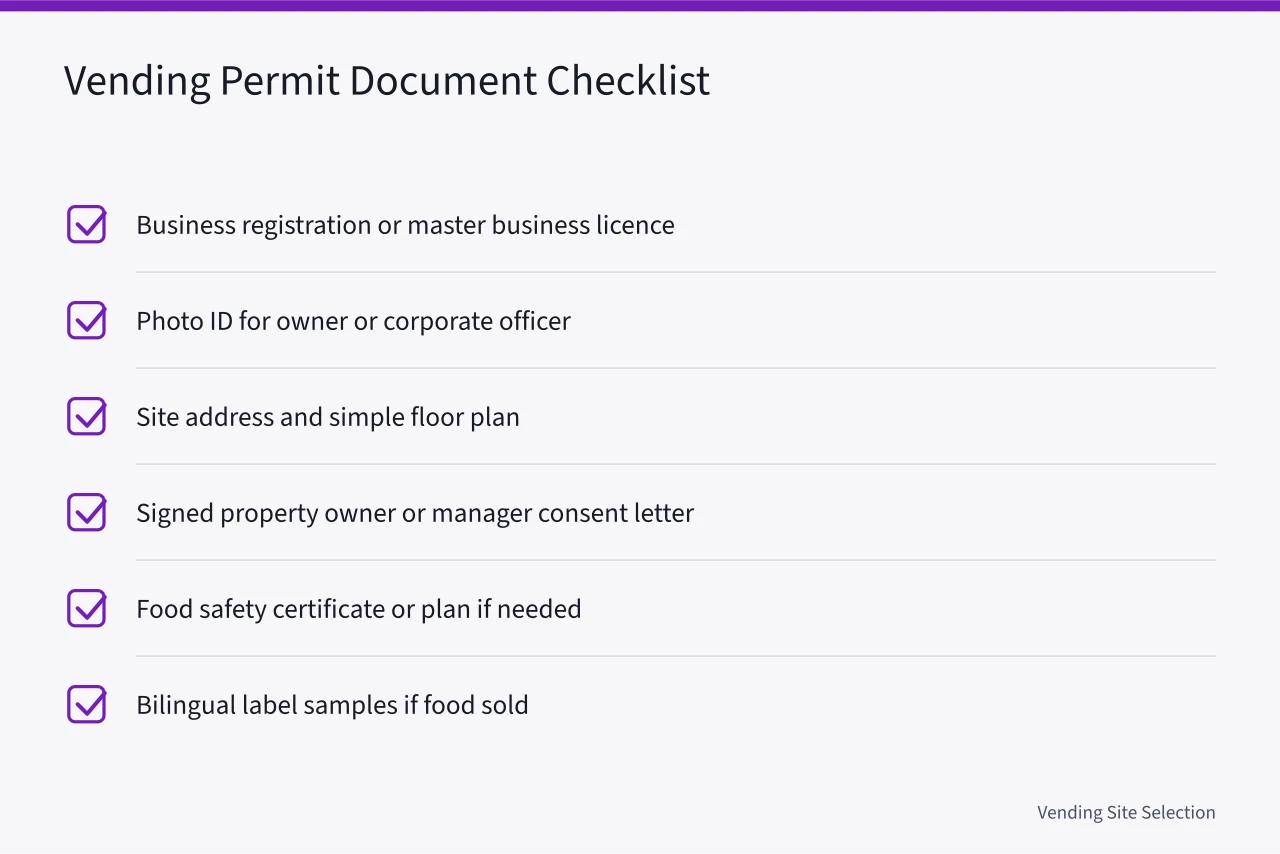
- Ask whether applications need business registration, site address, signed owner consent and food safety proof if you sell food.
- Operating without the right municipal permit can result in a ticket, a removal order or seizure of the machine.
In Canada, authority over a vending machine is split among provincial health and tax rules, municipal business licensing and the private property owner. Most online guides are written for American operators, but the Canadian split changes what you submit and to whom.
Who has jurisdiction
Provincial rules cover food safety, labelling and tax. Ontario's health units and BC's health authorities enforce food handling for machines that sell perishable items. Provincial law also sets sales tax collection rules. The GST/HST rates page helps operators charge the correct tax in Ontario and BC.
In BC, also ask the British Columbia Ministry of Finance whether provincial sales tax (PST) applies to the products you sell. GST/HST guidance does not resolve that separate provincial tax question.
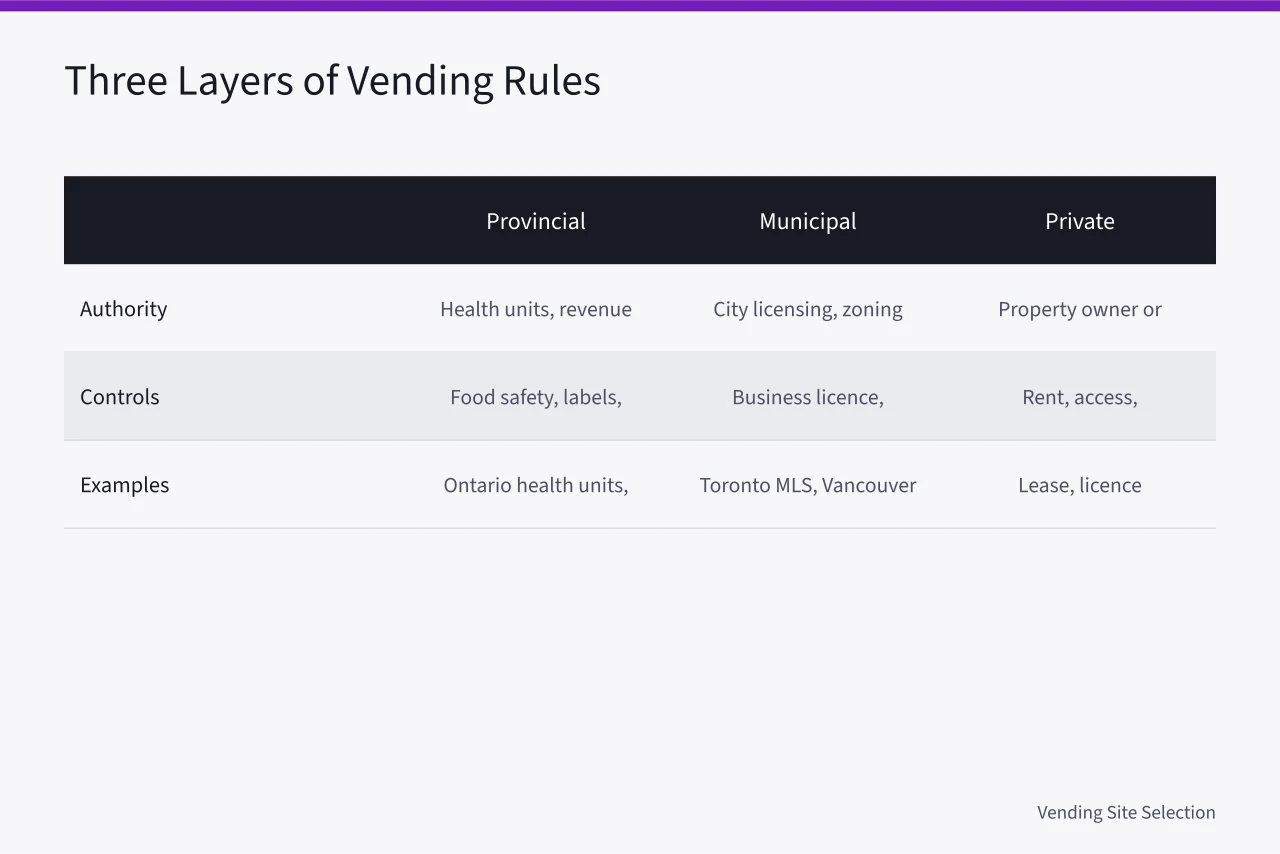
Municipal rules cover the actual business license, while cities issue permits for automatic vending machines, often through their licensing department. Examples include Toronto's Municipal Licensing and Standards division and Vancouver's Licence Office. Municipal zoning decides whether a machine can go in a particular building or public space.
BC business permits and licences page explains provincial oversight and links to municipal business licences.
For provincial business registration, check the Ontario Business Registry or BC Registries and Online Services, as applicable. Registration is separate from municipal licensing and health review.
Federal responsibilities also apply: the Canada Revenue Agency administers GST/HST, and the Canadian Food Inspection Agency oversees federal food-labeling requirements. These responsibilities are separate from the municipality's licensing decision.
Private rules come from the property owner or manager. A lease, licence agreement or placement contract sets rent, access hours and insurance requirements. Private consent is often a city application requirement.
| Layer | Authority | What it controls |
|---|---|---|
| Federal and provincial | Health units, revenue agency | Food safety, bilingual labels, GST/HST collection |
| Municipal | City licensing, zoning | Vending machine permit, location approval |
| Private | Property owner or manager | Placement consent, rent, access times |
Operators who also run US routes can compare vending permit and tax rules to see where provincial and state layers diverge.
What to check with the municipality
Before placing a machine, ask whether the municipality licenses the operator, the premises or the machine, and whether public-space placement requires separate approval. In Ontario, contact Toronto's Municipal Licensing and Standards division or Ottawa's licensing office to confirm the applicable business licence. In BC, ask Vancouver's Licence Office or the licensing staff in Burnaby or Surrey to identify the relevant licence requirements for the proposed address.
Selling food or beverages adds a health-review question: ask the local health unit or health authority whether the proposed stock and handling require notice, an inspection or a permit. In Ontario, the Health Protection and Promotion Act requires notice before starting to operate a food premises, and O. Reg. 493/17 (Food Premises) sets food-safety requirements. In BC, the Public Health Act and Food Premises Regulation (B.C. Reg. 210/99) govern food premises; the regulation requires a permit to operate a food service establishment. The Canada Business Permits and Licences page links to federal, provincial and municipal permit information.
For food-safety questions, contact Toronto Public Health in Toronto, Ottawa Public Health in Ottawa, Vancouver Coastal Health in Vancouver, or Fraser Health in Burnaby and Surrey. Describe the products, refrigeration, handling and proposed address, then ask which notification, inspection or permit requirements apply.
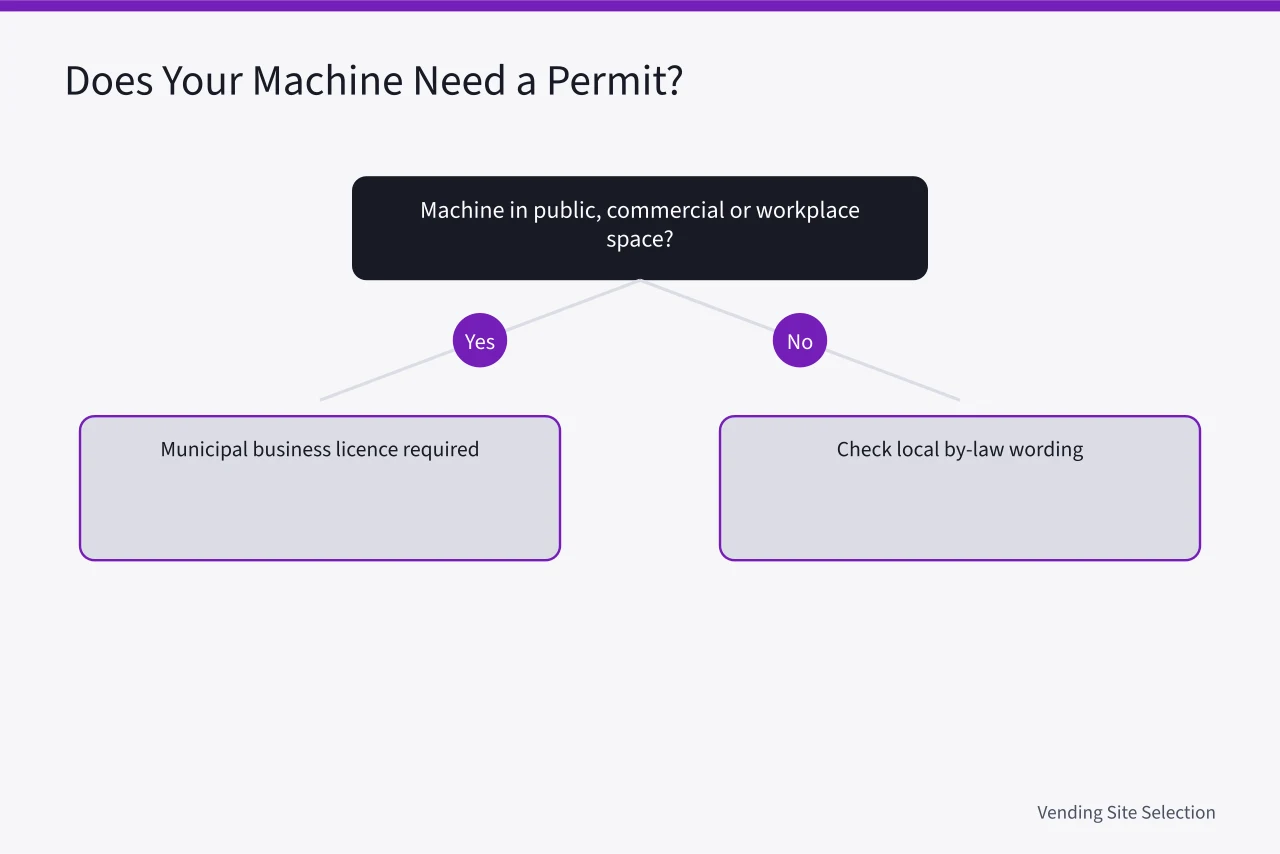
Private rules trigger the moment a machine sits on leased or managed property. The owner's signed consent is often a city requirement, not just a courtesy. Without it, the municipal application stalls.
A machine inside a private club or a staff-only area may still need a municipal permit if the public can access the building or if the city defines vending machine broadly. Check the local by-law wording.
Questions before submitting
Before submitting, ask the licensing office which business registration record, site address, signed owner consent and food-safety evidence it requires. Confirm the exact local form and whether the approval applies to the operator, the premises or each machine.
The Food and Drugs Act and Regulations require bilingual labelling for food sold in vending machines, and some health units ask for label samples.
Ask about review times
Municipal review for an automatic vending machine licence often takes 2-6 weeks. The timeline stretches when zoning checks or public health clearance is needed. BC municipal business licence applications submitted online can be faster, but first-time operators should still allow 3-5 weeks.
Confirm the local review time rather than treating these ranges as a municipal service standard.
Health approval for food service can add 3-4 weeks on top of the city permit. Private consent should be secured before submitting the municipal application, because a missing consent letter is the most common reason for delay. Confirm the expected review time directly with each office; these ranges do not establish a deadline for a particular application.
US operators curious about local permit approval can compare vending machine permits in Los Angeles, though forms and timelines differ.
Check enforcement provisions
Operating without a required municipal business licence can lead to enforcement. Ontario's Provincial Offences Act governs proceedings for provincial offences, including municipal by-law offences; check Toronto's Municipal Code Chapter 545, Licensing, for the relevant local requirements. Vancouver's Licence By-law No. 4450 provides penalties for contraventions. Ask the municipality which enforcement provisions apply rather than assuming every unlicensed machine can be removed or seized.
Food sales without health approval carry separate enforcement. A health inspector can issue a closure order under provincial public health legislation, stopping all sales from that machine until permits are in place.
A Mississauga operator placed a machine in an office lunchroom before getting the property manager's signed consent. The city required the signed consent before issuing the permit, so the operator had to remove the machine for three weeks.
Operators serving both countries can review serving Canadian clients for border-specific paperwork and tax obligations.